
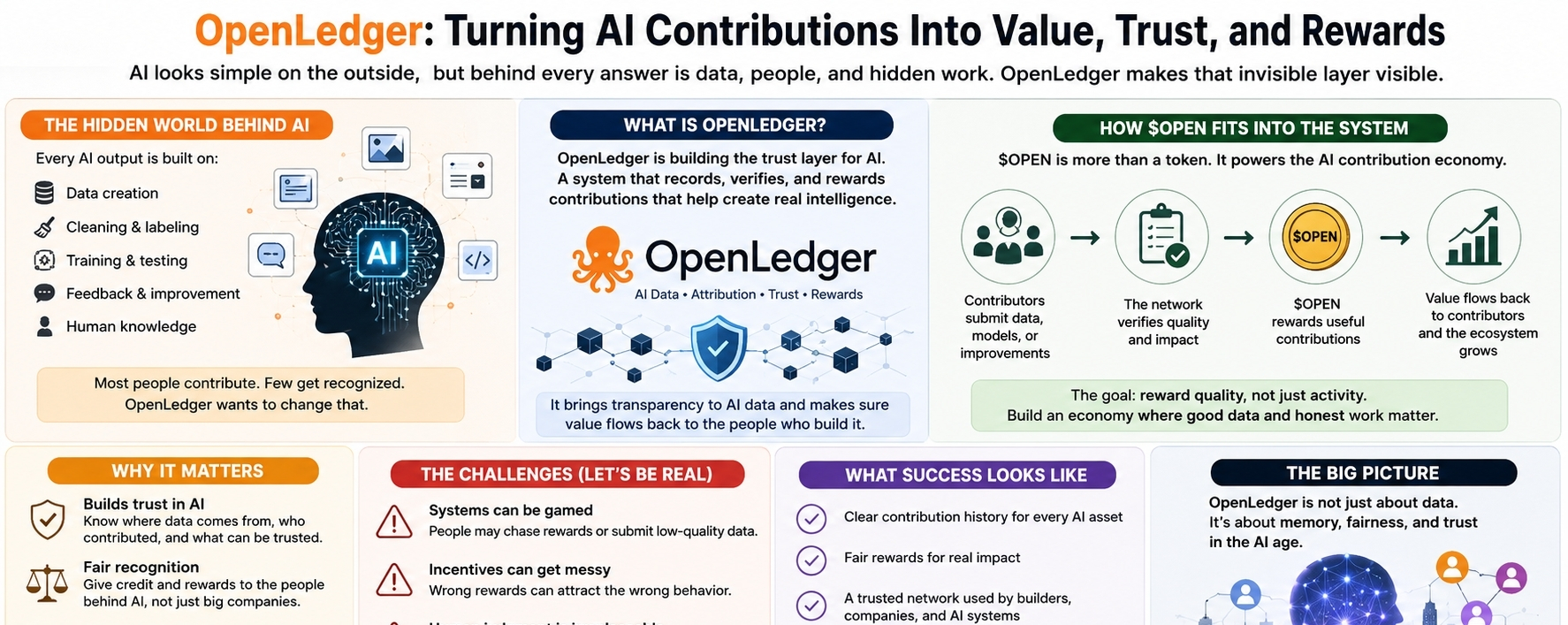
I’m looking at OpenLedger less like another AI crypto project and more like a serious attempt to deal with a problem people usually ignore: AI is being built from human knowledge, data, and contribution, but most of that value still disappears into the background.
That is what makes the project interesting to me.
OpenLedger is not just talking about AI in the usual way. It is not only saying “better models” or “more data” or “smarter agents.” The project seems focused on something deeper, and honestly more difficult. It is asking how AI contributions should be tracked, trusted, and rewarded.
Because AI does not become useful by magic.
Behind every good AI system, there is data. There are people who created that data, cleaned it, improved it, trained around it, tested it, corrected it, and gave feedback. Most users never see that part. They only see the final answer on the screen. But the hidden work is what gives the system value.
OpenLedger matters because it is trying to make that hidden work visible.
That sounds simple, but it is actually a big problem. If AI keeps growing, then the question of contribution becomes more important. Who helped build the intelligence? Which dataset mattered? Which input improved the model? Which person or community added real value?
Right now, most of that is unclear.
OpenLedger seems to be building a system where AI data and contributions can have a clearer history. Not just random data floating around, but data with ownership, proof, and value attached to it. That is important because trust is not built from hype. Trust comes from knowing where something came from and why it should be believed.
This is where $OPEN becomes part of the story.
For me, $OPEN is not interesting just because it is a token. A token only matters if it has a real purpose inside the project. With OpenLedger, the real question is whether $OPEN can help support the economy around AI contributions. Can it help reward useful data? Can it help connect value back to the people who created something important? Can it become part of how the network decides what contribution actually matters?
That is the part worth watching.
But I also think it is important to stay honest. OpenLedger is trying to solve a hard problem, not an easy one. Any system with rewards can be gamed. People may try to submit low-quality data. Some may chase incentives without caring about the project. Some may try to look useful instead of actually being useful.
That happens in almost every open network.
So OpenLedger has to prove more than just the idea. It has to prove that the system can separate real value from noise. It has to show that contribution tracking can work in practice, not just in a whitepaper or campaign. It has to build trust slowly, because trust is always harder than attention.
And that is why I do not see OpenLedger as a simple hype project.
I see it as a project trying to build the missing layer under AI: a way to remember who contributed, what mattered, and how value should move through the system. If AI keeps becoming more important, this kind of layer could matter a lot more than people think.
Still, human judgment will never fully disappear. Technology can track things, but people still decide what is useful. Systems can measure activity, but they still need to understand quality. Tokens can support incentives, but they cannot automatically create fairness.
That is the real challenge for OpenLedger.
It has to build something people can actually trust. Not just something that sounds good during a market cycle. Not just something that rewards activity for a while. Something that can keep working when users, builders, data contributors, and AI systems all depend on it.
That is why I keep coming back to the project.
OpenLedger feels important because it is focused on the part of AI that is usually hidden. The people. The data. The proof. The rewards. The trust. The uncomfortable question of who actually deserves value when AI becomes valuable.
Maybe OPEN becomes a strong part of that answer. Maybe the project still has a lot to prove. But the problem it is trying to solve feels real.
And sometimes the most important projects are not the ones making the loudest promises. They are the ones quietly building around the parts everyone else forgot to count.