
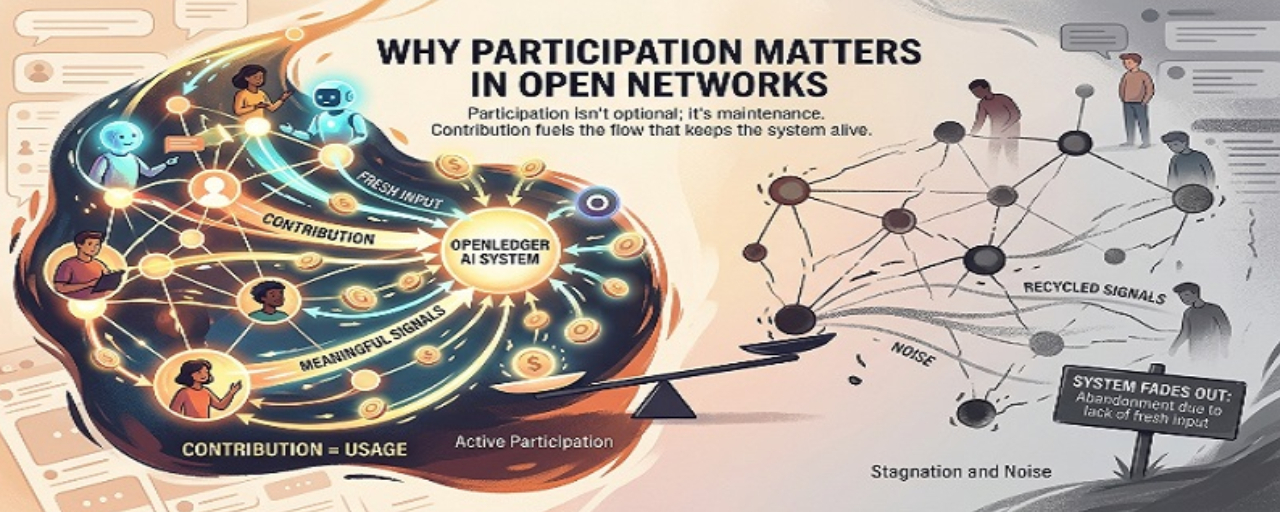
I was scrolling through a few discussions around open systems lately, and something small kept sticking in my head. Most people talk about networks like they’re finished products, but they don’t really feel finished. They feel alive, like they only exist because people keep interacting with them.
That’s where @OpenLedger came into my mind again.
Not in a dramatic way, just as one of those examples where participation isn’t optional in practice. If nothing flows in, nothing really happens. And that sounds obvious, but I don’t think it is when you look at AI systems built on top of shared data.

I might be wrong, but it feels like $OPEN is sitting inside that idea where contribution and usage are almost the same thing. You don’t just “use” the network, you kind of keep it alive while using it.
I noticed something interesting in a thread under #OpenLedger and #openledger . Someone mentioned that open networks don’t fail because of bad design, they fail because people slowly stop caring to participate. That line stayed with me for some reason.
Maybe it’s just me, but that shifts how I look at participation. It’s not just activity, it feels closer to maintenance. Like every small interaction adds a bit of weight that keeps the system from fading out.
I keep thinking about AI systems too. Especially multi-agent setups. #open shows up in those conversations as well, but what matters more is whether agents actually get meaningful input over time, or just recycled signals.

For some reason, that balance between input and stagnation feels more important than most technical details. Even the best system can feel empty if nothing fresh enters it.
I’ve been thinking about this a lot lately. Participation sounds simple, but in open networks it quietly decides whether anything stays relevant or just becomes noise over time.
And I don’t really know where that line is yet, between active systems and abandoned ones that still look alive.
It made me stop and think for a moment.
