
AI is getting smarter every month. That part is easy to see.
It writes better. It codes better. It searches faster. It can summarize, reason, plan, and increasingly take action across apps and websites.
But intelligence alone does not make an agent truly autonomous.
A real agent does not just answer questions. It needs to operate in the world. It needs to make decisions, pay for things, use resources, earn value, prove what it is allowed to do, and leave behind a trail that others can trust.
That is where the current AI story starts to feel incomplete.
We are building agents that can think, but we have not fully built the economy they are supposed to live inside.
This is why protocols like OpenLedger matter.
Not because every AI product needs a blockchain. It does not. A chatbot does not need a token to write an email. A summarizer does not need a wallet to explain a document.
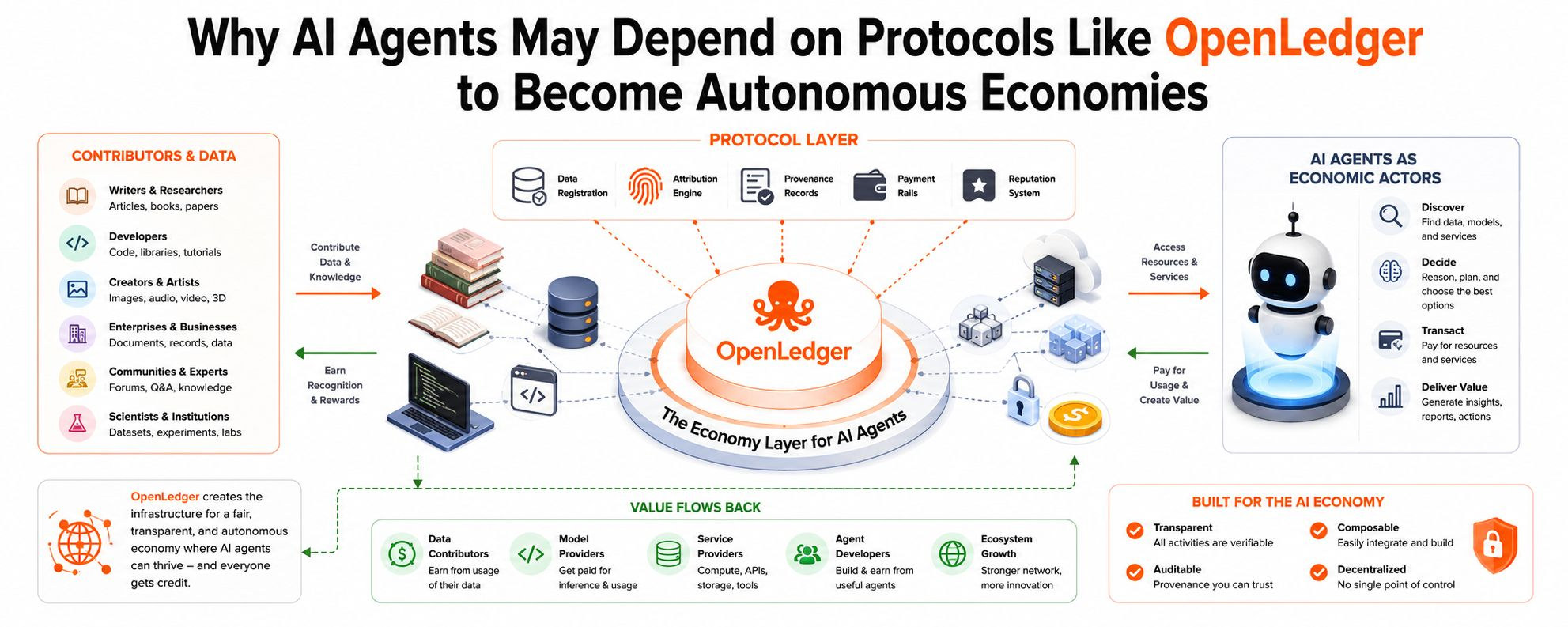
But once AI agents begin acting as independent economic participants, the situation changes. They need more than intelligence. They need payment rails, identity, ownership, provenance, incentives, and accountability.
In simple terms, they need an economy built for machines.
OpenLedger is trying to become part of that economy.
Its big idea is that data, models, applications, and AI agents should not remain locked inside closed platforms. They should become visible, usable, traceable, and monetizable. If a dataset helps train a model, if a model powers an agent, and if that agent creates value, the people and systems behind that value should be able to participate in the reward.
That may sound technical, but the human meaning is very simple:
AI should not keep taking from the world without remembering where its intelligence came from.
The Problem Hidden Under Today’s AI
Most people experience AI through a clean interface.
You ask a question. You get an answer.
It feels instant. Almost magical.
But behind that answer is a huge invisible supply chain.
There are books, websites, research papers, open-source code, forum posts, images, business documents, conversations, human feedback, annotations, datasets, and countless pieces of human labor. Modern AI is not created from nothing. It is built from the accumulated knowledge and work of millions of people.
The strange thing is that once all of this enters a model, it usually disappears from view.
The company has a product.
The user gets an answer.
The model gets attention.
But the original contributors are often forgotten.
This is one of the biggest tensions in AI today. Writers, artists, developers, researchers, businesses, and communities helped create the material that made AI powerful, but many of them have no clear way to be recognized or paid when that material creates value.
That is not only a legal issue. It is an economic issue.
The current AI economy often works like this:
Take data from everywhere.
Train models on it.
Sell access to the model.
Capture the value at the platform level.
That model may be efficient, but it is not sustainable forever. It creates lawsuits, distrust, resistance, and uncertainty. Data owners become more cautious. Creators feel exploited. Enterprises worry about compliance. Regulators demand transparency.
OpenLedger is trying to solve this from another direction.
Instead of treating data as something that vanishes into a model, it treats data as an asset that can remain connected to the value it helps create.
That is the heart of the idea.
Data Should Not Be a Ghost
In today’s AI world, data often becomes a ghost.
It influences the model, but you cannot see it.
It creates value, but it does not get paid.
It shapes the answer, but it has no identity.
OpenLedger wants to change that through attribution.
Attribution means asking a difficult but important question: when an AI model produces value, which data, model, or contributor helped make that possible?
This is not easy. AI models are complex. They do not simply copy one document and produce one answer. They absorb patterns from huge amounts of information. Measuring influence is difficult.
But the attempt matters.
Because without attribution, AI becomes an extraction engine.
With attribution, AI can become a value-sharing network.
That difference is enormous.
Imagine a medical dataset that helps improve a diagnostic model. Today, the dataset might be sold once, licensed once, or used silently. But in a better-designed economy, the contributor of that dataset could keep earning whenever the model creates value because of it.
The same could apply to legal data, financial data, robotics data, scientific data, creative data, or expert knowledge.
This is where OpenLedger’s idea becomes bigger than crypto. It is not just about putting data onchain. It is about giving data an economic memory.
Why Agents Make This More Urgent
AI agents make the problem much more important.
A chatbot can stay inside one platform. It answers and waits.
An agent is different.
An agent may need to take a goal and figure out how to complete it. It may search the web, call APIs, compare options, pay for services, use models, access data, make decisions, and report back.
That means agents will not only consume information. They will consume paid resources.
They may pay for:
specialized models,
private datasets,
compute,
APIs,
identity checks,
financial signals,
legal tools,
design tools,
research tools,
and other agents.
Once agents start doing that, they need an economic environment that works at machine speed.
Humans can sign contracts, open bank accounts, negotiate licenses, and review invoices. Agents need programmable versions of those things. They need wallets, permissions, rules, spending limits, receipts, and reputation systems.
A serious AI agent is not just a smarter bot.
It is closer to a tiny business.
It has costs.
It has suppliers.
It may have customers.
It may generate revenue.
It may need to share revenue with the resources that helped it perform.
This is why protocols like OpenLedger could become important. They help create the rails for agents to participate in markets, instead of being trapped as tools inside one company’s platform.
The Agent as a Tiny Business
Think about a future research agent.
You ask it to track climate risk for real estate investments.
To do that well, the agent might need satellite data, weather models, insurance-loss data, property records, scientific papers, and financial models. Some of those resources may be free. Others may cost money. Some may require licensing. Some may come from specialized contributors.
If the agent produces a valuable report and someone pays for it, where should the money go?
Only to the company that owns the interface?
Only to the model provider?
What about the data sources?
What about the specialized model that improved the analysis?
What about the person or organization that contributed the most useful dataset?
This is the kind of question OpenLedger is built around.
In a mature agent economy, value should not stop at the surface. It should flow backward through the chain of contribution.
That is what makes the idea powerful.
Agents could become economic participants, but the economy around them should not be blind. It should know what was used, who contributed, and how value should be shared.
Why Blockchain Actually Makes Sense Here
There is a fair criticism that many people make: why does this need blockchain?
And in many AI cases, it does not.
A normal AI writing tool does not need blockchain. A customer-service bot inside one company may not need blockchain. A private enterprise model may work fine with ordinary databases and contracts.
But autonomous agent economies are different.
Agents may need to interact with strangers. They may need to make small payments. They may need to use resources from many providers. They may need to prove permissions. They may need public records of transactions. They may need to work across platforms without relying on one central company.
That is where blockchain becomes useful.
Not because blockchain makes AI smarter.
It does not.
Blockchain can make AI more accountable, more composable, and more economically independent.
It can give agents wallets.
It can make payments programmable.
It can create shared records.
It can support transparent reward systems.
It can allow different models, datasets, and agents to interact without all being owned by the same platform.
OpenLedger’s specific angle is that these rails should be designed for AI from the beginning. Not just for money transfers, but for data, attribution, model usage, and agent activity.
That is the important distinction.
OpenLedger is not simply asking, “Can an AI agent pay for something?”
It is asking, “Can an AI agent pay the right people and systems behind the intelligence it uses?”
That question is much more interesting.
The Next Big Fight: Provenance
The next phase of AI may be shaped by one word: provenance.
Provenance means origin. Where did something come from? What was it trained on? Who contributed to it? Was it licensed? Can it be trusted? Can it be used commercially? Can it be audited?
For casual users, these questions may not always matter.
For businesses, they matter a lot.
A hospital cannot blindly trust an AI model without knowing whether it is safe and compliant.
A bank cannot use a black-box system for sensitive financial decisions without understanding its risks.
A law firm cannot rely on outputs that may be based on questionable or copyrighted material.
A government cannot deploy AI without asking who controls the data and what accountability exists.
As AI moves deeper into serious industries, clean provenance will become valuable.
A smaller model with clear, licensed, high-quality data may be more useful than a larger model with unclear origins.
This is one of OpenLedger’s strongest possible advantages.
It is building around the idea that AI systems will need receipts.
Not shopping receipts.
Receipts of origin.
Receipts of permission.
Receipts of contribution.
Receipts of value.
In the future, the most trusted AI may not simply be the AI that gives the best answer. It may be the AI that can explain where its intelligence came from.
The Human Side: A New Market for Knowledge
There is another side to this that deserves more attention.
If systems like OpenLedger work, they could create new markets for human knowledge.
Today, people contribute knowledge to the internet in many ways. They write tutorials, answer questions, publish research, share code, create art, upload videos, document processes, and build communities. Much of this becomes training material for AI, but the original contributors rarely benefit directly.
A better system could allow people and organizations to contribute useful data in a way that remains economically connected to future AI usage.
A doctor could contribute expert medical annotations.
A lawyer could contribute structured legal examples.
A mechanic could contribute repair knowledge.
A farmer could contribute crop and soil data.
A cybersecurity expert could contribute attack-pattern analysis.
A scientist could contribute research datasets.
A creator could license a style, voice, or image library.
If those contributions improve models or agents, they could continue earning from them.
This would not magically make the AI economy fair. No technology does that by itself. There would still be power imbalances, gaming, bad actors, and platform pressure.
But it could create a new category of digital labor.
Not just working for AI companies.
Not just being replaced by AI.
But contributing to AI systems in a way that can be tracked and rewarded.
That is a much healthier direction than silent extraction.
The Risk of Turning Everything Into a Market
Of course, there is a darker side too.
When you make data liquid, you also invite speculation.
When you reward contributions, people may try to game the system.
When agents can spend money, hackers will try to control them.
When attribution creates payouts, people may flood networks with low-quality or fake data.
When models become financial assets, hype can outrun real utility.
This is the danger for OpenLedger and every similar project.
The system has to reward real value, not just activity.
It has to identify useful data, not just uploaded data.
It has to support genuine agent economies, not circular token games.
It has to prove that attribution can work well enough to be trusted.
It has to make developers and enterprises want to build on it for practical reasons, not only speculative ones.
That is a high bar.
But every serious new infrastructure has a high bar.
The internet had spam, scams, broken business models, and speculation. Crypto had bubbles, hacks, and empty promises. AI has hallucinations, copyright disputes, and trust issues.
The presence of risk does not mean the direction is wrong.
It means the design matters.
OpenLedger’s Real Promise
The most interesting promise of OpenLedger is not that it makes AI decentralized.
That phrase is too vague.
The real promise is that it may help make AI economically accountable.
That means AI systems could know what they used.
Data contributors could know when they created value.
Agents could pay for intelligence instead of stealing or scraping it.
Models could become part of open markets.
Developers could build agents that are not trapped inside one platform.
Users and enterprises could demand proof, not just performance.
This is the kind of infrastructure AI will need if it becomes more than a set of apps.
Because the future of AI is not only about bigger models.
It is about the world those models operate in.
An intelligent agent without an economy is like a skilled worker with no bank account, no ID, no contract, and no way to buy tools.
It may be capable, but it is not independent.
The Bigger Picture
The internet changed how information moved.
Crypto changed how value could move.
AI is changing how decisions are made.
The next major shift may come from combining all three.
Information, value, and decision-making may begin to operate together through autonomous agents.
That is the world OpenLedger is preparing for.
In that world, agents will not simply respond to prompts. They will search, buy, sell, negotiate, license, collaborate, and compete. They will use models as workers, data as fuel, tokens as payment, and protocols as law.
Some agents will be simple.
Some will be dangerous.
Some will be useful.
Some will become businesses in everything but name.
The question is whether this economy will be controlled entirely by closed platforms, or whether open protocols will allow more people, developers, and data contributors to participate.
OpenLedger belongs to the second vision.
It imagines an AI economy where intelligence has roots, where value has a path, and where contributors are not erased once their knowledge becomes useful.
That is why its idea matters.
Not because AI needs blockchain to exist.
But because autonomous AI economies may need shared ledgers to become trustworthy, fair, and scalable.
Final Thought
AI agents are often described as the next interface.
That is too small.
They may become the next economic actors.
And if that happens, they will need infrastructure built for more than conversation. They will need systems for ownership, payment, attribution, identity, and trust.
OpenLedger is one attempt to build that missing layer.
Its most powerful idea is not technical. It is moral and economic:
If intelligence is created from many sources, then the value of intelligence should not belong only to the final platform.
It should remember its origins.
It should pay its contributors.
It should carry proof.
It should become part of an economy where machines can act, but humans are not erased from the value they helped create.
That is the real reason protocols like OpenLedger may matter.
They do not just help AI agents become autonomous.
They may help them become accountable.
