
Most days I spend way too much time staring at flickering charts or doomscrolling through alpha groups trying to convince myself that I am not just overtrading for the sake of it. So when something actually different lands in my lap I take notice. The Octoclaw launch from Open Ledger did not arrive with the usual circus of paid shillers and cringe worthy countdown threads. It was a quiet release that points to something the broader market is currently failing to price in.
I have listened to the endless chatter about AI agents in Web3 for over a year now but it has mostly been a parade of useless fluff. We are talking about sentiment dashboards or glorified chatbots that regurgitate whitepapers and yield trackers with an AI label slapped on them for the sake of marketing. They look great in a pitch deck but they do nothing for my bottom line. Octoclaw feels like a genuine pivot toward execution rather than just observation.
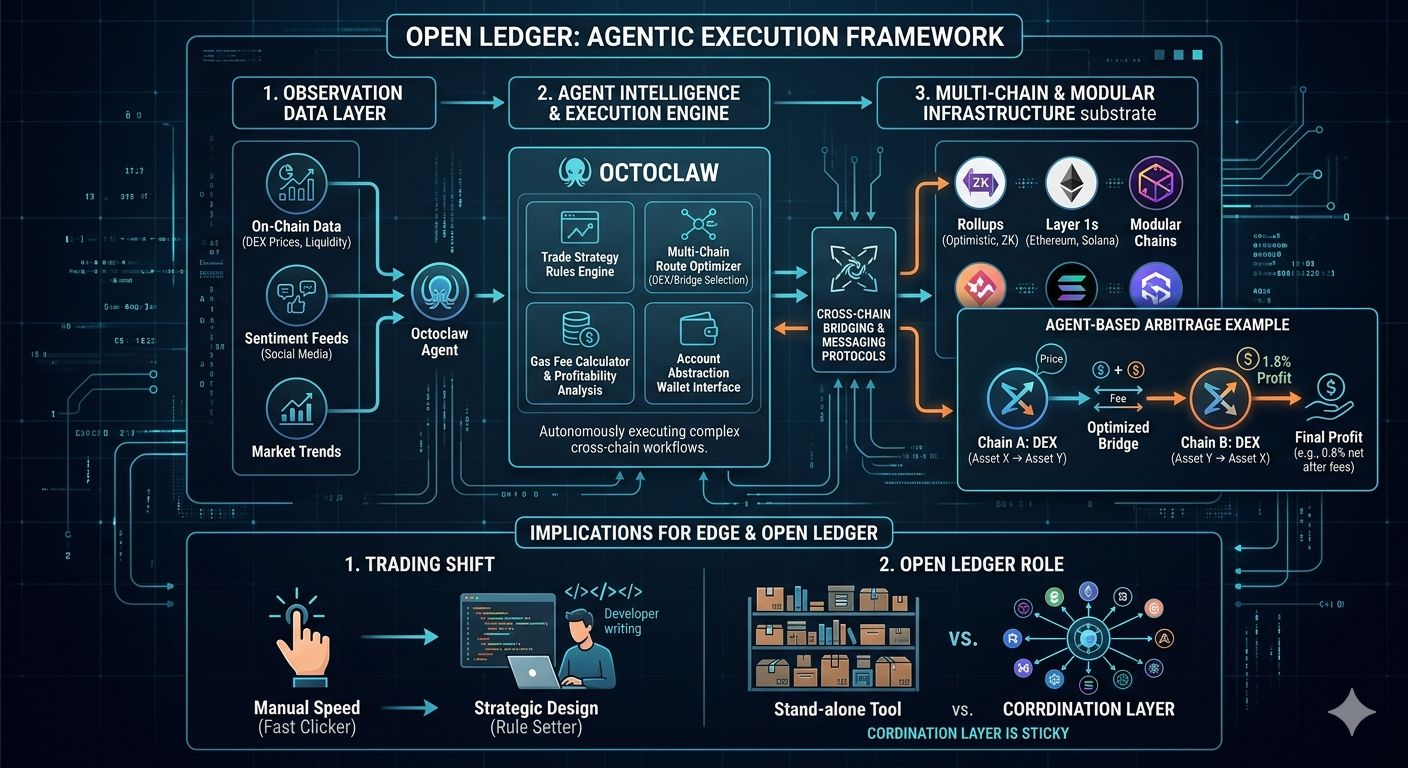
Think about the grind of a typical trading day for a second. I spot a spread between two different decentralized exchanges that might net me zero point eight percent after fees. By the time I manually bridge the assets and approve the token and sign the swap and sit there praying for that second leg to confirm the spread has long since vanished. Or even worse the gas prices spiked while I was fumbling through the interface and now I am bleeding on a trade that should have been a winner. An agent that can coordinate that entire flow across different chains while calculating if the trade remains profitable after every single fee is not some gimmick. That is actual edge. We are finally sitting here in 2026 with infrastructure that can actually support this kind of complexity. Modular chains are functional realities now and bridges are faster and account abstraction is becoming the standard. Two years ago letting an autonomous agent loose on chain would have been absolute chaos but today there is actually a substrate for it to function.
I have to be honest about the fact that I am still plenty skeptical about this whole situation. Letting agents act on my behalf across decentralized systems is a security nightmare that I cannot fully wrap my head around yet. If the agent misinterprets a price feed who is on the hook for the inevitable loss. If a smart contract reverts in the middle of a complex execution does it have the intelligence to retry or does my capital get stuck in limbo forever. These are not just pessimistic questions meant to spread fear because they are genuine holes in the current architecture. I would never hand my main wallet over to a system like this until I see several quarters of flawless execution on a sacrificial hot wallet first.
The broader question for me is what happens to my personal edge if agent based execution becomes the new normal for everyone. Right now my advantage is a mix of raw speed and screen time and gut instinct. If every retail participant has an agent that is faster than me across every single chain then speed stops being a moat entirely. The only thing that does not get commoditized in that world is the actual design of the strategy. The traders who survive will not be the ones with the fastest mouse clickers but the ones who write the best rules for their agents to follow. Trading shifts from being a manual chore to something closer to coding a strategy and then letting it run.
For people holding the Open Ledger token the lens has to shift as well. The real question is not whether this is just another wave of AI hype but whether Open Ledger can cement itself as the core coordination layer that every other project plugs into. Coordination is incredibly sticky once it works because developers do not want to tear out their backend every six months. Tools on the other hand get swapped out and discarded every single cycle when something shinier comes along.
Octoclaw is not the final form of this technology but it is a massive signal that we are finally moving from AI that just tells you what to do to AI that does it for you across chains while you are asleep. This transition is going to be incredibly messy and most of the projects rushing into this space are going to end up as vaporware. The few teams that actually nail the coordination and security and trust components have a shot at becoming the boring infrastructure that people stop thinking about. That is usually where the durable value lives in this industry. I am watching Open Ledger with that exact frame in mind because this is not a trade for next week but a thesis I am building over the next few months. It is not the final answer to our problems but it is a direction worth tracking while everyone else is still busy chasing the latest meme coin flavor of the month.