
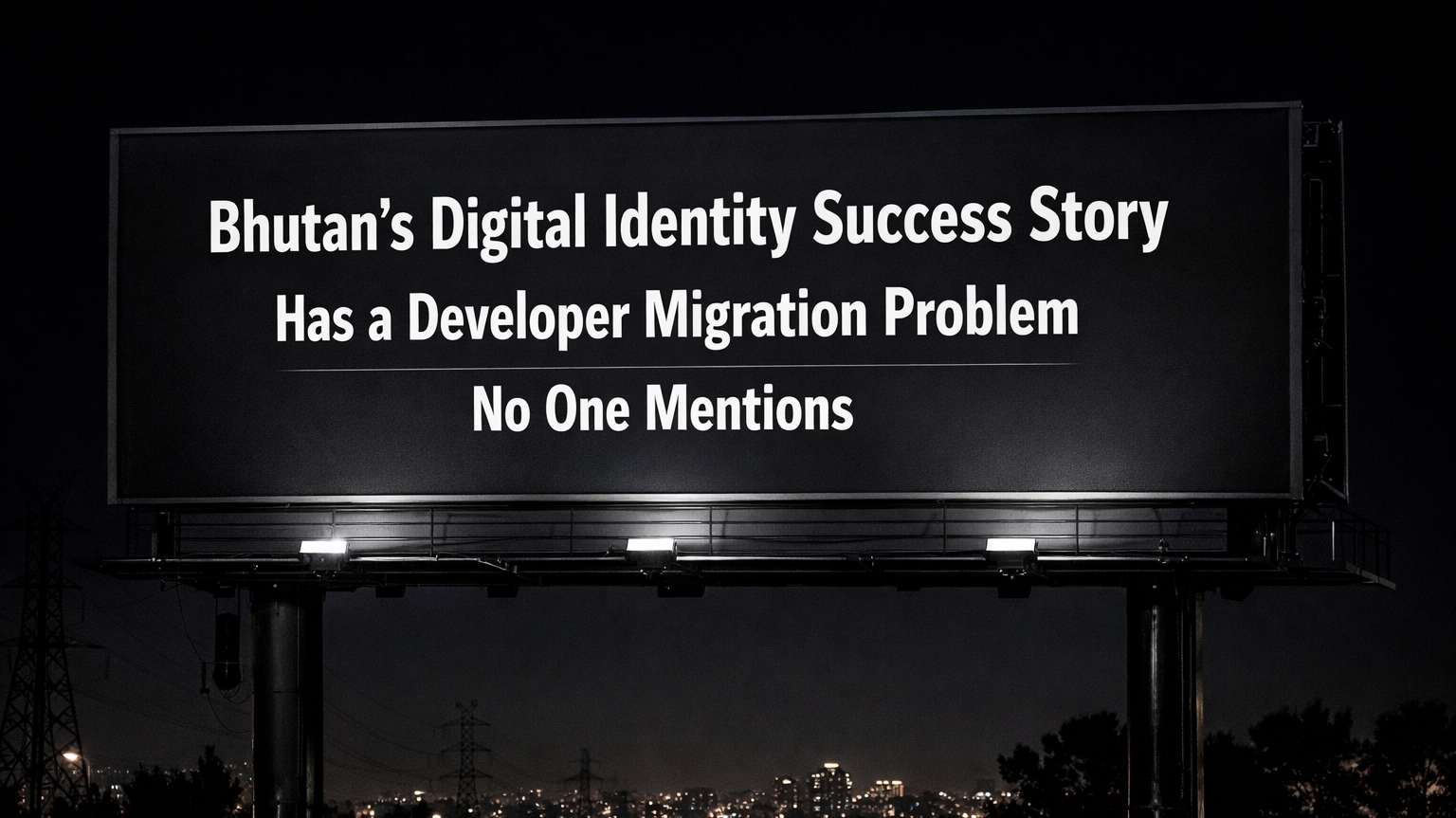
@SignOfficial #sign #SignDigitalSovereignInfra $SIGN
One small detail in Bhutan’s digital identity story stayed with me longer than I expected.
Not the obvious part. Not the blockchain layer. Not the privacy language. Not even the polished government-tech optimism that always sounds a little cleaner on paper than it ever does in real life.
It was the developer line.
SIGN’s whitepaper points to Bhutan’s National Digital Identity ecosystem as proof that the platform is mature. It mentions hackathons, developer engagement, and says that 13+ teams built NDI-integrated applications across government and private-sector use cases.
On the surface, that sounds like exactly the kind of thing a serious national identity system should want to say about itself.
It suggests the platform is not just a government-built tool sitting in isolation. It suggests other people found it usable enough, valuable enough, and stable enough to build on top of it. It suggests the system has moved beyond a single implementation and started becoming something closer to real infrastructure.
And honestly, that is a strong point. Probably one of the strongest points in the entire Bhutan story.
Because once outside developers start building on top of identity rails, the conversation changes.
A system like that feels more alive. More resilient. More legitimate.
It is one thing for a government to say it has built a digital identity framework. It is another thing for actual teams to start building services around it. That is the moment it starts to look less like policy ambition and more like a living platform.
That is why the 13+ teams line matters.
But the more I sat with it, the less simple it felt.
Because Bhutan’s NDI platform has not stayed still in the way that sentence quietly assumes. It has moved. More than once. And the whitepaper barely slows down long enough to ask what that means for the people building on top of it.
That is the part I keep coming back to.
Bhutan’s identity system did not stay on one stack and gradually deepen from there. It started on Hyperledger Indy. Then it moved to Polygon. Then it began shifting toward Ethereum.
You can frame that as pragmatism, and people clearly do. You can say it reflects better infrastructure choices over time. Stronger security. Better decentralization. A broader developer base.
Maybe all of that is true.
Maybe the platform really did get stronger with each step.
But migrations always look cleaner in platform narratives than they do from the application layer.
That is the part polished infrastructure writing tends to flatten.
A migration gets described as one strategic decision made by one platform team, as if it is simply a matter of choosing better foundations and moving forward. But if there are really 13+ teams building applications on top of the system, then that decision does not stay contained inside the platform team.
It spreads outward.
Every application built on top of those rails has to deal with some part of the change. Maybe not in exactly the same way. Maybe not at the same cost. But enough that it matters.
And that is where the Bhutan story starts feeling more interesting to me than the whitepaper allows.
Because now those 13+ teams are doing two things at once.
They are the strongest proof that the platform works.
And they are also the people most exposed when the platform underneath them keeps changing.
That tension feels more important than the whitepaper lets on.
It is easy to present developer activity as a maturity signal. And to be fair, it is one. But ecosystem depth is not just a strength. It is also where the pressure lands.
If no one is building on top of your system, migration is mostly a core-team problem. Painful, maybe, but contained. Once real teams are building real applications, every architectural shift creates work somewhere else. Integrations have to be checked. Flows have to be retested. Assumptions have to be revisited. Release schedules have to be coordinated around a transition the application teams did not choose for themselves.
That is what makes this more than just a nice number in a whitepaper.
The more mature the ecosystem is, the more expensive change becomes.
And that is why I keep returning to the same question:
What happened to the people building on top of Bhutan’s identity system every time the platform moved?
That is not some technical side note.
That is the ecosystem question.
The whitepaper leans on hackathons and developer engagement programs as evidence of platform health, and I understand why. Hackathons are useful. They bring builders in. They make a platform feel open. They generate ideas, prototypes, and sometimes genuinely valuable applications. They create momentum around infrastructure that might otherwise feel too abstract for anyone outside the core circle to care about.
But hackathons solve the beginning of the problem.
They do not solve the part that comes after.
A team that built something during an NDI hackathon and then kept working on it does not mainly need another event. It needs continuity. It needs updated tooling. It needs migration documentation, clear timelines, testing environments, support channels, and some level of confidence that the base layer is not going to shift in ways that leave them scrambling to catch up.
That is what long-term ecosystem support actually looks like.
And that is the part I do not really see described with the same confidence as the public success story.
What I do see is onboarding energy. I see developer excitement. I see the ecosystem being presented as proof that the system has traction.
What I do not see as clearly is the maintenance layer that keeps an ecosystem healthy once traction turns into dependency.
That gap matters.
Because it is one thing to get developers to build.
It is another thing entirely to carry them through repeated infrastructure changes without quietly pushing the cost onto them.
To be clear, I do not think this is some neat gotcha that invalidates Bhutan’s progress. That would be too easy, and honestly too lazy.
If anything, Bhutan may have done something genuinely difficult here.
Because if the platform really kept expanding while moving across different infrastructure layers, and if developers stayed engaged through that, then the impressive part of the story is not just that apps were built.
The impressive part is that the ecosystem stayed alive while the foundation itself kept moving.
That is much harder than the usual look, people are building narrative.
That would suggest actual institutional depth. Not just technical deployment, but coordination, flexibility, and enough trust from builders that the ecosystem did not fall apart every time the substrate changed.
That would be a serious achievement.
But if that is the real achievement, then that is the part that deserves more attention.
Because right now the public version of the story feels slightly compressed. It gives the output. It gives the number. It gives the clean signal of ecosystem maturity.
But it does not spend much time on what the ecosystem may have had to absorb in order to keep looking mature.
And that, to me, is the more revealing part.
The 13+ teams line reads one way at first. It sounds like a normal success metric. Thirteen teams built applications. Great. That sounds like momentum.
But the more I think about it, the more it stops sounding like a simple adoption number and starts sounding like a stress test.
Because if those teams were real, active, and building against live identity rails, then they were also the people feeling every platform decision in practice.
They would be the ones dealing with whatever changed. Whatever broke. Whatever needed retesting. Whatever had to be re-explained to users, agencies, or partners depending on their applications.
That does not make them less important.
It makes them central.
They are not just evidence of success. They may also be evidence of how much invisible adaptation work the ecosystem has already had to carry.
And that changes the emotional texture of the story.
It makes the whole thing feel less like a clean case study and more like a question about who absorbs the cost of progress.
If a government is evaluating SIGN and looking at Bhutan as a reference point, the obvious takeaway is easy enough. National SSI can work. Developers can build on top of it. Identity infrastructure can grow beyond a single government interface.
That is the clean version.
That is the part designed to travel well.
But the more serious question sits underneath it.
Not whether developers exist.
Not whether apps were built.
The real question is what happens to those developers when the infrastructure changes.
How are they informed?
What tooling do they get?
How much compatibility is preserved?
Is there a transition window?
What happens to services that rely on live identity verification during the move?
How much of the migration burden is absorbed centrally, and how much is quietly pushed outward to application teams?
That is what maturity actually looks like once a system becomes real.
Not just visible activity, but how much disruption the ecosystem can absorb without breaking trust for the people who depend on it.
I think that is why this one detail keeps sticking with me.
The Bhutan story is usually presented as evidence that self-sovereign identity can work at national scale. Maybe it can. Bhutan is one of the few cases that gives that claim some actual weight.
But what makes the story interesting to me is not the smoothest part of the narrative.
It is the part with friction.
It is the fact that the strongest proof of ecosystem maturity, those 13+ teams, may also be the clearest place to look if you want to understand the hidden operating cost of that maturity.
Because ecosystems are easy to celebrate from a distance.
What is harder is asking what they have had to survive.
And in Bhutan’s case, that question feels especially important because the infrastructure has moved fast enough that survival itself may be part of the achievement.
So I do not really look at those 13+ teams and think, nice, developer traction.
I look at them and think:
What did they have to carry?
If the answer is not much, then Bhutan’s architecture may be more robust than the public story has fully explained.
If the answer is quite a lot, then the ecosystem is still impressive, just for a different reason.
Either way, those teams are doing more work in the story than the whitepaper admits.
And that, to me, is the part worth paying attention to.
