

Apro Token (AT) landed on Binance Alpha on October 24, 2025, at a moment when traders have been rotating back into infrastructure. When majors chop and risk appetite fades, the stuff every app needs, like oracles, tends to get a second look.
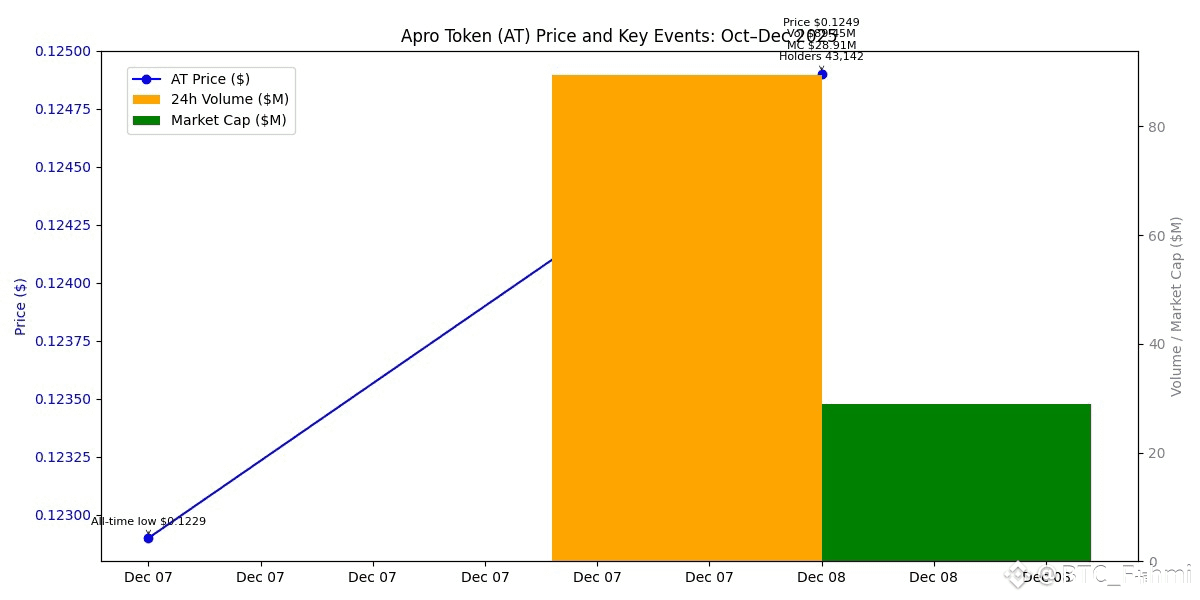
As of December 8, 2025, AT is about $0.1249. It’s down 3.2% over 24 hours and down 45.6% over 7 days, yet it’s still doing roughly $89.45 million in 24-hour volume on a market cap near $28.91 million. That combo screams “attention,” but it also screams “fragile.”
Three recent dates frame why AT keeps showing up on screens. October 24, 2025 was the initial Binance Alpha debut and the start of price discovery. On November 4, 2025, a Nubila Network collaboration was reported, keeping the project in the news. Then on November 27, 2025, Binance spot trading opened for AT and 20,000,000 AT were distributed via BNB HODLer Airdrops, with eligibility snapshots taken from November 4 to November 6, 2025. So yes, the token launched, but there was also a second wave of distribution and visibility later on.
Now here’s the simple version of what APRO does. An oracle is a messenger that brings outside information onto a blockchain. If a lending app needs an ETH price to decide whether your collateral is safe, it can’t just “check the internet.” It needs an on-chain feed. APRO describes two delivery styles Data Push. Where updates are published regularly like a radio broadcast and Data Pull. Where an app requests data when needed, like calling a taxi. CoinGecko’s profile also notes 161 price feeds across 15 networks, which is the kind of detail I like because it’s specific and measurable.
Adoption is where I stop listening to stories and start counting. APRO’s site claims 200 ecosystem partners, 1,400 data feeds, and support across 40 chains, with nine nodes. On-chain distribution is also meaningful: the BNB Chain token tracker shows 43,142 holders for the AT contract. Holder counts aren’t daily active users, but they do show the token isn’t held by just a handful of wallets.
Competition matters because oracles win by integrations, not vibes. DefiLlama estimates Total Value Secured around $50.972 billion for Chainlink and about $4.571 billion for Pyth. AT isn’t in that league yet, and APRO doesn’t have a clear DefiLlama-secured figure to point to today, which is something to watch. Market cap comparisons underline it: Chainlink is roughly $9.5 billion while AT is roughly $28.9 million.
Tokenomics are unusually transparent because the mint is readable in the verified contract. Total supply is 1,000,000,000 AT, with circulating supply around 230,000,000 AT. CoinGecko pegs fully diluted valuation near $125.68 million at current prices. The contract mints 250,000,000 AT to an ecosystem bucket, 200,000,000 AT to investors, 200,000,000 AT to team, 200,000,000 AT to a launch bucket, 100,000,000 AT to staking, and 50,000,000 AT to a foundation address. Public breakdowns also describe allocations in percentages, and the Binance-linked airdrop number, 20,000,000 AT, lines up as a small slice of that broader supply picture.
People ask about TVL, total value locked, which is just how many dollars are sitting in a protocol’s contracts. For oracle tokens, staking TVL is the relevant slice. DefiLlama shows RedStone Oracles staking TVL around $3.94 million today right now.
Q1 2026 is the “show me” quarter. The roadmap messaging points to expanding dApp support, improving tooling and incentives for data providers, and pushing further into AI-facing oracle products. If those plans land as real integrations, you should see it in new feeds, more chains, and eventually secured value.
My bull case has three legs. One, liquidity is already there: $89.45 million daily volume means AT is tradable without heroic slippage. Two, distribution is broad early, with 43,142 holders and a 20,000,000 AT airdrop catalyst tied to November snapshots. Three, the footprint claims, including 161 feeds across 15 networks, suggest active shipping. If market cap simply re-rates from about $29 million to $100 million, that’s about a 3.5x, and at the same circulating supply you’re looking at roughly $0.43 per AT.
Now the bear case. One, the chart is ugly: down 45.6% in 7 days, with an all-time low of $0.1229 on December 7, 2025, tells you sellers are still in control. Two, competitors are entrenched, and their secured-value numbers are massive. Three, oracle reliability is a reputational business, and running on nine nodes today means decentralization and monitoring have to scale fast.
Zooming out, AT is a bet that the next wave of on-chain apps, especially ones tied to AI and real-world assets, will demand verifiable inputs. If APRO can turn partner logos into measurable secured value, the story changes. What would convince you first: a big secured-value milestone, a top-tier protocol integration, or a staking model that meaningfully pulls AT out of circulation?

