



The card protects users in high-inflation markets by preloading funds in stable currencies pegged to the US dollar.
This program acts as an extension to the existing prepaid card, allowing spending or conversion to local cash through Rain and Western Union branches.
This initiative is linked to Western Union's plan to launch its own stablecoin, USDPT, on the Solana blockchain in early 2026.
This move signals the adoption of stablecoins as a tool for real-world financial infrastructure for money transfers and value preservation.
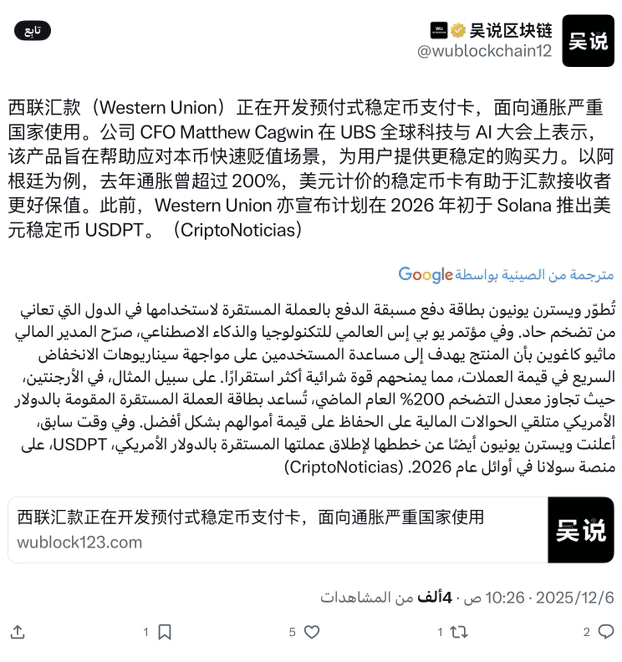
Western Union is delving further into payments backed by digital technologies. The global remittance company is currently developing a prepaid payment card based on stablecoins, targeted at countries suffering from hyperinflation. The goal is clear: to protect individuals' money in places where the local currency is constantly losing value. The company's CFO, Matthew Kaguein, announced the plan during the UBS Technology and AI Conference, explaining that the card targets countries where inflation rapidly erodes purchasing power.
Argentina has emerged as the clearest example. Inflation there surpassed 200% last year, and in some estimates reached between 250% and 300%. In such markets, timing becomes a critical factor. A $500 remittance today could lose a significant portion of its value within weeks. Western Union wants to stop this bleed. The card will be loaded with dollar-denominated balances through stablecoins, not the weak local currency. This way, users can spend later without watching their savings diminish.
How the stable card works
The stablecoin card will act as an extension of the existing Western Union prepaid card. However, this version is aimed at highly volatile economies, not just the U.S. market. Users will hold balances in stablecoins instead of cash balances. Western Union is partnering with Rain, the issuer of Visa cards backed by stablecoins. Through this framework, users can spend stablecoins directly using the card or convert them to local cash at participating Western Union branches.
This link between cryptocurrencies and cash is an important step. Many residents in high-inflation areas still rely on physical cash to meet their daily needs. The stable card gives them the opportunity to hold value digitally while having access to money on the ground. Kaguein illustrated the real-world impact with a simple example: if a family in the United States sends $500 back home, inflation can reduce its value to $300 within a month. However, with a stablecoin card pegged to the dollar, this risk disappears. The money retains its value.
USDPT stablecoin and Western Union's expansion on the Solana blockchain
This card is not an independent product. It is directly linked to Western Union's larger plans in the stablecoin space. The company has already confirmed that it will launch its own stablecoin, USDPT, in early 2026. The currency will operate on the Solana blockchain and will be issued by Anchorage Digital, a regulated digital asset bank in the United States. Western Union believes this structure will enable faster settlements, lower costs, and instant cross-border transfers.
The company has also begun building a comprehensive digital asset network. It has partnered with several providers to create on/off ramps. The goal is to reduce reliance on slow banking channels and minimize the time money is held during transfers. Kaguein noted that Western Union moves $500 million daily. Even small delays hold up massive amounts. Thus, stablecoins can unlock this capital quickly and improve liquidity across the network.
Why does this step represent a shift in global payments?
The Western Union stable card highlights how traditional finance continues to merge with the world of digital currencies. This is no longer an experiment. It is a lifeline for residents of unstable economies. The card provides users in high-inflation countries with:
Better protection for purchasing power
Faster access to dollar-denominated funds
Easier spending without exchange rate shocks
For Western Union, the benefits are clear as well. It reduces costs, speeds up settlements, and lowers reliance on fragile banking pathways. Most importantly, this step proves a fundamental point: stablecoins are no longer just tools in the crypto world; they have become a true infrastructure for money. Western Union wants to be at the forefront of this shift.
#BinanceSquareFamily #BinanceSquare #WesternUnionCrypto #NewsAboutCrypto #newscrypto
