
The catalysts for altcoin season have returned, reflecting the specific conditions that preceded the two largest previous surges in altcoins.
Two major signals were activated simultaneously: a breakdown in Bitcoin's dominance (BTC.D) and a reversal in the Ethereum/Bitcoin pair (ETH/BTC). For many traders, this combination historically marks the moment when capital rotation accelerates away from Bitcoin and into the broader altcoin market. Trader Merlin notes that retail traders have already missed this shift twice. With both catalysts flashing again, the question now is whether investors will recognize this pattern early enough this time.
The collapse of Bitcoin's dominance repeats the classic behavior of altcoin season.
The chart shows Bitcoin's dominance retreating from a key resistance level, similar to the breakdowns that preceded altcoin rallies in 2017–2018 and 2020–2021. When Bitcoin's dominance (BTC.D) starts to decline, it indicates that Bitcoin's share of the total cryptocurrency market cap is shrinking. Historically, this shift has been driven by an increasing appetite for higher-risk assets such as Layer-1 networks, DeFi tokens, infrastructure, gaming coins, and emerging projects.
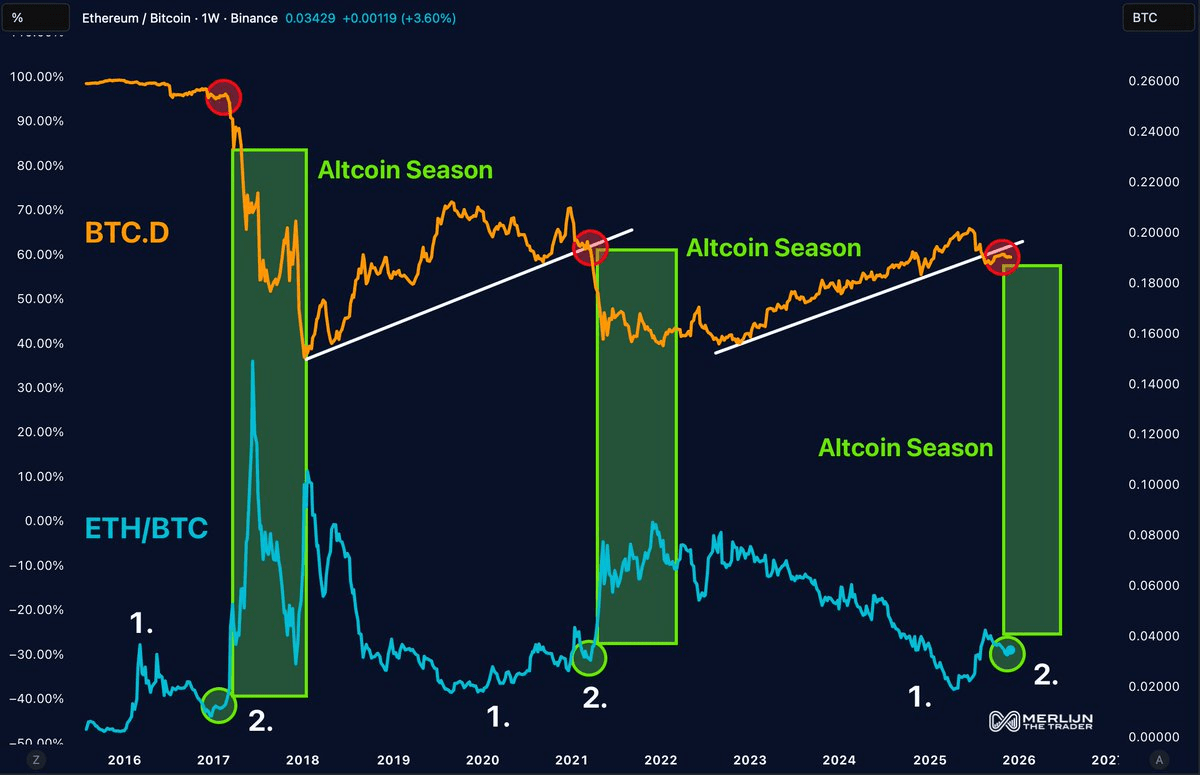
In previous cycles, declines in Bitcoin's dominance represented the final stage of Bitcoin-led rallies, followed by months of strong capital rotation. The current breakdown resembles those previous setups almost identically, adding weight to the assertion that a phase of altcoin expansion may be in formation.
The reversal of the Ethereum/Bitcoin pair confirms a change in market structure.
At the same time, the Ethereum/Bitcoin pair (ETH/BTC) recorded a reversal from the cycle's lows — another key signal that preceded previous altcoin seasons. When Ethereum begins to outperform Bitcoin, broader risk appetite usually accelerates. This shift reflects a familiar dynamic: institutional money tends to enter Bitcoin first, then rotate into Ethereum, and only later move into the broader altcoin market.
In both previous cycles illustrated in the chart, the ETH/BTC reversal acted as a confirming signal. It reinforced the idea that Bitcoin's dominance had peaked and that investors were positioning themselves ahead of a broader market rotation. The current reversal closely aligns with those historical turning points.
Why retail traders often miss these phases and why timing is crucial.
Merlin emphasizes that retail traders have missed this setup twice before. In both previous cycles, altcoin rallies began quietly, with little excitement or clarity. By the time social sentiment rose, prices had already surged significantly. The same phase of quiet accumulation may be unfolding now, as Bitcoin's dominance (BTC.D) weakens and the ETH/BTC pair rises while sentiment remains relatively calm.
If this pattern repeats, early positioning becomes crucial. The strongest altcoin moves in previous cycles occurred shortly after these signals appeared, but before retail participation surged.
A familiar setup precedes a potential expansion of altcoins in 2026.
The chart identifies three altcoin seasons across three different market environments, each beginning with identical structural catalysts. The current setup, forming now ahead of 2026, closely mirrors previous phases. While nothing is guaranteed in markets, the coincidence of Bitcoin's dominance breakdown and the ETH/BTC reversal is an uncommon mix, which has historically preceded explosive altcoin performance.
The message from Merlin is clear: these signals do not appear often, and when they do, the window of opportunity tends to be early. With both catalysts activating again, traders who prepare in advance may find themselves in a position to capitalize on what could be the next major rotation in the cryptocurrency cycle.

