

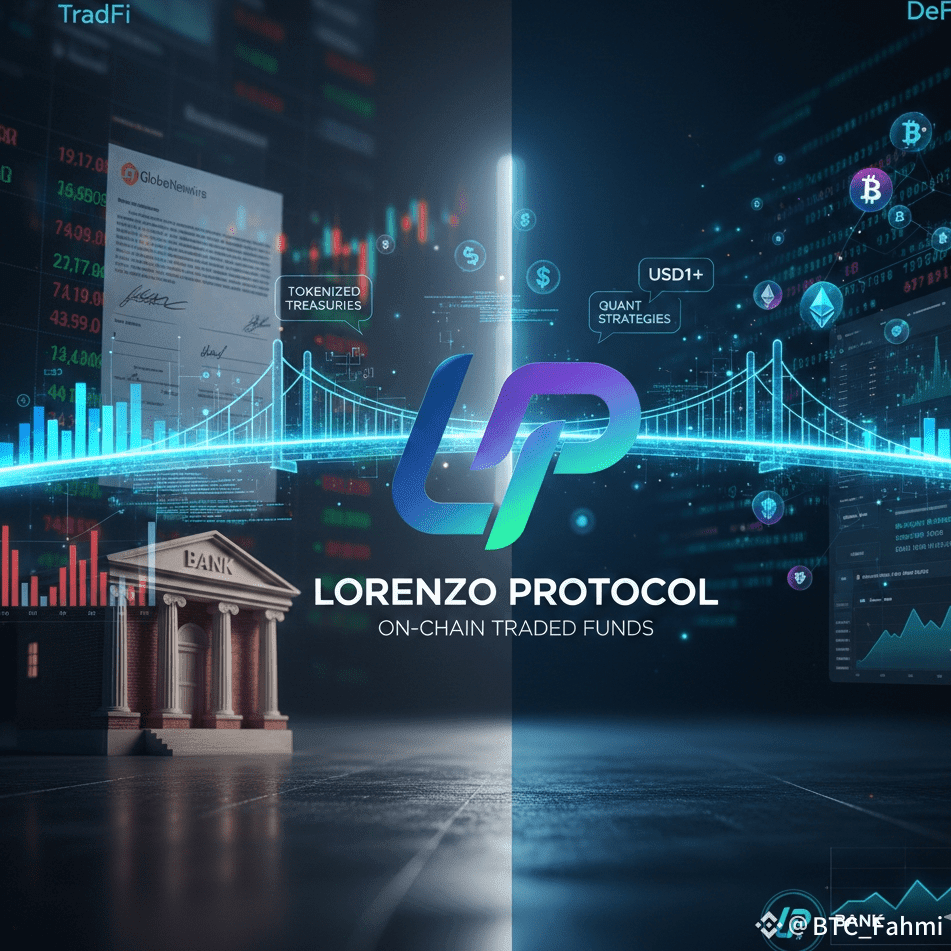
Lorenzo Protocol is one of those projects that sits right on the fault line between TradFi and DeFi. If you strip away the buzzwords, the idea is simple: take the kind of fund structures you’d usually see in hedge funds or structured products desks, rebuild them as programmable strategies on-chain, and wrap them into tokens anyone can hold, trade, or plug into DeFi. The team calls these On-Chain Traded Funds, or OTFs, and they’re basically tokenized versions of traditional funds that live entirely on smart contracts. That’s the bridge to traditional fund strategies. In a classic fund, you commit capital, sign a bunch of docs, and then get monthly PDFs while a manager runs option overlays, basis trades, RWA yield ladders, whatever their playbook is. With Lorenzo, that “playbook” becomes transparent logic: a strategy vault or OTF contract that anyone can inspect. The vault takes deposits, allocates into a mix of quant trading, volatility harvesting, DeFi liquidity, real-world asset yields, and other structured strategies, then tokenizes your share of that portfolio. The flagship example is USD1+, a fund running on BNB Chain that combines yields from tokenized treasuries and other RWAs with algorithmic trading and DeFi-native strategies in a single token. It’s built on cross-chain infrastructure that has already processed sizable liquidity across networks, and Lorenzo even became the official asset management partner of World Liberty Financial around this product. In TradFi language, think of USD1+ as a blended yield fund: part bond fund, part quant strategy, but tokenized and composable inside DeFi instead of living on some broker portal. On the token side, Lorenzo’s governance and ecosystem token is BANK, launched via an IDO on April 18, 2025 at $0.0048, raising about $200,000 with an initial supply of 425.25 million tokens. Since then, the token has traded up multiple times from IDO price; it hit an all-time high around $0.23 on October 18, 2025 before pulling back. As of early December 2025, BANK is hovering around the four to five cent range, with a market cap in roughly the $18–23 million zone and daily volumes in the eight-figure range, depending on the data source and the day. For traders, that combo of modest market cap and meaningful volume is usually a signal that the market cares, but hasn’t fully decided what long-term value looks like. Why is this thing suddenly all over crypto Twitter and Binance Square in late 2025? A big part of it is timing. The space has been moving hard toward tokenized treasuries, real-world assets, liquid staking and restaking, and more sophisticated structured products. Capital is scattered across RWAs, LSTs, LRTs, synthetic dollars, and wrapped BTC, and most of it just sits there unless you manually optimize it. Lorenzo pitches itself as the “strategy OS” or liquidity engine for that tokenized world: a layer that routes all this tokenized value into coherent, risk-controlled strategies. From a trader’s point of view, what stands out is how they treat the strategy as the asset. Instead of subscribing to some opaque fund, you hold an OTF token that directly represents your share of the underlying strategy. You can trade it, use it as collateral, or pair it in other DeFi pools. If you don’t like the risk profile anymore, you don’t send a redemption form and wait; you just exit the token on-chain. That’s structurally different from most “vaults” or farms we’ve seen in previous cycles, which tended to be black boxes with retroactive explanations when things blew up. Progress-wise, this isn’t just a whitepaper story anymore. By Q4 2025, Lorenzo has live OTFs on BNB Chain, including USD1+, and a growing catalog of strategy vaults spanning quant, volatility, RWA yield, and DeFi liquidity. BANK is listed on major trackers like CoinGecko, CoinMarketCap, and multiple centralized exchanges, and on-chain analytics sites like DappRadar track its TVL footprint across networks. The narrative is also getting amplified by a steady stream of long-form pieces on Binance’s content platforms that frame Lorenzo as a blueprint for programmable fund engineering and a quiet breaker of old DeFi logic. That kind of narrative push doesn’t guarantee success, but it usually signals serious backing and a deliberate branding strategy. If you’re trying to map this to real-world portfolios, imagine an asset manager building a suite of funds: conservative yield, growth, volatility, multi-chain exposure, even meta-portfolios that hold other OTFs as components. That’s roughly the future Lorenzo’s ecosystem articles are pointing toward. For developers, the interesting angle is composability: fund logic becomes code that others can plug into, extend, or stack. For traders, the interesting question is whether OTFs can become a standard “primitive” you see alongside spot, perp, and options exposure in a portfolio. Of course, none of this removes risk. You still have smart contract risk, execution risk on the underlying strategies, liquidity risk on the OTF tokens and BANK, and regulatory risk around tokenized funds and RWAs. A strategy that looks great in backtests can behave terribly in a real panic. The fact that logic is transparent doesn’t mean every user will actually read or understand it. Personally, if I were trading around BANK or parking size in an OTF, I’d be watching a few things closely: how diversified the strategy set really is, how they handle drawdowns, whether TVL is sticky or purely mercenary, and how regulators talk about tokenized funds over the next 12–24 months. Still, compared to the yield-farming meta of 2020–2021, this feels like a more mature iteration of on-chain finance. Instead of chasing APYs on a rotating set of farms, you’re starting to see fund-style products with defined mandates, risk frameworks, and tokenized shares that plug into the rest of DeFi. Lorenzo isn’t the only team working in this direction, but it’s one of the louder and more structured attempts right now. If you’re a trader, that doesn’t mean “ape”; it means this is a corner of the market worth watching, backtesting, and sizing into carefully if the thesis fits your view on where tokenized funds and on-chain asset management are heading.
@Lorenzo Protocol #lorenzoprotocol $BANK


