
On the first trading day of December 2025, the cryptocurrency market faced a severe storm driven by drastic changes in macro policy. While the market generally expected the Federal Reserve to cut interest rates in December, Bank of Japan Governor Kazuo Ueda sent the clearest signal yet for a rate hike on the morning of December 1, causing market expectations for a December rate hike probability to soar above 76%. This sharp contrast in monetary policy completely disrupted market equilibrium.

1. Macroeconomic 'Black Swan': Divergence in US-Japan Policies Withdraws Global Liquidity
The core driving force behind this plunge came from the unexpected divergence of monetary policies from the two major central banks globally. On one hand, although the Federal Reserve stopped 'quantitative tightening' yesterday and released liquidity to the market, it remains 'far from certain' whether it will continue to cut rates in December. On the other hand, the Bank of Japan's unexpectedly tight shift directly impacted the long-standing 'yen carry trade' model. Investors are concerned that a yen rate hike will trigger accelerated unwinding of carry trades, leading to a withdrawal of funds from global high-risk assets. This tightening of liquidity expectations makes highly volatile assets like cryptocurrencies the first to be affected.
At the same time, regulatory pressures have also cast a shadow over market sentiment. Domestic regulations have classified stablecoins as virtual currencies, and the EU's MiCA legislation has also imposed strict restrictions on stablecoins, all of which have suppressed market sentiment from a policy and compliance perspective.
2. Market Performance: Crash-like Decline and a Vicious Cycle of Leverage Liquidation
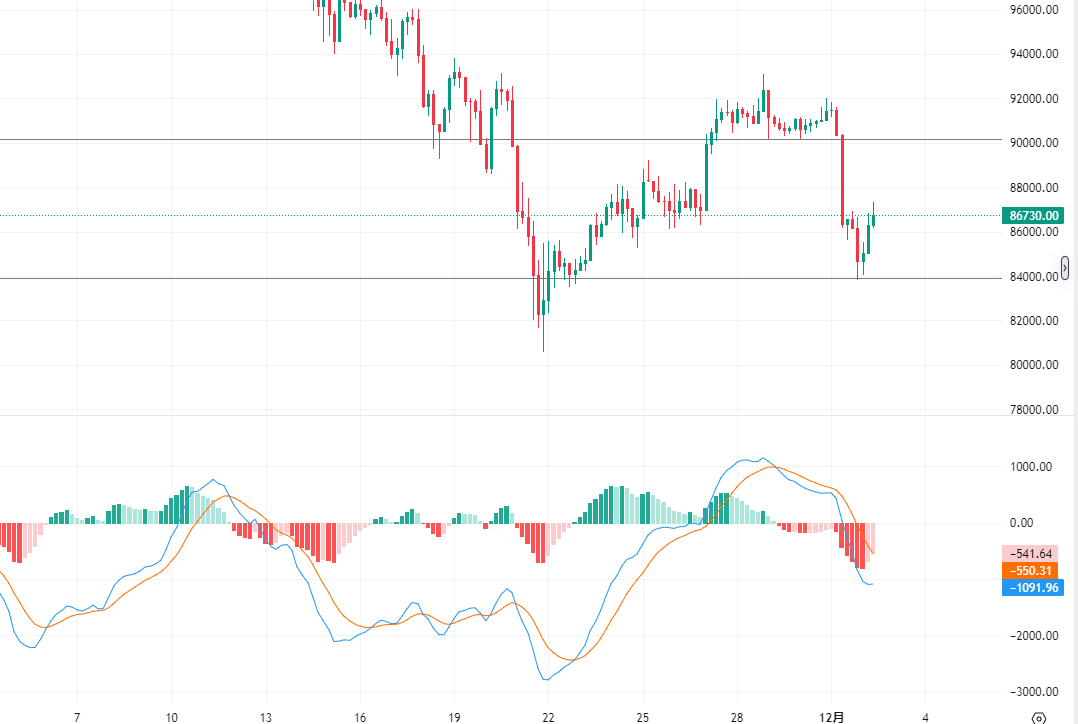
Under the aforementioned macro pressures, the market experienced a crash-like decline on the evening of December 1. Bitcoin (BTC) price plummeted by 8% at one point, hitting a low near $83,800; Ethereum (ETH) also sharply declined, approaching the $2,700 level in the evening. This crash triggered a chain liquidation of high-leverage contracts. Data shows that in the past 24 hours, the total amount of liquidations across the network reached $941 million, with over 260,000 traders forced to close positions, forming a vicious cycle of 'decline - liquidation - sell-off', dramatically amplifying market volatility.
3. Technical Analysis: Mid-term Turn Bearish and Short-term Oversold Rebound
After the crash, the technical structure of the market has been severely damaged.
Bitcoin: The monthly chart has confirmed a bearish MACD crossover signal, which historically usually indicates that momentum will remain weak for the next 2-3 months, and the medium-term trend has turned bearish. The key support level has shifted from $84,000 down to the $80,000 level.
Ethereum: Similarly, its short-term rebound structure has been disrupted. Despite positive fundamentals such as the 'Fusaka' upgrade, it struggles to stand alone in the face of systemic selling.
As of the morning of December 2, the market experienced a sharp rebound. Bitcoin rose back to around $87,000, and Ethereum also returned above $2,800. Observing from a smaller timeframe (like the 4-hour chart), signs of declining downward momentum have appeared, indicating a demand for technical correction in the short term. However, as the larger cycle indicators have turned bearish, and market sentiment is cautious, the strength of this rebound may be suppressed.
4. Market Outlook: Focus on Key Resistance and Macro Speeches
The short-term trend will revolve around the tug-of-war between oversold rebounds and mid-term bearish pressure.
Key Levels:
The short-term resistance for Bitcoin during the day is at $88,000, with significant resistance in the $90,000-$92,000 range; on the downside, the initial focus for support is at $85,500, followed by the $84,000 level, while the $80,000 level is generally regarded as the last support for bulls.
Ethereum's upper resistance is focused on the $2,880-$2,950 range; short-term support is at $2,750 and $2,700.
Macro Catalysts: The market will closely monitor speeches from Federal Reserve officials and the upcoming Federal Reserve meeting next week. Any further hints regarding the December interest rate cut path could provide short-term direction for the market. If the speech leans dovish, it could support the current rebound; if the attitude is ambiguous or hawkish, it may further undermine market confidence.
Overall, the panic sell-off triggered by the unexpected divergence of US-Japan monetary policies has temporarily come to an end, but the medium-term technical outlook of the market has already been damaged. Before macro uncertainties are resolved and new sustained buying emerges, the market is expected to enter a phase of high volatility and overall bearish consolidation. Investors should beware of the risk of further declines to support after a rebound encounters resistance. The hope of returning above $90,000 in the short term is becoming increasingly bleak!

——Original by the author, welcome to follow, like, and communicate

