
I originally thought I would lie in my hometown, a friend's happy event could bring some joy!
As a result, my BTC experienced a waterfall drop, and what I thought was a surprise turned into a scare. I also knew before that if $81k was the bottom, then there would be at least three chances to test this position to confirm it as the true bottom.
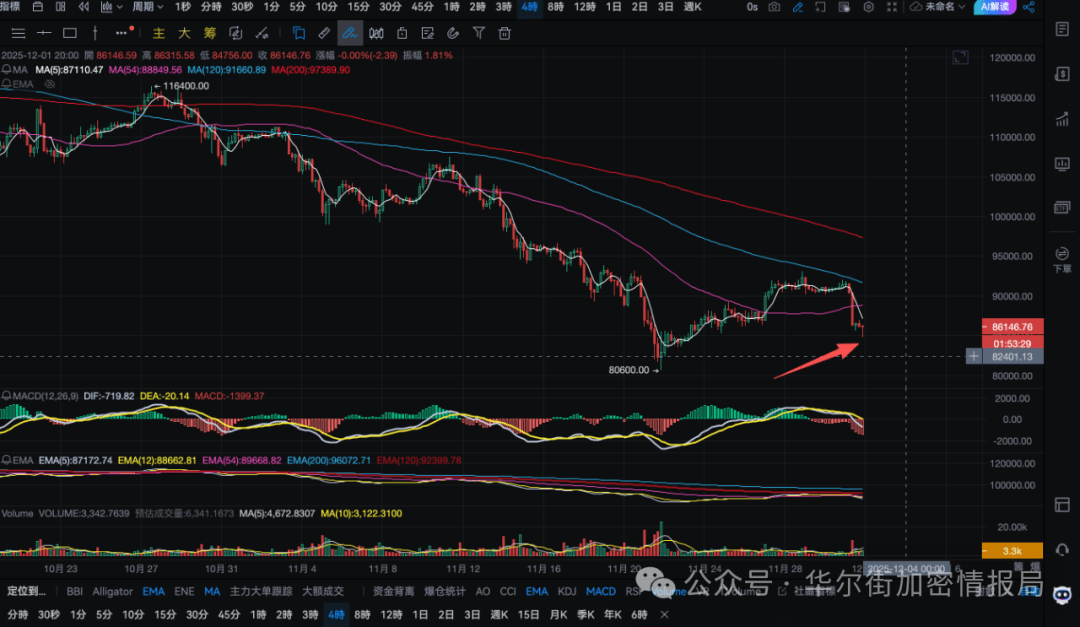
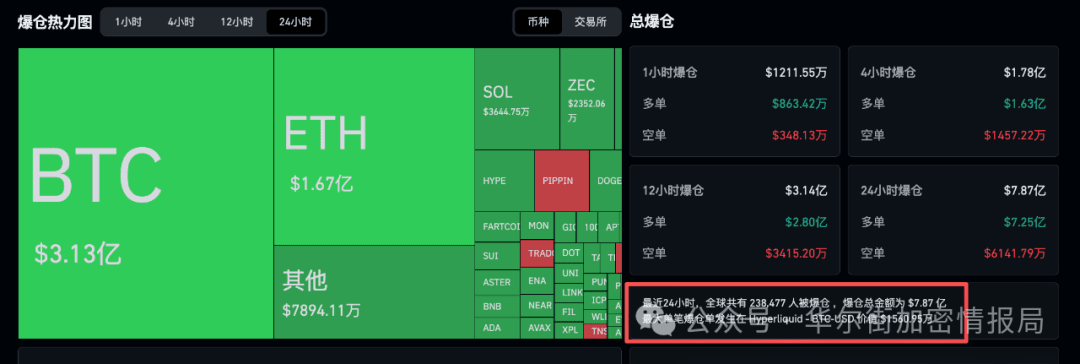
But today, with over 240,000 people and nearly $800 million in liquidation amounts across the network, it makes me reflect deeply again:
Has the trend changed? Or has BTC confirmed a bearish trend?
Is the interest rate hike in Japan in December going to exacerbate the bearish trend?
So does the Federal Reserve's rate cut in December still have a big impact on the market?
Next, Yongqi will take you to explore:
'When $14 trillion starts flowing back to its mother body, no asset is safe.' In the past 24 hours, BTC fell below $85,000, and the sentiment collapsed instantly. Many thought it was just another routine dump until a number pierced the entire market — 76%.
This is the probability given by traders: The Bank of Japan will raise interest rates in December.
When I ran through the entire logical chain again, the conclusion was only one sentence: this is not a simple correction, but possibly a precursor to a 'chain reaction' in the global financial market.
Why? Because behind it stands a long-ignored but colossal monster — the yen carry trade.
Question 1: The market has bet 76% on Japan's interest rate hike in December.
Will it exacerbate the bearish trend?
In the past week, the statements of officials related to the Bank of Japan have almost all been sending the same signal: 'We are approaching the exit from the ultra-loose policy.'
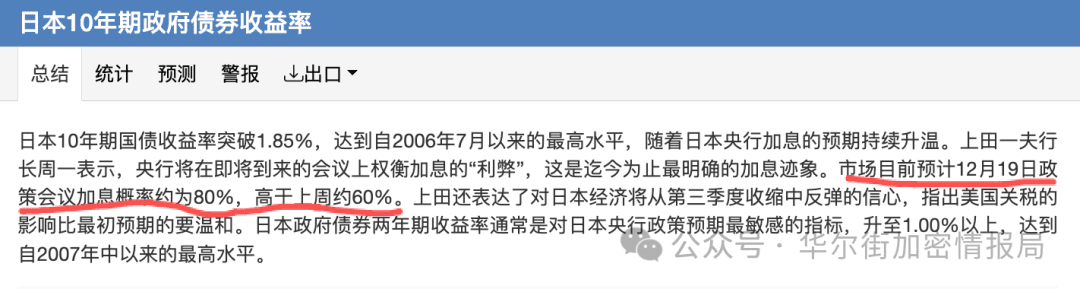
The market directly gave the probability pricing: December interest rate hike probability: 76%; January 2026 interest rate hike probability: 90%.
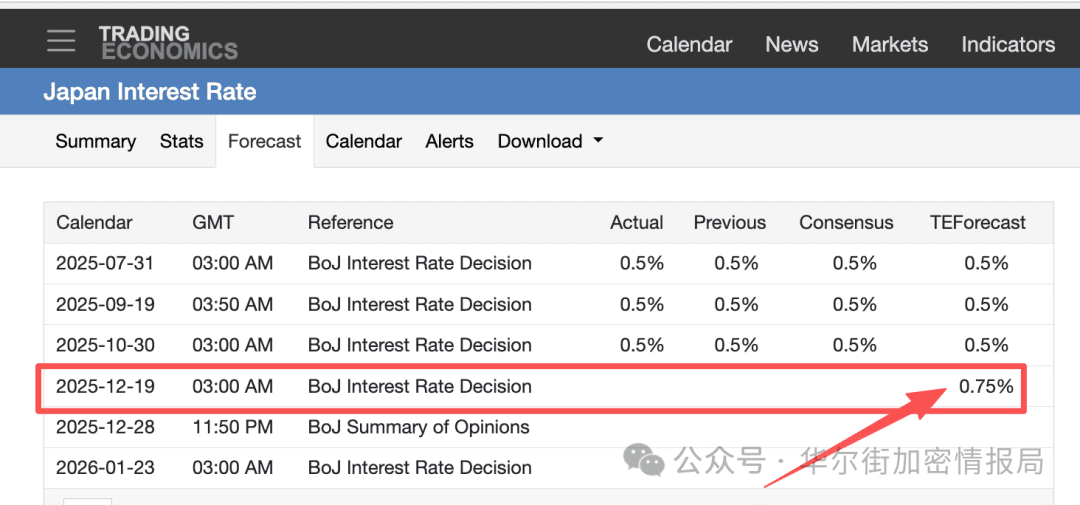
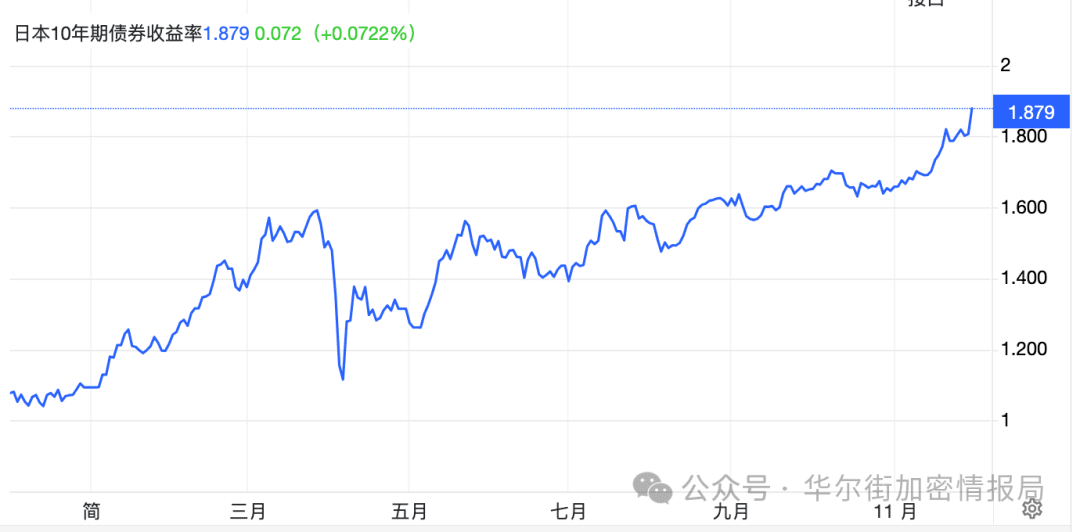
The yield on Japan's 2-year government bonds has surged to the highest since 2008. What does this mean?
The market has already told you one step ahead: Japan is really going to take action this time.
Why is Japan suddenly raising interest rates? Yongqi summarized:
1) Inflation cannot be suppressed: CPI remains above 2% for a long time, and rising wages further push costs.
2) The yen has depreciated too sharply: in the past year, it has depreciated to a record level, causing import costs to explode, and Japan's manufacturing industry is under tremendous pressure.
3) Uncertainty in U.S. monetary policy shifting: Japan does not want to become the only 'zero-interest island' in the world.
In other words: raising interest rates is not a choice, but a necessity.
Question 2: $14 trillion:
The world's largest 'invisible bomb' is about to be dismantled.
If the interest rate hike itself is not a disaster, then something will be — the forced closure of yen carry trades.
Many old-timers in the cryptocurrency circle may have heard this term, but may not realize its true scale. It is not tens of billions or hundreds of billions, but a global invisible leverage system of $4-20 trillion.
This system has lasted for decades, forming three characteristics:
Japan's interest rates are extremely low → funds can borrow yen at almost zero cost.
Convert to U.S. dollars, euros, etc. → invest in U.S. stocks, bonds, commodities, BTC, and other high-yield assets.
Earning interest spreads → becoming the largest and longest-lasting arbitrage link globally.
Simply put: 'cheaply borrowing yen → buying global assets → earning the interest spread.'
The $14 trillion liquidity is circulating in the global market like blood. It is the booster for the rise of U.S. stocks, the lubricant for the liquidity of U.S. Treasuries, and also an important behind-the-scenes force in the past rounds of bull markets for BTC.
However, now the question comes: Japan raising interest rates = this system is forced to 'reverse explode'.
That is: borrowing yen costs skyrocketing → forced to close all assets → converting back to yen → repaying debts
This process is apocalyptic, especially for: BTC, tech stocks, the foreign exchange market, and the commodity market, all will be affected.
Question 3: Will BTC directly go bearish with Japan's interest rate hike?
This question may be the one that people in our cryptocurrency circle care about the most. If it really goes bearish, then the market's panic will be far beyond the present, and this is just the beginning!
What is the relationship between Japan's interest rate hike and BTC? Let's look at the fivefold impact:
1) Carry trade closure: Forced selling of BTC for yen.
Simply put: global funds need to return to yen, and BTC is the first risk asset to be sold. This is not panic, it's mathematics.
2) Global liquidity is instantly drained.
The speed at which $14 trillion-level capital 'flows back to Japan', if confirmed to start, means: the global siphon is operating at maximum power. BTC's price originally relies on liquidity, especially the dollar funding chain. Once liquidity tightens, high-volatility assets are the first to be cut.
3) Bond yields rise, BTC's competitiveness decreases.
One of the core narratives of BTC is: 'digital gold, zero-interest assets, are most attractive in an inflationary era.'
But what if both Japan and the U.S. raise interest rates? Government bond yields rise sharply?
Zero-interest assets will be revalued. Especially those speculative funds supported by 'printing money expectations' will exit faster.
4) Crypto VCs and market makers are forced to contract.
Rising interest rates mean declining risk appetite, venture capital will reduce allocations to the cryptocurrency industry, and market makers will reduce liquidity provision. This will cause further contraction of on-chain funds.
5) The technical aspects have already collapsed.
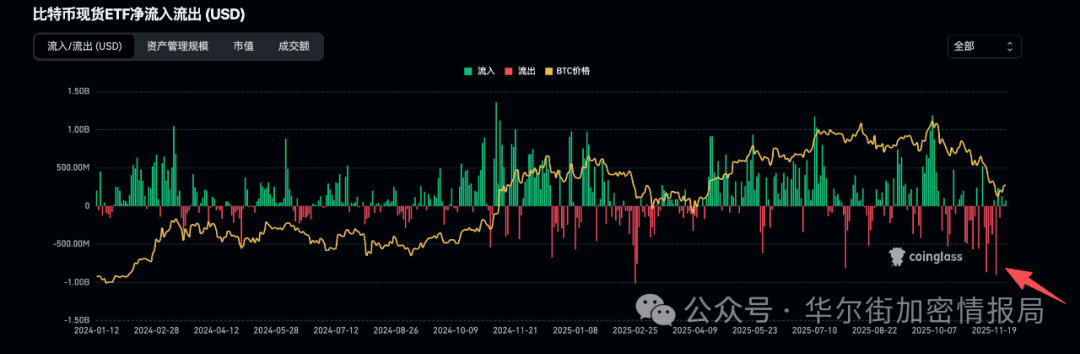
Using the simplest indicators: BTC breaks all short-term moving averages; ETFs see a continuous 8-day net outflow; leveraged long positions are continuously washed out; the market value of stablecoins stops inflowing.
Data tells us: the market's fragility far exceeds imagination
Data 1: BTC fell more than 20% in November
In October, it reached a new high of $126,700, and in November, it dropped to a low of $80,600. There was no chance for a rebound, it just went down like this, without looking back! This is the harshest single-month pullback in 2024.
Data 2: The scale of liquidations is extraordinarily shocking.
Last December, I remember during the offline event in Kunming, several massive liquidations started in the middle of the month, making everyone feel the market's panic. This year at this time is still the same. On October 11, the historical liquidation was the largest, and on November 3, the last straw was broken.
The continuous liquidation amounts have exceeded $10 billion in the past month. This indicates one thing: market leverage is much higher than you think.
Data 3: BTC ETFs have seen a continuous net outflow of $3.5 billion.
This is not retail running away, but institutions fleeing. When institutions begin to withdraw, the risk exposure of the bull market will quickly deteriorate.
Data 4: Long-term holders are reducing their positions.
On-chain data is very clear: a large number of old addresses holding for more than 5 years are selling. This is a behavior commonly seen at the top of a bull market.
Data 5: Liquidity of stablecoins is declining.
Especially: USDT issuance slows down, ETH on-chain activity decreases, and CEX stablecoin net inflows continue to be negative; without liquidity, there can be no rebound.
The data is real and the most rational. This represents the current reality!
The key question: does BTC really still have a bottom?
First, the conclusion: there is no 'bottom' in the short term, only 'ranges.' To see the real bottom, I think three conditions are needed:
Condition 1: The Bank of Japan meeting is finalized (12/18–19)
As long as the market still expects interest rate hikes, funds will not flow back to risk assets. If there is ultimately no rate hike? BTC will immediately surge.
If there is really a rate hike? BTC will plunge again, but 'the bad news will land.' The key position for the decline is at $75k for BTC, which is also the lowest point in 2025. Last time, buying at this position was very strong.
I don't know this time, if it happens can we hold on!
Condition 2: The U.S. Federal Reserve meeting in December
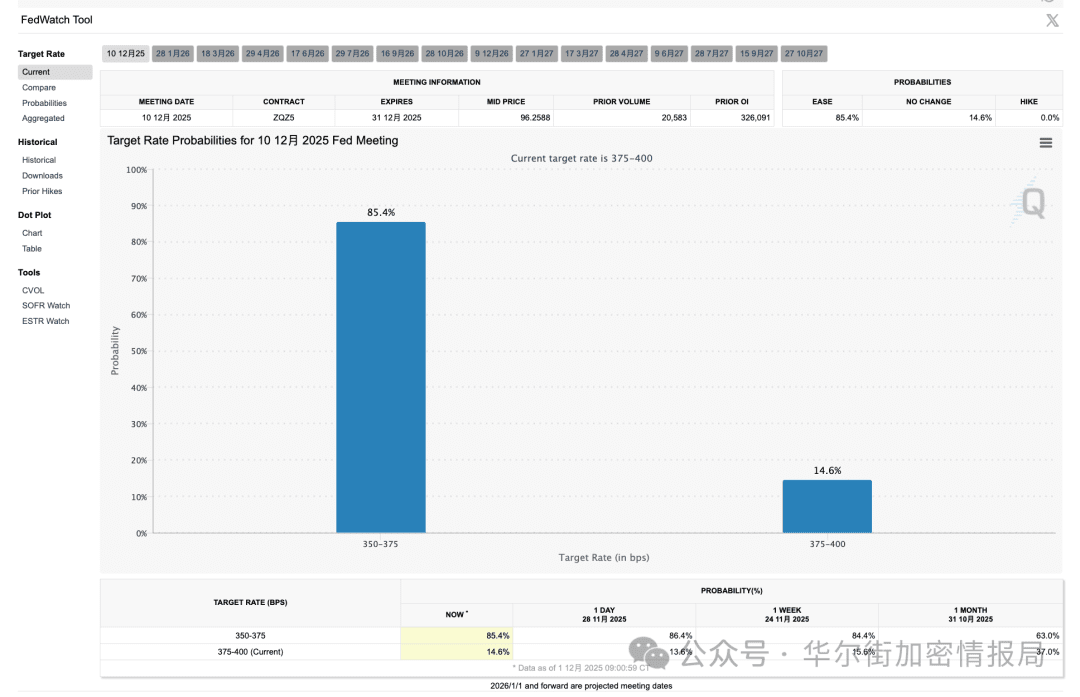
The probability of the Federal Reserve lowering interest rates by 25 basis points in December has exceeded 85%.
If the Federal Reserve: releases a signal to cut rates → BTC immediately rebounds;
Hawkish → combined with Japan's rate hike = double whammy.
The worst-case scenario is: Japan raises interest rates + the U.S. does not cut rates. This will lead to another round of slaughter for all risk assets.

Condition 3: the carry trade closure is completed
Be aware that carrying out forced liquidations is a round of shocks, not an eternal state.
You can compare: August 2024: Japan raises interest rates → BTC plummets. Three months later: BTC reaches an all-time high.
I once wrote an article: How did the entire cryptocurrency market perform after the 8·05 disaster? — Let's take a look at the data analysis.
Why? Because: a round of forced liquidation is one-time and not trend-based.
When this wave of panic ends, BTC will regain its rhythm.
The ideal outcome is: in December, the Federal Reserve cuts interest rates by 25 basis points, then on the 19th Japan does not raise rates, and then around mid-January 2026, there is likely to be a decent market.
Otherwise, this market will at least have more than three months of fluctuating panic emotions.
The most important content: what should investors do now?
First: don't easily try to catch the bottom
I know this sentence is harsh, but there are no signs of stabilization in the market right now.
What are the characteristics of the bottom?
Volume declines → Low volume consolidation (not happening now); stablecoin inflows (not happening now); ETFs turning into net inflows (not happening now); volatility decreasing (currently increasing in the opposite direction).
Now is not the time to increase positions, but to take on more risk.
Next is: controlling positions, protecting yourself.
You must always remember the first truth in the cryptocurrency circle: 'Surviving is more important than being right about the direction.' During this period, having a light position is an advantage, not a disadvantage.
Finally: don't forget that the long-term logic of BTC has not changed.
Short-term may be hell, but long-term is still paradise. Because BTC's long-term logic remains solid:
A global sovereign debt crisis is inevitable.
The impact of the halving will truly manifest in 2025.
U.S. ETFs are still continuously absorbing.
Corporate balance sheets are turning towards BTC.
Structural inflation in the world is difficult to disappear in the long term.
A short-term plunge is just an energy release in a long-term bull market.

Yongqi concludes with one sentence: Panic is not a bad thing; it's the beginning of opportunity.
What you see is the decline. Old hands see the behavior of funds.
Every round of sharp declines is fuel for the next round of rises.
The question is not whether BTC will rise.
The question is — can you 'survive' before the next bull market arrives?
May you remain calm in the fog, rational in the bear market, and patient in the volatility.
Because only in this way can you become the one who sits until the end.
Deep observation · independent thinking · value is more than just price.
Star mark #WallStreetCryptoIntelligence, don't miss good content ⭐
Finally: many points in the article represent my personal understanding of the market and do not constitute investment advice.

