
The People's Bank of China reiterates its call for a crackdown on cryptocurrency speculation—the underlying logic and historical context of the central bank's policies in 2025.
The phrase "crack down on speculation" has once again ignited the market's sensitive nerves.
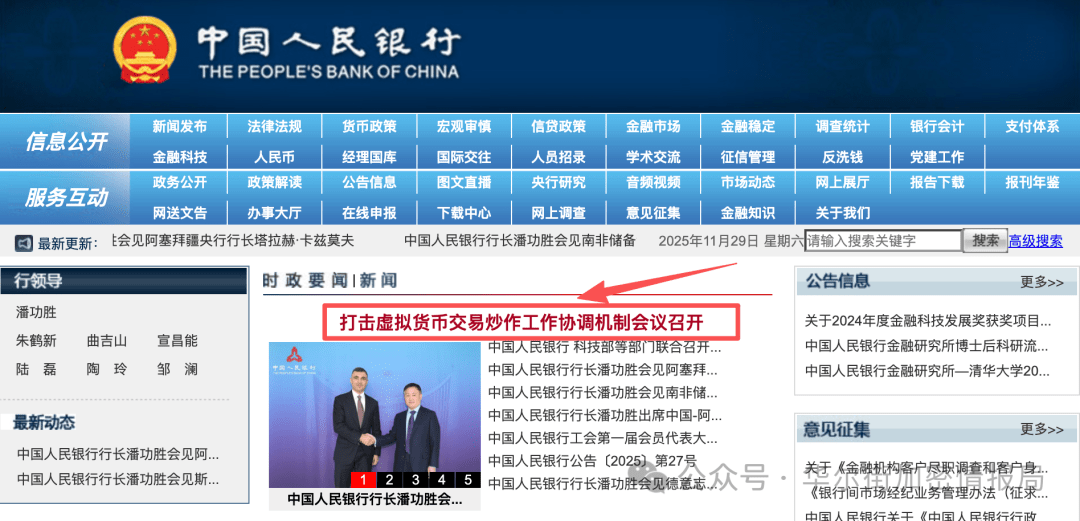
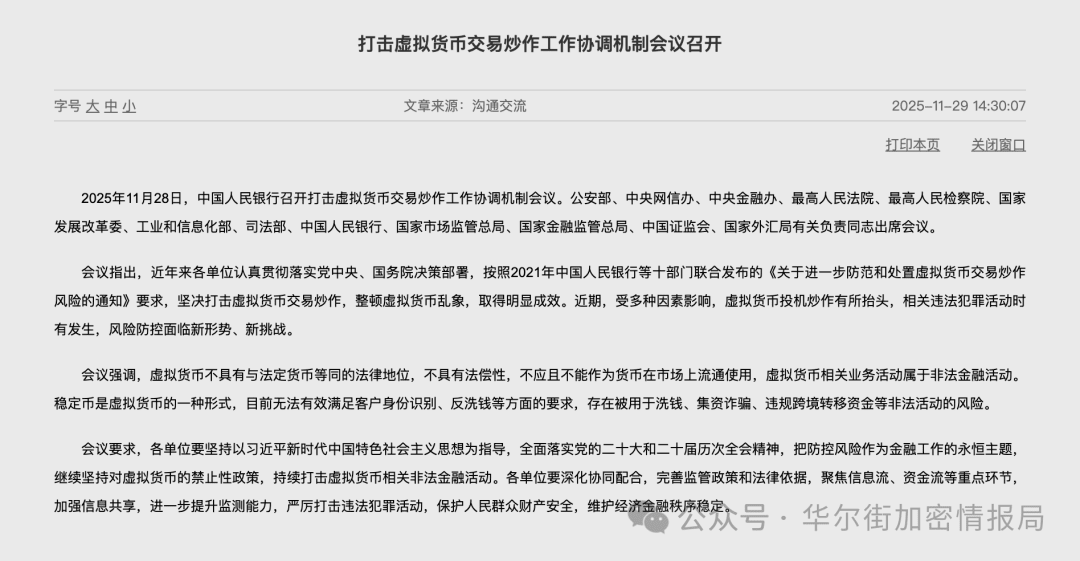
At the end of November, the People's Bank of China reiterated that it would continue to crack down on speculation in virtual currency trading to prevent the spillover of financial risks.
This statement alone is enough to put the entire crypto industry on alert in an instant. But what makes 2025 special is that: China's monetary policy, international financial competition and cooperation, the AI and payment technology revolution... these factors are all overlapping in the same time window for the first time.
So today, we'll explain this matter thoroughly:
1) Why did the central bank make a "tough stance" at this juncture?
2) What was the main policy theme of the central bank this year?
3) What will be the future relationship between China and the crypto industry: tightening or structural opening?
By reading this article, you will understand the logic behind China's cryptocurrency regulation over the next three years.

I. Why has the People's Bank of China reiterated its emphasis on "cracking down on virtual currency speculation"?
The regulation in 2025 will not suddenly tighten, but rather the background will have changed profoundly.
The following three contexts are particularly crucial:
① A rare structural contradiction has emerged in China: "stabilized asset prices + weak consumption".
Since the third quarter of this year, the Chinese economy has faced a delicate situation: real estate transactions have rebounded and asset prices have begun to rise, but consumer spending remains weak and investment confidence is insufficient. Meanwhile, speculative demand from younger generations is clearly spilling over: the number of accounts opened on overseas exchanges has increased, cryptocurrency communities have seen a surge in activity, and stablecoin OTCs have regained popularity.
From the central bank's perspective, this sends a dangerous signal: money isn't flowing into consumption or the real economy, but instead is being used to speculate on volatile assets. This violates the core task of China's current economic recovery: "funds must enter the real economy, not speculative channels." Therefore, the central bank must speak out.
② Cross-border capital flows involving virtual currencies have become a key focus of regulation this year.
In 2025, the core themes of China's foreign exchange management will be: "Blocking illegal outflows + Controlling speculative arbitrage + Protecting genuine trade."
Among all cross-border channels, cryptocurrencies have three major regulatory pain points: difficulty in tracing their origins, lack of transparency regarding their destination, and ease of cross-border transfer.
Some individuals are using OTC transactions, stablecoin trading, CEX-to-CEX transfers, and "third-party payment + U" schemes to circumvent foreign exchange controls. This is precisely an area where the central bank cannot afford to ignore.
③ New financial risks brought about by the internationalization of stablecoins
What will be the biggest black swan event of 2025? The Trump family – openly issuing stablecoins.
The emergence of World Liberty / World Finance signifies that: the United States is using stablecoins as a strategic financial weapon; the digital influence of the US dollar is increasing; and global on-chain clearing and payments will be rapidly restructured.
This means for China that the "penetration" of the digital dollar is increasing, and the cross-border flow of risky assets is becoming more covert.
Therefore, regulators will inevitably tighten controls on virtual currency-related activities.
II. What is the main policy theme of the central bank this year? Why is regulation being tightened?
If you connect all the central bank's policies in 2025, you'll find that the main theme of China's monetary and financial policies can be summed up in one word: stability. But this "stability" is not passive stability; rather, it involves stabilizing expectations, stabilizing the market, stabilizing cross-border capital flows, and stabilizing systemic risks.
Let's break it down logically:
① Monetary policy: Loose, but by no means "unlimited looseness"
2025: Multiple reserve requirement ratio cuts, multiple reductions in the loan prime rate (LPR), and ample counter-cyclical adjustment tools.
It appears to be a comprehensive effort to protect the real economy. However, the central bank's stance has always been clear: easing is acceptable, but the flow of funds into high-risk speculation will absolutely not be allowed. This statement directly targets: virtual currencies, cross-border speculation, and illegal financing.
In other words, the money should flow to the real economy, not to Binance, OKX, or Bybit.
② RMB internationalization: Expand cross-border settlement, but will not liberalize virtual assets.
The use of RMB in cross-border trade reached a new high this year: ASEAN trade, Middle East energy trade, BRICS clearing, and the Hong Kong offshore RMB market all showed structural growth.
However, the central bank's logic is very clear: it aims to expand the real trade settlement of RMB, rather than expand the circulation of speculative assets.
This means: supporting cross-border RMB payments; supporting offshore RMB innovation; and supporting the Hong Kong Financial Lab.
However, it does not support the path of "converting RMB into USD and then flowing out".
③ Comprehensive Upgrade of Fintech Regulation: Penetrating the Risks of Virtual Currencies
The three bottom lines of regulation in 2025: anti-money laundering, anti-illegal fundraising, and anti-cross-border capital flight.
Cryptocurrency transactions fall under all three red lines. This is because crypto assets inherently possess the characteristics of speed, anonymity, decentralization, and cross-border mobility. In any country's financial regulatory system, these would be labeled as "high-risk."
Third, the regulation of virtual currencies is not a complete ban, but rather "bottom-line management".
China's position has been consistently misunderstood. The real logic is: not to interfere with technological innovation, nor to intervene in the development of traditional blockchain, but only to crack down on: speculation, excessive leverage, illegal cross-border activities, and financial spillover.
The three bottom lines are very clear:
Bottom line one: Systemic risks must not be created.
Cryptocurrencies are extremely volatile, and if leverage explodes, it will cause social risks, so it is impossible to relax restrictions.
Bottom line two: Do not interfere with the main line of monetary policy.
The key to China's monetary policy in 2025–2026 is: controlling risks, expanding credit, and maintaining market stability; overheated speculation in virtual assets will disrupt this main theme.
Third bottom line: It must not become a channel for capital outflow.
This is a point of constant concern for regulators: stablecoin arbitrage; USDT wash trading; and cryptocurrency exchange for foreign currency. These are all red lines.
IV. Will China open up encryption in the future?
The answer is: Yes, but not the kind of openness you're thinking of. Over the next three years (2025–2028), China will experience four types of "structural openness":
① RWA (Real-World Assets) becomes a key breakthrough point
China will promote: on-chain bond issuance; on-chain corporate asset issuance; on-chain supply chain finance; on-chain real estate registration; and on-chain public data services. These are national strategic-level blockchain applications. They will be open, but no cryptocurrency will be issued.
② Blockchain will be deeply embedded in financial infrastructure
These include: interbank trading systems, data ownership confirmation, cross-border clearing, and increased transparency in financial auditing; these will become increasingly common.
③ Hong Kong will continue to serve as a "compliant crypto finance center".
Hong Kong's role is very clear: to serve as a bridge for China's participation in international crypto and asset tokenization, rather than allowing the mainland to directly access cryptocurrencies.
This is essentially: "The mainland guards against risks, while Hong Kong opens up."
④ China will allow Web3 + AI + payment companies to develop application-oriented innovations.
This is a combination of "open technology + closed currency".
V. Conclusion: The central bank's core logic is simple, but it has been misunderstood for many years.
To put it simply: China is cracking down on "cryptocurrency speculation," not "blockchain technology," much less "digital economy innovation." Remember these three key points:
① China will not allow cryptocurrencies to become a major channel for cross-border capital outflows.
② China will not allow the price of crypto assets to interfere with the main goal of stabilizing economic growth.
③ China will advance its Web3 strategy through “Hong Kong + RWA + financial infrastructure”.
In conclusion: China is not against encryption; what China opposes is "high leverage + speculation + illegal cross-border transactions".
When you apply this logic to policy, you'll find that all regulatory actions become rational and predictable.
In-depth observation, independent thinking, and value that goes beyond price.
Star#WallStreetCryptoIntelligenceBureauto never miss great content ⭐
Finally: Many of the views expressed in this article represent my personal understanding and judgment of the market and do not constitute investment advice for you.
