

When the BTC price fell below 100,000, 90,000, and reached a low of 81,000 USD, you would always hear a voice beside you: 'Brother, I said long ago, the bear is here!' 'It's a bear market, and you still hold onto it?'
Actually, at this moment, I just want to silently reply to him: Brother, are you experiencing the big purge of 10.11, bringing you back to before liberation! The bull and bear market no longer has anything to do with you.
When the market once again stood above 90,000 USD in these past two days, he said again: 'The end of the year market may break through 200,000 USD. The 80,000 position has already been confirmed as the bottom.'
In the past ten years, I have experienced various ups and downs since entering the market in 2016, achieving eight-digit gains from contracts, only to see them go to zero! It took me five more years to reach the current point.
I have seen various extreme emotions in the crypto circle for eight years. I am not numb, but gradually understand: it's not that people are unwilling to believe in the future, but when the bear market comes, they dare not believe in the future.
But the reality is quite the opposite: when we discuss prices, we are never discussing the present, but the market's discounting of the future. Prices are a compressed package of future expectations, not a snapshot of the present.
If you only focus on K-lines, you will always miss the real future. You live in a world of anxiety every day!
More importantly, in a bear market, most people see declines; while I see - layering, filtering, and reordering. Emotions recede, the tide goes out, skeletons are exposed, and trends are rewritten.
At the same time, I am also thinking, why are there more and more new projects but fewer and fewer truly meaningful things?
We all know the industry is going to change, but how will it change?
This article is not just hype, nor am I shouting that 'the bull market will return'.
Yongqi, as a builder in the industry, has written over 500 crypto articles.
Also a long-term holder in this industry, I have been in this field for 10 years and have never left. If it weren’t for the eight-digit liquidation in 2020, I might have already exited the circle.
What I hope to do now is: take you to a higher position to see where the true navigation path is after the tide goes out.
A bull market is noisy; a bear market is a magnifying glass, microscope, and revealing mirror.
In the mist of emotions, I want to take you to a higher position to see where the future navigation path is after the tide goes out.
First, why say: the bubble is actually the biggest positive for 2025?

In 2025, there is a fact that everyone can feel but is unwilling to admit: we did not wait for the 'altcoin bull market', but instead waited for a round of systematic de-bubbling.
This may sound like a bad thing, but if you extend the timeline, you will find that the years without growth but initial kills are often key years for industry structure maturity.
Why? Because everything about crypto is actually replicating the trajectory of the early internet, only accelerated by 5 times or 10 times by leverage.
The simplest way to understand it is to treat crypto as 'an accelerated version of the early internet'.
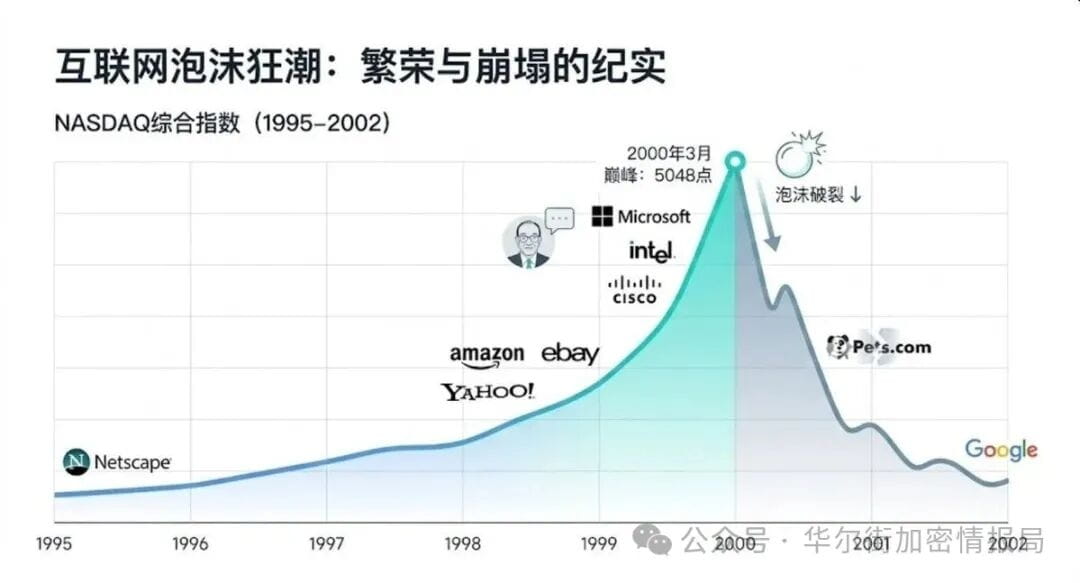
In fact, if you look closely here, the amplified leverage efficiency is a common feature from Web1.0 to the Web3.0 era we are discussing today, and in the past decade of crypto, the underlying logic of both is the same.
1.1 The internet also went through the same: incomprehensible → craze → collapse → rebuilding.
In 1999, as long as the name had '.com', you could get funding. The company's stock surged 900% on its first day of listing; investors were crazed, not much different from the boom of altcoins.
Then the bubble bursts. The Nasdaq fell from over 5000 points to 1114 points. The media cover read: 'The internet is a scam.'
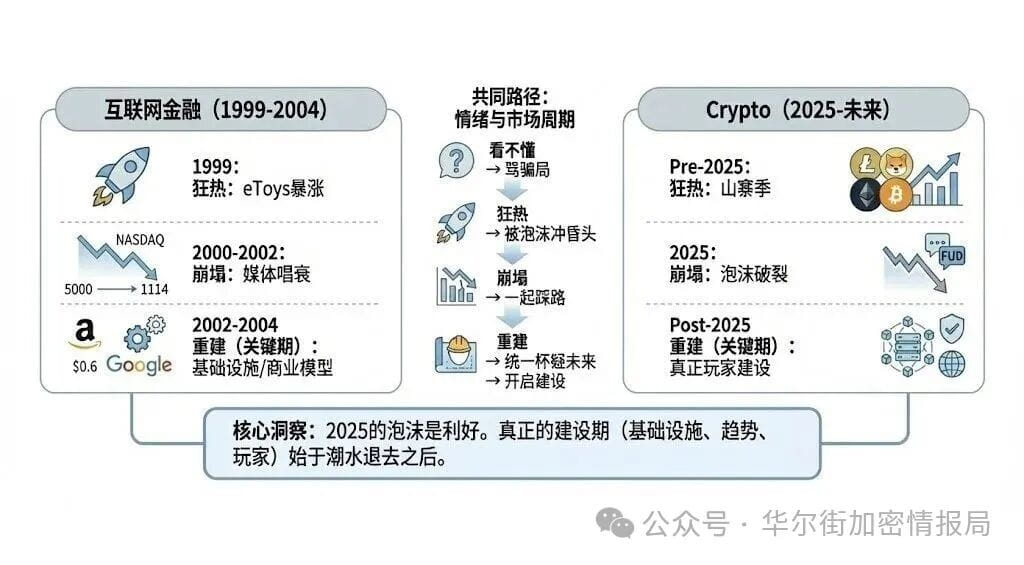 Everyone is starting to doubt the future. Does it sound familiar?
Those who can’t understand call it a scam; those who can understand are also confused by the bubble!
Finally, a collective trampling; then a collective suspicion of the future itself.
But ironically: the true internet era began the moment the bubble burst.
Amazon fell to $0.6, and Google had not gone public yet. The least visible years were actually the years when infrastructure, business models, and profit logic were all rebuilt.
The year 2025 for Crypto is almost identical to the years 2002–2004 for the internet.
This is why I say: the bubble of 2025 is not a negative, but a positive. Only when the tide goes out will the true value and direction emerge.
1.2 'The negation of the negation': the industry is never linear but spirals upward.
Technology is never a straight line; it progresses like this: step back two steps, move forward three steps; returning to a similar point but at a higher level.

The most typical case: three iterations of computing architecture.
Mainframe: centralized power.
The PC revolution: the first denial of decentralization.
Cloud computing: centralized 'the negation of the negation'.

It seems to have returned to concentration, but in fact, it is at a higher structural level. Crypto is the same:
No one understands, but the direction is vaguely appearing.
Everyone is fervent, and the bubble is soaring (we just experienced this).
The bubble bursts, spiraling upwards (2025 is happening).
You think the industry 'has returned to the past'? In fact, it is starting over at a higher 'origin'. Trends, technology stacks, capital structures, and regulatory paths are all being rearranged in this round.
2025, the most important signal before the next round begins.
Second, 2025 is the prologue; 2026 is the main text:
The real trend of the industry is taking shape.
Whoever solves the directional issue of (Crypto x traditional finance integration) will possess the world for the next five years!
The feeling of 2025 is actually very strange.
K-lines resemble a bull market, but emotions resemble a bear market;
Regulation is advancing, but expectations are declining;
Narratives are flying everywhere, but making money is harder than any other year.
The deepest judgment this year is: Crypto Native innovation will reach a bottleneck.
The true explosion in the next five years will come from the complete integration of Crypto and traditional finance.
In other words: the engine for the next bull market is not memes or Layer 2, but RWAFi, compliant stablecoins, and on-chain financial infrastructure.
2.1 Everything happening in 2025 points to one thing: the industry is 'restructuring its skeleton'.
When BTC was at $126,000, everyone was looking at $200,000, but little did they know this was a short-term peak. Just like I only have a few BTC and haven’t sold, still holding, luckily at around $4,880, I sold ETH and bought it all back below $3,800. My strategy is: before 2030, I will just increase my coin holdings!
The biggest problem is: this round, we did not wait for the crazy tenfold or hundredfold altcoins! In the last round, there were many such tokens, so in this round, the bulls you see seem to only be: BTC moving! ETH hasn’t even broken its last round's high!
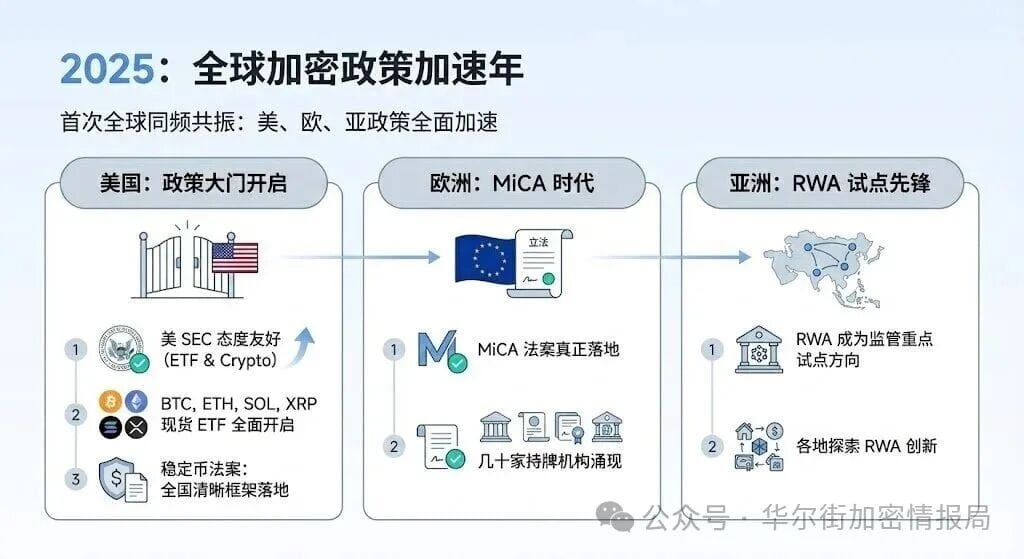
But when you look at 2025 from a 'structure' perspective, this year suddenly becomes very clear: this is the first time that global regulation collectively enters 'acceleration mode' in the same year: remember, regulation is always a positive!
The U.S. SEC's attitude towards Crypto is warming.
BTC/ETH/SOL/XRP spot ETFs are fully opened.
The stablecoin bill provides a compliance framework across the U.S.
Europe's MiCA has landed.
RWA becomes a key pilot for global regulation.
Crypto is being integrated into the center of the global financial system for the first time. Do you remember the title of the article? When we talk about prices, we are talking about the future.
And the future has already given the answer: the story of the next round of the market is called: the great integration of Crypto and TradFi.

2.2 High track heat, weak prices; this is a typical 'verification period'.
The stablecoin track list for 2025: RWA, AI, stablecoins, on-chain asset management, perpetual contracts, DAT.
Every word can excite the market in the short term. But excitement aside, prices don’t go up.
Why? Because: 2025 is not a 'realization period' but a 'verification period'. What the market wants to see is not concepts but actionable frameworks.
The true significance of 2025RWA: the infrastructure layer completes the puzzle. These sound boring, unable to create FOMO. But you must understand one thing: 2026's RWA-Fi can only run.
This is why I say: 2025 is a prologue. 2026 will be the main text.
Three, AI × Crypto:
There are not many truly valuable parts, but the value density is extremely high.
To put it bluntly: the AI track looks lively, but there are actually very few things of true value.
3.1 There are too many pseudo-issues.
Let’s first discuss the LLM that most excites the market. I honestly say: the traditional AI large model stack has matured to an extent that Crypto simply cannot compete.
What are ChatGPT, Claude, Gemini, and DeepSeek burning behind? It is truly billions of dollars worth of GPU clusters, data systems, and model talent density.
Are you going to challenge OpenAI with a single chain? Are you going to compete with NVIDIA using one token? Are you going to confront Crypto projects that raise hundreds of thousands of dollars against models built with billions?
This is not innovation; this is [using a knife to rob a battleship]. More critically: the core moat of AI is computing power, data, and a closed loop of model training, not tokens.
The token economic model of Crypto is mostly a pseudo-demand in LLM narratives. Many narratives you see:
'Let model weights go on-chain.'
'Let model training participate in DeFi.'
'Use tokens to incentivize computing power distribution.'
'Use on-chain data to train models.'
It sounds grand, very futuristic. But on the engineering level, one sentence breaks it: a cluster that can run GPT-4 does not need you to issue an ERC-20 to 'incentivize computing power'.
This is like asking Apple to move the iPhone's supply chain to a DAO: you are creating an illusion, not solving a problem.
3.2 So where is the true value of AI × Crypto?
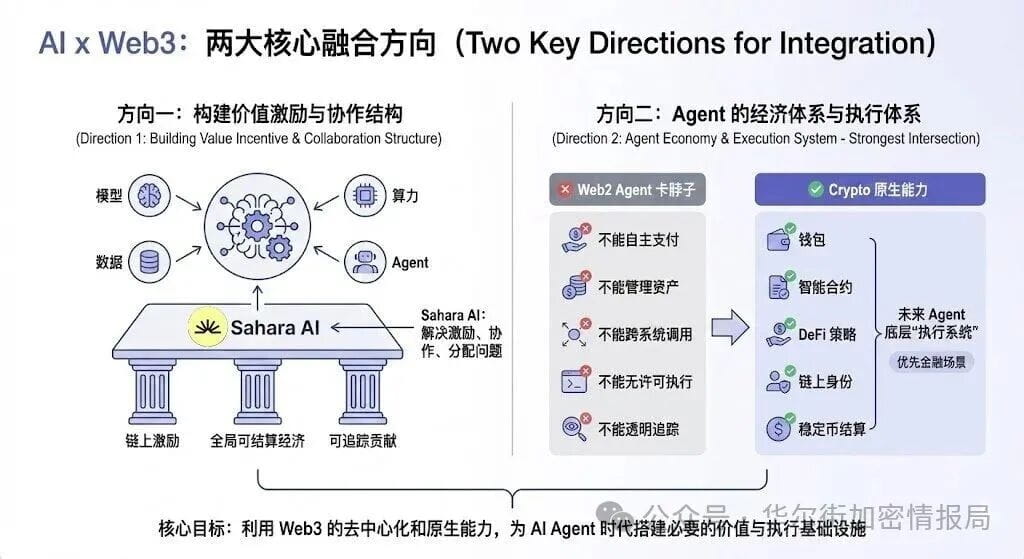
So does AI × Crypto have no value? Of course not.
The truly valuable parts have only one direction: AI is not 'running models on-chain', but 'running economies on-chain'.
In other words - AI does not need chains to help it improve computing power, but needs chains to help fill in the 'agent economic system'.
All previous economic participants were humans, and now for the first time, there are 'non-human economies', which are AI Agents.
These agents will have: budgets, revenues, decision-making, consumption, investment, and behavioral loops.
What does this mean? It means that an automated economic system will emerge between AIs in the future.
At this time, the importance of the chain is not 'running models', but rather: the chain is the only system that allows AI to have 'assets, permissions, and contract execution capabilities'.
You cannot give an AI Agent a bank card, set up a company, or sign a contract. But you can provide it with: a wallet, smart contracts, strategies, access controls, and execution permissions.
This is why I repeatedly say: traditional AI large models belong to Web2, but AI economics belongs to Web3.
AI Agents will not open bank accounts by themselves, nor will they run legal processes by themselves; but they can master a wallet, operate a set of smart strategies, and execute transactions on-chain.
Human economic behavior has been automated on-chain; AI's economic behavior is self-organizing on-chain. This is the true 'AI × Crypto' golden crossover point.
3.3 The true value of tokens is not 'incentivizing', but 'coordinating'.
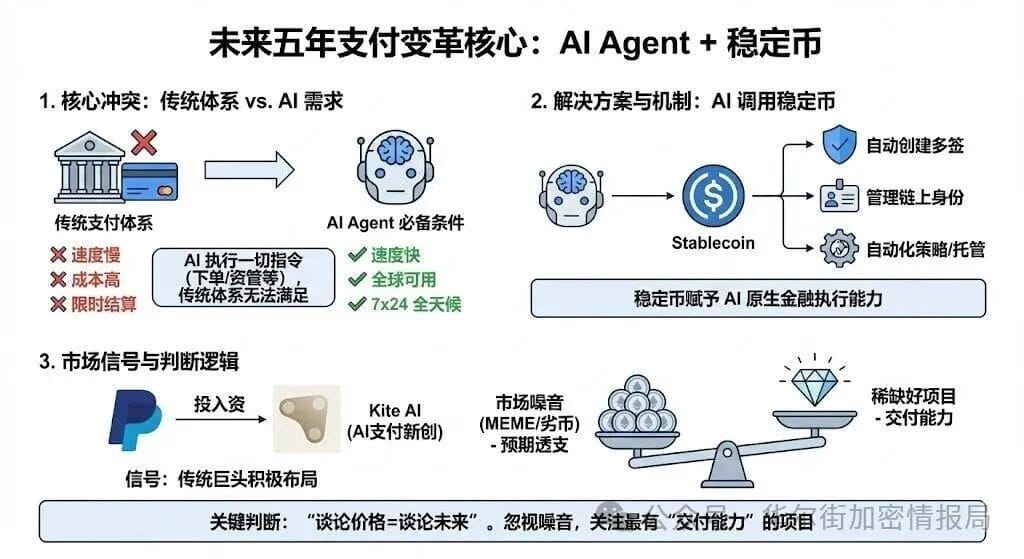
The strongest function of Crypto's tokens in the AI era is not 'incentivizing', but 'coordinating'.
The number of AI Agents will grow from millions to billions. They need a unified economic language and a unified value protocol.
Tokens are this 'coordinating layer'. They are the economic language of agents.
The real question today is never 'how many agents does it serve today', but in the AI-led future economic form: who is already building the foundational capabilities needed for the future? Who is laying the groundwork for the value network in the AI era?
It's like after Coinbase released the 402 protocol, dozens of 'cryptographic new projects' emerged within days. Bad coins will preemptively overdraw the market's expectations because when people discuss prices, they represent their own visions of the future.
The issuance efficiency of the industry, the prosperity of Crypto driven by memes and junk coins, also makes it more difficult for entrepreneurs.
However, good projects in the market are always scarce, and in this regard, raising the threshold for entrepreneurship is not necessarily a bad thing.
When this happens, AI × Crypto will transition from the pseudo-issue period of 2025 into the systematic explosion period after 2026.
Fourth, stablecoins: the most cognitive early stage of 2025.

If there is a track that must be 'quietly but must be emphasized' in 2025, it is stablecoins. I have also specifically written several articles about stablecoins.
Circle: an undervalued global monetary infrastructure company.
Valuation of $500 billion, refinancing of $20 billion!! - the stablecoin giant Tether.
The second-largest stablecoin issuer, Usdc Circle, goes public - the crypto world welcomes a compliance milestone.
Currently, stablecoins are still in the early narrative stage, the market does not understand it, and the vast majority of stablecoin-related projects that emerged in 2025 are neither stable nor applicable. I believe the market has not yet entered the real FOMO stage.
First, the most eye-catching stablecoin event of this year is not USDT or central bank digital currency, but - the Trump family issuing coins.
Yes, you read that right. The hardest punch in the stablecoin track in 2025 is that the Trump family issued stablecoins: World Liberty / World Finance.
No unnecessary explanations, no lengthy white papers. The less content, the bigger the matter.
Because in the crypto circle, everyone understands: when a certain family no longer needs to explain 'why', then everything they do is not a project but a signal.
What does the entry of the Trump family into stablecoins mean?
Stablecoins are entering the 'political capital' era from 'company products'.
The narrative of the digitization of the dollar has been directly incorporated into the American political system.
The future competition of stablecoins will no longer be a 'competition of on-chain TVL', but a struggle for 'national influence'.
American politicians are beginning to realize: stablecoins = tools = weapons = digital extensions of dollar hegemony.
In summary: the Trump family's issuance of coins is telling the world: the future of the dollar is not in banks, but on-chain.
Second, the real demand scenario for stablecoins in 2025 is quietly but violently exploding.
The stablecoin track appears calm on the surface, but the underlying logic is undergoing structural changes. You think it's 'speculating on stablecoins'? In fact, AI, cross-border e-commerce, RWA, institutional finance, and exchange scenarios are driving stablecoins to become the foundational settlement layer of the global digital economy.
A, Treasury reserves become mainstream → Compliance accelerates.
The biggest trend in 2024–2025 is: stablecoin reserves fully transitioning to U.S. Treasuries. USDT, USDC, FDUSD, PYUSD... all major issuers are beginning to: strengthen reserve audits, abandon high-risk assets, increase the proportion of U.S. Treasuries, and actively approach regulation and institutions.
Why? Because U.S. Treasury yields are stable, safe, and can become an internationally recognized asset for 'large-scale settlement'.
In other words: stablecoins are transitioning from 'private products' to 'quasi-state financial infrastructure'.
B, on-chain payments are 'forced to upgrade' by AI Agents.
This is the key point that many people overlook. AI is not 'empowering stablecoins'; rather, it is directly forcing stablecoins to evolve rapidly.
Why? Because: AI Agents will place orders by themselves, automatically procure resources, automatically deploy services, and make cross-platform payments, needing real-time settlement 24/7.
Are you going to let an AI Agent use a credit card? That's a joke. Are you going to let it wait for bank settlements? Impossible. What AI Agents need are: instant deductions, instant arrivals, and low-cost large-scale transactions.
What is that? It's not Visa, not PayPal, but on-chain stablecoins.
Moreover, this is not just a Web3 issue; it is a hybrid market of Web2 + Web3: cross-border SaaS, global content payment, automated supply chains.
When on-chain payments mature, the ceiling for stablecoins is not $100 billion, but a global payment network on the scale of $10 trillion.
Stablecoins first appeared with 'structural layering'; previously, everyone discussed stablecoins with only one question: 'USDT or USDC?'
It's different now; clear stratification has emerged since 2025:
① Centralized stablecoins (USDT, USDC) - moving towards regulation, institutions, and policy scenarios.
Large enterprises, financial institutions, governments, and sovereign funds use this type of coin. It is the 'digital extension of the dollar'.
② Exchange stablecoins (FDUSD, Binance series) - serving trading, issuing new tokens, and high liquidity scenarios.
Characteristics: fast, cheap, can issue new tokens, can act as a matching counterparty.
What you see on CEX regarding 'stablecoin competition' is essentially: a reserve war for exchanges + a settlement rights war.
③ On-chain native stablecoins (DAI, USDL, sDAI series) - the local currency of DeFi scenarios.
Instead of U.S. Treasury bonds, use on-chain assets as collateral. Characteristics: transparent, censorship-resistant, decentralized. This is the national currency of Crypto natives.
④ RWA stablecoins (collateralized by funding pools) - needed in institutional and financial market scenarios.
When U.S. Treasuries, notes, and even real estate assets go on-chain, they will naturally generate 'credit-type stablecoins'.
Usage: on-chain staking, settlement, mortgage financing, financial clearing - these are bank-level scenarios.
⑤ Payment-type stablecoins - the kind most needed by AI Agents and cross-border e-commerce.
They emphasize: high TPS, low fees, universally applicable across chains.
This will become the foundational settlement currency for ultra-large-scale businesses. Its market size will far exceed that of the crypto industry itself.
Third, 99% of the virtual power of stablecoins is just junk projects riding the hype.
Once a track begins to be noticed, there will be a collective rush of 'pseudo-stablecoin projects' to deceive quick money.
Their tricks: create a white paper, add some subsidies, increase TVL, claim to have an 'innovative model', and then run away after getting listed.
In essence: packaged like a product, operated like a Ponzi scheme.
Users will short-term FOMO. In the medium term, they will be disappointed with the stablecoin track. In the long term, the real giants will rise during the downturn.
The core values of stablecoins boil down to two points: stability; utility.
If you can't even achieve: real reserves, scenarios, and consensus, then no matter how many white papers you issue, it is a waste.
Some might say, 'Isn't USDT also not strictly 1:1?'
Yes, but the consensus level of USDT is something that money cannot buy.
That’s because:
USDT is the world's largest shadow bank for U.S. dollars.
Usage scenarios are spread across 200+ countries.
OTC, cross-border trade, and small payments all use it.
Exchanges, miners, and gray economies all rely on it.
The key point: currency is about consensus in use, not asset structure. If everyone believes it is stable, it becomes stable.
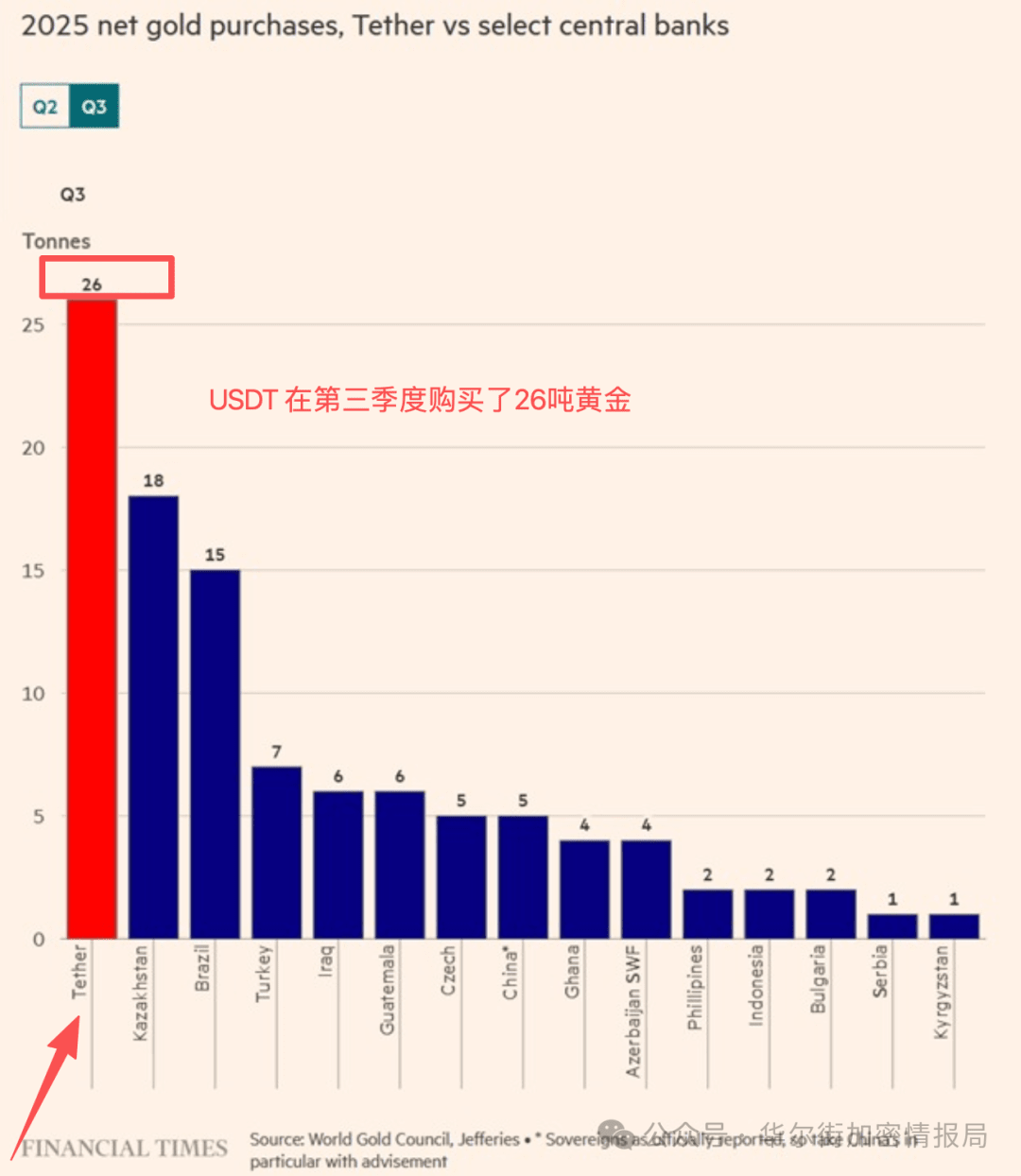
Fourth, the explosion of stablecoins is more fierce, stable, and long-lasting than anyone imagines.
In the next 3–5 years, the development of stablecoins will not be linear but will structurally explode:
① Policies are accelerating implementation; governments around the world are beginning to view stablecoins as strategic assets.
It's not regulatory hostility; it's regulatory takeover. What you see is compliance, but behind it is a game.
② Financial institutions enter, treating stablecoins as 'on-chain U.S. dollars'.
Banks, brokerages, funds, and clearing institutions will treat stablecoins as: settlement certificates, collateral, and cross-border clearing channels.
③ AI Agents, cross-border e-commerce, and local life payments are all starting to use stablecoins.
What you see now is just the beginning. In the future, any AI application that involves 'automatic payments' will ultimately have to turn to on-chain.
Stablecoins will become the currency language driven by AI economics.
④ New users entering Crypto find stablecoins the easiest to understand.
This will create immense growth. Stablecoins will be the first asset for the vast majority of new users entering Web3.
⑤ Stablecoins = RWA × Traditional finance × Crypto's super fusion point.
It can be said that stablecoins are the common entry point for all future tracks. I would like to define: stablecoins are the 'underlying fuel' of the entire future crypto industry.
Whoever can master the underlying infrastructure of stablecoins will hold the core power of the future digital economy.

Fifth, when we talk about prices, we are actually talking about the future.
How to reverse-engineer current opportunities using 'the next five years'? By this point, you should already feel one thing:
If you agree with my statement that the most important main line in the next five years is: the complete integration of Crypto and traditional finance, then during the bear market, we should shift from focusing on secondary price adjustments to considering industrial value opportunities and pricing these matters.
Just like the earliest MATIC in the L2 sector (later renamed Polygon), which once broke even and fell to $9 SOL. In a bear market, watching prices causes anxiety, while seeing future value opportunities brings joy.
From the market's perspective, what is pricing? It is pricing emotions; it is pricing the fluctuations of expectations; it is pricing the heat of narratives.
But I believe that the real value low is determined by who is laying the foundation for the next five years; who is building financial infrastructure that serves both Web2 and Web3; who is embedding themselves into 'the financial system of the world under future liquidity integration', rather than just enjoying self-indulgence on-chain.
So, if you agree with the logic I presented earlier, then the next question is very direct: how should we view current prices?
First, clarify a fundamental logic: in the next five years, the vast majority of unicorns will no longer be 'purely Crypto Native giants'.
'Pure Crypto Native innovation' is conducted under the extreme innovation of on-chain in the absence of a traditional financial market being connected; it is also a crop driven by the economy where the foundations of blockchain or Web3 infrastructure have yet to be built. Over the past decade of blockchain history, we have reached numerous peaks.
Native public chain.
Native DeFi Lego.
Native NFT & Game narrative.
Native DEX, derivatives, lending protocols.
The giants of the last round (exchanges, public chains, leading DeFi protocols) have basically occupied the high ground of 'on-chain native infrastructure'.
Most of the 'purely on-chain' things are either minor innovations or repackaged, or just regulatory avoidance. More and more new projects emerge, but truly meaningful things are becoming fewer.
Because true next-layer innovations must meet three conditions:
Able to connect Web2 and serve Web3.
Can be used by real-world users, institutions, and capital.
Able to be embedded in real financial systems, rather than just circulating internally within the crypto space.
In other words: whoever can truly connect Crypto to 'the flow of money in the real world' and 'the real financial system' will be qualified to obtain the largest valuation premium in the next round.
2. Reverse-engineering the three main lines of the next five years to see what is the 'desirable track' now.
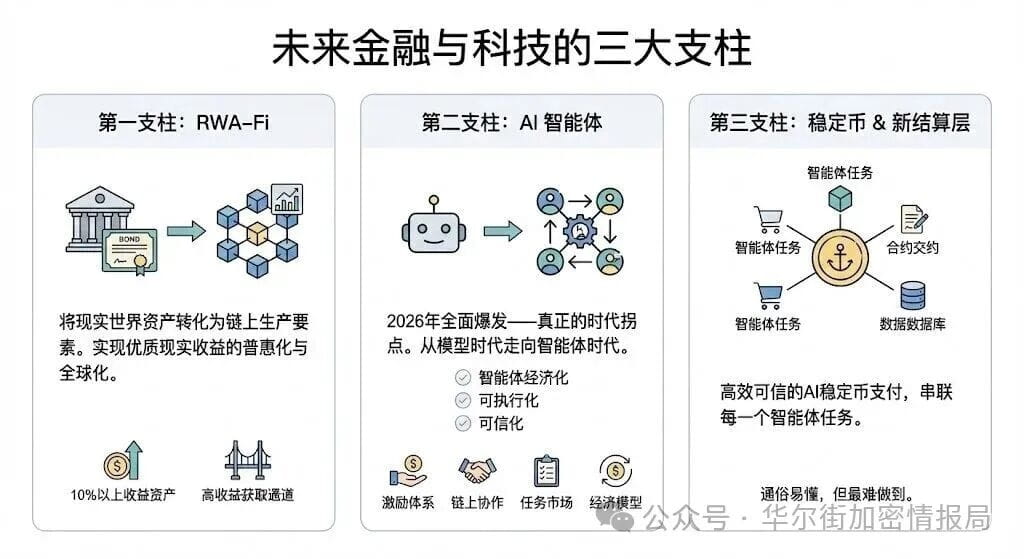
Main line one: RWA-Fi → turning real-world assets into on-chain combinable production materials → excellent real yield assets becoming universally accessible.
Many outstanding assets with annual returns of over 10% have not flowed into Crypto, creating a true vacuum. Most of these assets have high user entry thresholds, and many who want to participate only stop at institutional investors, large holders, and those with connections.
The real linkage between coins and stocks, rather than being limited to pure DAT-based financing investment logic.
Main line two: AI Agents will fully bloom in 2026 - a true era-defining inflection point.
Traditional AI companies have pushed the 'big language model competition' to the limit by 2023–2025. The era of models has ended; the era of agents has begun. For Crypto, the breakthrough point in the future lies in - making agent-driven economics executable and trustworthy.
The 'large-scale landing period' of AI Agents, especially the formal surge of financial scenarios; Web3 will bear the most crucial part of Agent landing: the economic system will become a red ocean - Agent incentive systems - on-chain collaboration systems - Agent task markets - on-chain economic models (yield, payment, custody).
Efficient and trustworthy AI stablecoin payments will connect every Agent Task.
Main line three: Stablecoins & new settlement layers.
Sixth, why is 2025 not a bull market, but more important than a bull market?
Here, I want to present a brutal but real conclusion: 2025 is a year when everyone wants to make money, but most people won't.
Because this is a 'track-changing year'. Track-changing years have three characteristics:
1. The profit-making methods of the old cycle have failed.
You can't blindly buy memes; L1 hype dissipates in days; AI is hot but doesn't rise; L2s are too many to count; new chains have no new plays.
2. The structure of the new cycle has not yet formed.
RWA is still laying the groundwork; the AI Agent ecosystem has yet to emerge; institutional capital is entering very slowly; traditional finance is still figuring out the processes; the regulatory framework has just landed.
3. The entire industry is forced to 'face reality' for the first time.
Crypto has survived the past decade by relying on three things: stories, expectations, and volatility.
But starting in 2025, what will sustain us? Structure. Relying on real-world assets, real-world demands, and real-world financial logic.
This is the necessary path for 'industry growth'.
Seven, 2026–2030: The industry future roadmap I see.
If you ask me: 'What are the three most certain things in the next five years?'
Yongqi summarized three conclusions, enough for you to set the investment logic for the next five years:
① 2026: The RWA financial system begins to scale.
The signs are: government-level institutions participating, pensions, sovereign fund pilots, on-chain strategies serving as institutional-level LPs, and multi-chain RWA clearing becoming the standard.
RWA will become the foundation of the on-chain interest rate system. The significance of this matter is greater than anyone can imagine.
② 2027: The AI Agent economy begins to form a closed loop.
You will see: AI Agents starting companies, operating products, doing arbitrage, and creating strategies.
What is that? That is the year when 'non-human economies' first appeared.
③ 2028–2030: Traditional finance and on-chain finance will truly merge.
At this stage, the world will for the first time see: a unified on-chain settlement layer; large-scale popularization of compliant wallets; on-chain KYC becoming a global standard; ETH/BTC becoming essential options for global asset allocation; tokenized assets surpassing crypto-native assets.
Crypto is no longer an 'alternative asset' but the 'underlying technology of mainstream finance'. This is a historic migration.
Eighth: Yongqi summarizes the core discourse.
First: when we talk about prices, we are actually talking about the future. If you only focus on prices, the future will slip away from you.
Second: a bull market is noisy; a bear market is a magnifying glass, microscope, and revealing mirror.
Third: The bubble of 2025 is not a bad thing; it is the 'fracture period' before the industry truly grows. The cleaner the bubble bursts, the clearer the future.
Fourth: Pure Crypto Native innovation is approaching its ceiling.
Fifth: the latest narrative direction for the next five years: the complete integration of Crypto and traditional finance.
Sixth: RWA-Fi, AI payments, and stablecoins are the three super main lines for the next five years. They are not hotspots but the foundation. RWA, AI, and stablecoins are accelerating the integration of Crypto and traditional finance. RWA bridges skeletons and assets, AI solves practical efficiency and execution, and stablecoins are the underlying fuel for all innovations.
Seventh: Crypto is transitioning from a 'single-player game' to a 'plugin of the real-world financial system'. Only those that can connect with real finance will be long-term winners.
Eighth: the truly important thing in the AI era is not the models, but execution: payments, settlements, custody, identity, automated strategies. Who provides the execution power for agents, whose AI Agents will impress users, and who will capture the future.
Ninth: all short-term spikes are expectations; all long-term increases are structures; price is a lagging indicator, structure is a leading indicator.
Tenth: If you can't understand 2025, you will miss the entire text of 2026.
Finally: when the tide goes out, we can see the future.
I summarize this article not to tell you: 'The bull market is coming soon', 'Hold on to win', 'RWA will definitely rise', 'AI will definitely take off.'
These words do not need me to say; anyone can say them. I am writing about something more important: when we talk about prices, we are actually discussing the future. When we only look at prices, we lose the ability to see the future.
The most real truth of 2025 is: emotions are receding, noise is disappearing, structures are being rebuilt, real players are entering, and real infrastructure is being completed and growing.
This is neither a bull market nor a bear market. This is the industry’s once-in-a-decade 'track-changing moment'.
After the tide goes out, you will find - we are not waiting for the next bull market; we are waiting for the next round of civilizational structure to restart.
And where you are now will determine your height three years from now.
Only do things that cognitive beliefs support, only support people that cognitive recognition agrees with. Do not cater to short-term market emotions, do not betray long-term structural logic.
The future will still experience repeated fluctuations, but cognition will never decline.
Deep observation · Independent thinking · Value beyond price.
Starred #Wall Street Crypto Intelligence Bureau, don't miss good content ⭐
Finally: many of the views in this article represent my personal understanding and judgment of the market and do not constitute investment advice for you.


