
 Can't stand it
Then don't hold a position, just keep trading until liquidation, until the account falls silent!
There is profit to be made in any market, and similarly, any market can lead to losses, but no one can handle every market situation.
Therefore, if you don't learn to hold a position, when you don't understand the market and when your entry conditions haven't appeared, forcing trades will definitely lead to greater losses than profits!
Holding a position is definitely part of trading! Here are some tips from experience.
For example, as a firm bull patient, in the following situations, it's better to stay out of the market than to stubbornly force a trade.
First type: The market that has been validated by the 123 rule, stay in cash.
An upward market needs higher highs and higher lows to be confirmed, but if a rising trend meets the 123 rule, it means the original upward structure is broken, resulting in lower highs and lower lows.
The upward trend may undergo a reversal or oscillation.
As shown in the figure below:
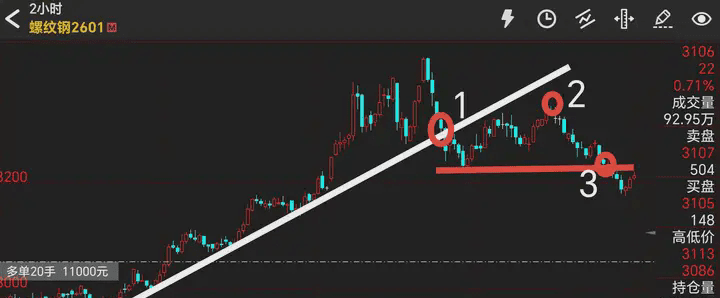 Step 1: Break below the upward trend line.
Step 2: The rebound did not break through the previous high.
Step 3: Turn and break below the previous low.
Three actions meet the three key points of the 123 rule. Previously, buying on dips was okay, but now it's best to stay in cash and observe, to prevent getting caught at the peak.
Should we go short directly? NO, a trend change does not equal a reversal; it may turn into a larger oscillation range.
To understand how to use the 123 rule, you can check here:
Second type: When the three moving averages show intertwining or a bearish arrangement, do not stubbornly buy, stay in cash.
For example, three moving averages: fast line 20, medium line 60, slow line 120.
If the three moving averages are in this situation as shown in the image, it indicates a bullish arrangement, suggesting the current upward trend is relatively healthy.
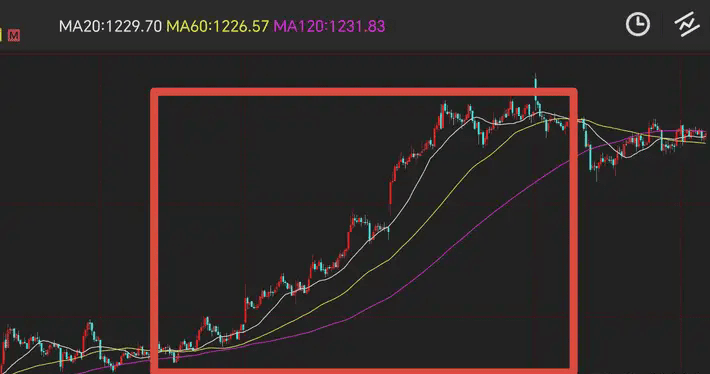 However, if the three moving averages change from a bullish arrangement to intertwining, this indicates that the current market is unclear. If you want to buy on dips, it's best to avoid entering.
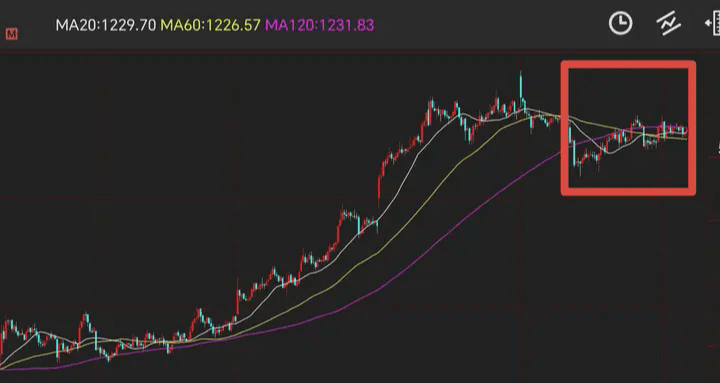 Although moving averages have lagging characteristics and cannot help us identify the establishment of trends immediately, they are still effective in identifying shifts between bullish and bearish.
For the usage of moving averages, look at this:
 How to build a simple and practical trading system using moving averages and K-lines?
Third type: Do not touch when MACD shows divergence; it's better to stay in cash than to enter and risk getting caught at the peak.
After the two lines of MACD cross above the 0 axis below, the market starts a wave of increase. Later, when the two lines show a death cross, the peaks of the fast line correspond to the swing highs of the K-line. When the rise of each swing high of the K-line slows down or no longer creates new highs, while the peaks of the MACD fast line gradually decrease, this forms a divergence.
As shown in the figure below:
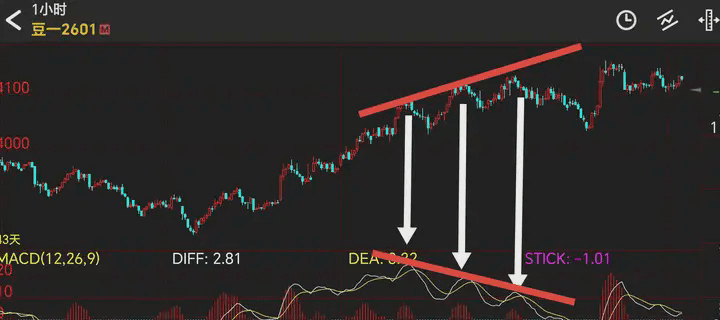 When the MACD shows divergence, does it mean you must turn bearish? Not necessarily, it just indicates that the upward momentum is weakening, and it will be harder to rise further...
You can check this for how to use MACD:
 What indicators can be combined with MACD to reduce its lag and allow for more timely entry?
These are the three market conditions where it's better to stay in cash than to forcefully enter.
Some people feel that if they don't buy this or that, then what are they trading for?
You should know that the market is never short of opportunities; you need to select those that are advantageous for you among many trading opportunities. The moment you can control your actions is when you truly begin to understand trading.
If this helps, give a thumbs up. I am Xiao Fei, happy to meet everyone. I focus on Ethereum contract spot ambush, the team still has positions available, come join to become a market maker and a winner.#加密市场观察 $BTC$ETH


