
What truly prevents you from making money in this world is not the environment, not the market,
but rather that thought in your mind: 'Forget it, I don't deserve it.'
Arthur Hayes Family Office criticizes Pantera: $100,000 turned into $56,000, exposing the brutal truth of crypto funds
The hottest insider news in the crypto world recently is not about a project soaring in value,
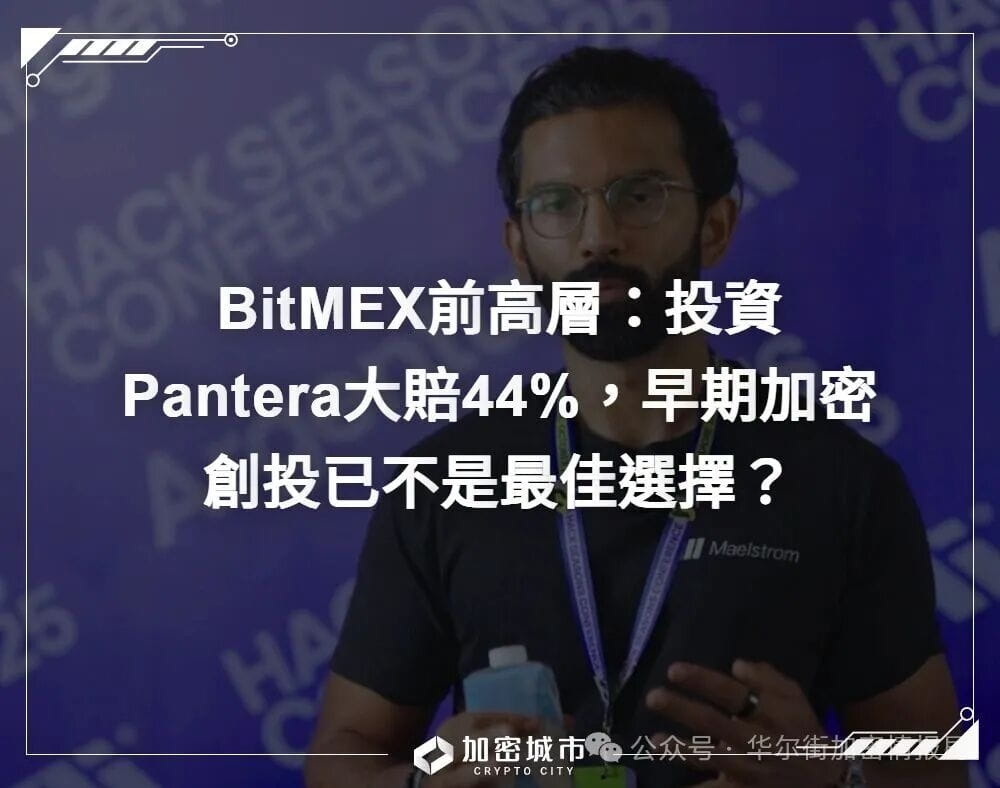
Instead, it was Akshat Vaidya, the investment director of Arthur Hayes Family Office Maelstrom, who personally came out to criticize Pantera Capital—with real loss data.
He revealed in a post on X (formerly Twitter): Four years ago, he invested $100,000 in Pantera's Early-Stage Token Fund, and now only $56,000 remains, a 46% loss.
What's even more heartbreaking is: 'During the same period, Bitcoin rose 2 times, many crypto startups 20-75 times, while the fund I invested in lost half.'
Once this statement was made, the entire industry was in an uproar. Today, we use this incident to help you see the truth of crypto funds, the problems in the industry, and the hidden worries of the next round of cycles.
01 | 100,000 becomes 56,000: The real returns of crypto funds.
The first time being publicly torn apart.
According to reports from several official media outlets (Sina Finance, Weex, CryptoNewsZ, Odaily):
Akshat invested 100,000 USD LP share in Pantera, and after four years, the remaining value is only 56,000 USD, losing nearly half; how did the market perform during the same period?
Bitcoin doubled, many early projects 20–75x, ETH and BNB also strengthened.
But Pantera's fund not only lost money but also underperformed the market, mainstream, altcoins, early projects, and everything else.
Why is this happening? Vaidya directly gives three core reasons:

02 | 'The larger the scale, the worse the returns':
Akshat points out the hidden rules of crypto funds.
Akshat says bluntly: 'Blockchain has no economies of scale. The bigger the fund, the harder it is to achieve high multiple returns.'
Why?
Reason 1: The number of quality early-stage projects is limited.
Outstanding Web3 entrepreneurial teams are not numerous. However, venture capital giants like Pantera raise hundreds of millions of dollars, and to spend that money, they need to invest in more projects, relax standards, and take on some late-stage projects with high valuations.
The result is that the average return rate is diluted.
Reason 2: 'Large funds' mean slower and more conservative.
Small funds dare to go all-in on 20x projects, while large funds can only choose 'stable projects'—but stability often doesn't lead to explosive growth.
Crypto is an industry that completely disregards stability.
Reason 3: Structural contradictions: Fund size is growing, but high-multiple opportunities are not.
As the scale expands → it's hard to spend money: limited opportunities → can't achieve high multiples: high fees → eat into profits.
So the result becomes Vaidya's plaintive remark: 'This is an industry that doesn't take responsibility for LPs.'
03 | The behind-the-scenes culprit that kills LPs:
It's that notorious '3/30'; the thing Vaidya complains about the most is Pantera's fee model: 3% management fee + 30% performance fee.
This is much more expensive than the traditional venture capital '2/20'. What impact does it have on LP?
① Management fees over many years directly consume the principal.
4 years = 12% management fee; if the projects don't perform, the management fee first eats away a chunk from the LP.
② Performance fees repeated deductions will dilute returns.
As long as the project rebounds a little, the fund can 'lock in profits'. If the project falls back, the losses are borne by the LPs.
③ This is a type of 'bull market fee structure'.
It's reasonable in a bull market, but in a mediocre cycle → it turns into a way to cut leeks and charge fees.
No wonder Vaidya would post a complaint.
04 | This round of the bull market only saw BTC, ETH, and BNB rise:
If altcoins don't rise, funds can't survive; why are institutions generally 'doing poorly' in this round of the bull market?
Because this round of the market has an unprecedented characteristic: BTC is soaring → altcoins are collectively lying flat.
Including: some funds from a16z, Pantera, Multicoin, and Paradigm have been dragged down by the weakness of altcoins.
The reason is simple: early funds rely on multiples.
Instead of stable growth, what they need is: 30x, 50x, 100x.
However, in this round, altcoins as a whole did not experience a 'frenzy'; most projects: not launched, not listed, no liquidity, no narrative, no token appreciation.
Without those multiples, the fund's performance is naturally poor.
Some analysts even directly say: 'If altcoins don't rise, many funds won't survive this cycle.'
This is the harsh reality of the industry.
05 | Another heavy truth: many funds are now struggling even to raise capital.
The well-known Asian fund ABCDE you mentioned exited the crypto space this year; this is not an isolated case.
The entire industry is experiencing: LP tightening, institutional fundraising difficulties, altcoins freezing, declining yields, and high-cost structures that are hard to maintain.
In other words: the 'money tide' of crypto funds is receding.
In the coming years, we may see a large number of funds collapse.
06 | But the story isn't that simple:
Akshat complains about Pantera while promoting his new fund; yes, this is the most subtle point of the whole matter.
After criticizing Pantera, Akshat also promotes his family office Maelstrom and is raising a new fund, focusing on crypto businesses that can generate cash flow in the 'real world', establishing a more reasonable and cycle-resistant fund structure.
This is typical: both lifting and stepping on are interests.
Even so, the questions he raised are still the realities the industry must face.
07 | Final thoughts: This is a cycle reshuffling.
It's also a maturation of the industry.
Vaidya's complaints reveal three truths to us:
Large funds ≠ High returns: A larger scale often means decreased efficiency.
High fee structures are no longer suitable for the current industry: LPs need a more reasonable way to align interests.
If there hadn't been a frenzy of altcoins, the investment logic of funds would have been reshaped: this is an industry structure upgrade. Future crypto funds,
Possible: More focus on cash flow, more focus on infrastructure, more emphasis on real users and revenue, less reliance on bull market speculation
Perhaps this is the true beginning of the crypto industry's maturity.
Conclusion
What you can't earn is not money, but cognition; what you can't overcome is not difficulty, but your old self.
Destiny is never passively awaited; it is chosen.
Akshat's 100,000 → 56,000 is not just a tragedy for one LP, but: a run on the entire crypto VC model; the collapse of the industry's return structure; a reassessment of capital efficiency, and the chain reaction after the weakening of the altcoin cycle.
In prosperous times, many problems are hidden under the bull market. In cooling times, problems really become apparent.
This public 'criticism' may help the entire industry reflect.
In the next round of cycles, what kind of funds are truly worth holding long-term?
In-depth observation · Independent thinking · Value is more than just price.
Bookmark #Wall Street Crypto Intelligence Bureau, great content not to be missed ⭐
Finally: Many of the views expressed in this article represent my personal understanding of the market and do not constitute investment advice.


