In most PoS chains, staking is only used for network security, and the token economy relies on inflation subsidies.
Injective has built a trinity self-reinforcing flywheel: staking ensures security → security attracts ecology → ecology generates income → income repurchases and destroys → destruction enhances staking value → more staking.
This is a value closed loop that requires no external blood transfusion and is completely endogenously driven.
Flywheel four-step logic
High staking rate (currently 64%) → network has extremely strong anti-attack capability;
Secure network attracting dApps and institutions → Helix, RWA, derivatives, and other high-frequency uses;
The protocol's daily average income exceeds $330,000 → Automatically repurchasing INJ and permanently destroying it;
Circulating supply continues to decrease → The same staking rewards correspond to higher unit value → Attracting more users to stake.
"I'm staking not for that 6% APR, but because I know every transaction is making my INJ scarcer."
—— Long-term holder @HODLerPrime
Key data verification (as of December 2025)
Total destroyed: 8.6 million+ INJ (≈ 8.6% of initial circulating supply)
Annual destruction rate: ~4.2% (deflationary asset)
Staking yield composition: 5% basic inflation + 1-3% protocol revenue sharing
Staking threshold: Starting from 1 INJ, no lock-up period, can unbind at any time (21 days release)
Compare with traditional models
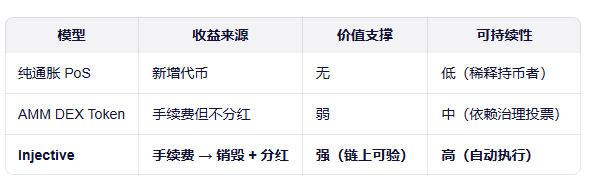
When staking shifts from 'passive lock-up' to 'active participation in value creation', holders transform from bystanders to ecological co-builders.
Will you stake INJ long-term due to the mechanism of 'less usage leads to stronger value'? If an asset is deflating every day while the ecosystem is growing daily, what do you think it will ultimately become? Feel free to share your valuation framework in the comments.