
ERC-4337 (Account Abstraction) makes Ethereum wallets smarter—supporting multi-signature, social recovery, Gas payment, and more. Many believe this is enough to support AI agent interactions. However, Kite's design philosophy goes further: AI does not need a smarter wallet, but rather a completely new identity and interaction primitives.
The key difference lies in the 'identity granularity':
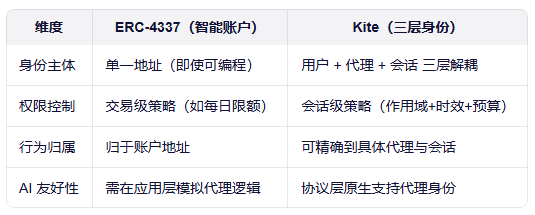
For example:
You want the AI agent to automatically purchase weather data every day.
In ERC-4337, you need to create a dedicated smart account, hard-code the rules, and hand over the private key to the AI—once the rules need to be adjusted, you have to deploy a new contract.
In Kite, you only need to update the policy contract, and the same agent can obtain new permissions in a new session without changing identity or keys.
More importantly, Kite's session model inherently supports behavior auditing and reputation accumulation. Each session is an independent event that can be verified by third parties: "Did this agent use the service as agreed?" — whereas all operations of ERC-4337 are mixed within the same address history, making it difficult to separate.

In short: ERC-4337 makes human wallets more powerful, while Kite has built a digital household registration system for the machine society. The former optimizes the existing paradigm, while the latter defines a new paradigm.@KITE AI #KITE $KITE

