
Many small and medium-sized businesses want to trace their goods, but as soon as they hear "blockchain" or "on-chain," they back off—thinking the barriers are high, the costs are expensive, and the operation is complex. They worry they won't be able to learn it or afford it. However, Lorenzo Protocol has long tailored a "lightweight tracing solution" for small and medium-sized businesses, allowing them to avoid investing huge sums to transform their existing systems, without needing to hire a professional technical team. With just a mobile phone, they can operate it and complete the first order of goods on-chain in 5 minutes, and the costs are reduced by more than 50% compared to traditional tracing solutions. Today, I am sharing this exclusive practical guide with small and medium-sized businesses, making it easy for you to manage goods tracing.
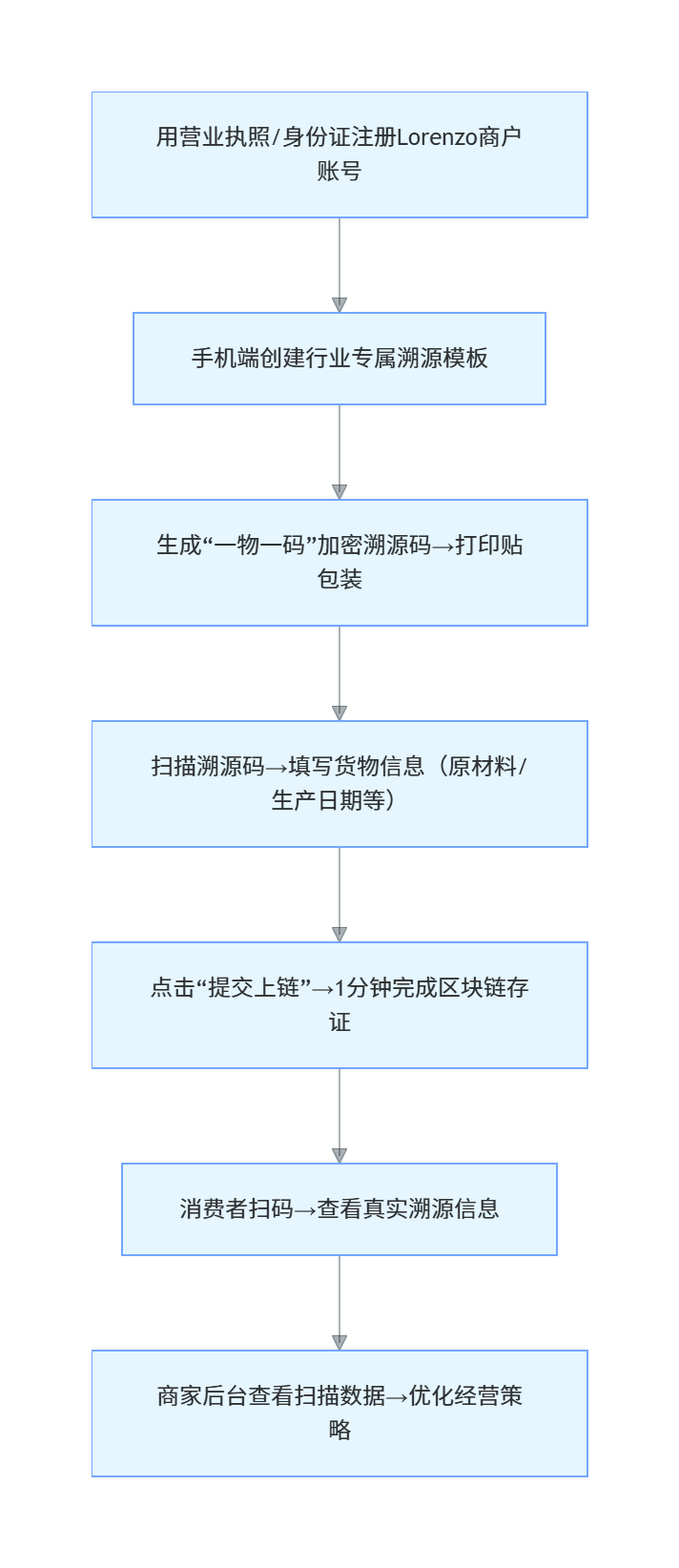
First, it is important to clarify: the core needs of small and medium-sized businesses for traceability are 'simple, cheap, and effective', and Lorenzo's solution fully aligns with those needs. The first step is to register a Lorenzo merchant account — by opening the 'Merchant Center' on the Lorenzo official website, one can register for free using a photo of their business license (individual businesses can use their ID photo), completing the process in just one minute. After successful registration, a dedicated 'Traceability Management Backend' and 'Mobile Operation Mini Program' will be automatically generated, allowing all operations to be completed on a mobile phone without needing a computer.
The second step is to create the product traceability template, which can be done in 3 minutes. After logging into the mobile mini program, click 'Create Traceability Template', and choose the corresponding template based on your industry (such as food, clothing, or electronics). The template has preset common traceability fields for that industry (for example, food has 'Raw material origin', 'Production date', 'Shelf life', and clothing has 'Fabric composition', 'Production factory', 'Size specifications'). If the preset fields are not sufficient, you can also add custom fields (such as 'Distributor authorization number', 'After-sales contact information'); the operation is as simple as editing a form on your phone.
After creating the template, click 'Generate Traceability Code', and the system will automatically generate a batch of unique encrypted traceability codes — these codes can be directly downloaded and printed to be affixed to product packaging; alternatively, merchants can contact Lorenzo's partner printing factory to have them printed directly on the packaging, with costs comparable to regular QR code printing, costing only a few cents each. It is important to note that Lorenzo's traceability codes are 'one code per item', with each code corresponding to a unique product. Even if someone tries to copy it, they cannot generate identical encrypted information, effectively eliminating counterfeiting from the root.
The third step is to input the product information, which can be completed in 1 minute. When the product is produced or stored, open the mobile mini program, scan the traceability code on the product packaging, and fill in the information according to the template fields — for example, for food items, fill in 'Raw material origin: Yantai, Shandong', 'Production date: May 20, 2024', 'Shelf life: 6 months'. After completing the input, click 'Submit to Chain', and the system will automatically upload the information to the Lorenzo blockchain, generating the corresponding timestamp and merchant signature. The entire process takes only 1 minute, and there are no on-chain fees; only when the traceability code is scanned and queried by consumers will a small fee of $BANK be incurred (0.01U per transaction, which is almost negligible).
Here’s a real case: An individual business owner in Guangzhou who runs a milk tea shop had been troubled by the issue of 'knockoff shops imitating' them. After adopting Lorenzo's traceability solution, they affixed traceability codes to the cup sleeves of every cup of milk tea. Consumers could scan the code to see 'tea leaf origin', 'milk brand', 'production time', and 'staff information'. This not only resolved the imitation issue but also increased consumer trust, resulting in a 30% improvement in business. Moreover, the overall cost of the solution is extremely low, with printing traceability codes costing only a few dozen yuan per month, and the on-chain fee is almost negligible, completely within the affordability of small and medium-sized businesses.
Some merchants may worry: what if they don’t know how to operate? What if consumers don’t know how to scan codes for inquiries? Actually, there’s no need to worry at all. Lorenzo's mini program interface is designed to be very intuitive, with text prompts and video tutorials for each operation step, allowing even older individuals who are not tech-savvy to learn; for consumers, after scanning, they will be directly redirected to a simple query page that presents traceability information in layman's terms, making it easy to understand without needing any blockchain knowledge.
Additionally, Lorenzo provides a 'Traceability Data Statistics' feature, allowing merchants to see the scan count, scanning regions, consumer profiles, and other data for each traceability code in the backend. By analyzing this data, they can identify sales hotspots and consumer preferences, providing references for business decisions. For example, a fruit-selling merchant discovered through data that consumers in Beijing scanned the traceability codes the most, and were particularly concerned about 'pesticide residue testing' information. Thus, they increased their promotional efforts in Beijing and prominently displayed the pesticide residue testing reports in their traceability information, leading to a significant boost in sales.
Summarizing the entire process of traceability for small and medium-sized businesses using Lorenzo with a single image is ridiculously simple:
Finally, let’s highlight a few key points: ① Registration and template creation are completely free, with very low on-chain costs; ② The entire process can be operated via mobile, completing the first order on-chain in 5 minutes; ③ Traceability codes cannot be copied, ensuring good anti-counterfeiting effects; ④ Data statistics features are provided to assist in business decision-making.
For small and medium-sized businesses, product traceability is no longer a 'exclusive benefit' for large enterprises but a 'necessary tool' to enhance competitiveness and gain consumer trust. Lorenzo has lowered the entry barrier with a lightweight solution, enabling every small and medium-sized business to utilize blockchain traceability technology without spending a fortune, effectively addressing issues such as counterfeiting, imitation, and loss of trust. More and more small and medium-sized businesses have joined Lorenzo's supply chain traceability ecosystem, empowering their businesses through technology. What are you waiting for? Hurry up and register an account to start your traceability journey!

