
The bear market in the blockchain gaming industry often sees a 'muddy waters' scenario—most projects either shut down or run away, or significantly reduce user earnings, leaving players with nothing. However, during the 2024 blockchain gaming bear market, the YGG ecosystem not only did not shut down or reduce earnings but achieved a dual growth in user numbers and ecosystem pool funds, with monthly user earnings fluctuating no more than 10%. Behind this is the 'three-tier risk resistance barrier' constructed by the YGG ecosystem, allowing it to stand firm during the industry's winter.
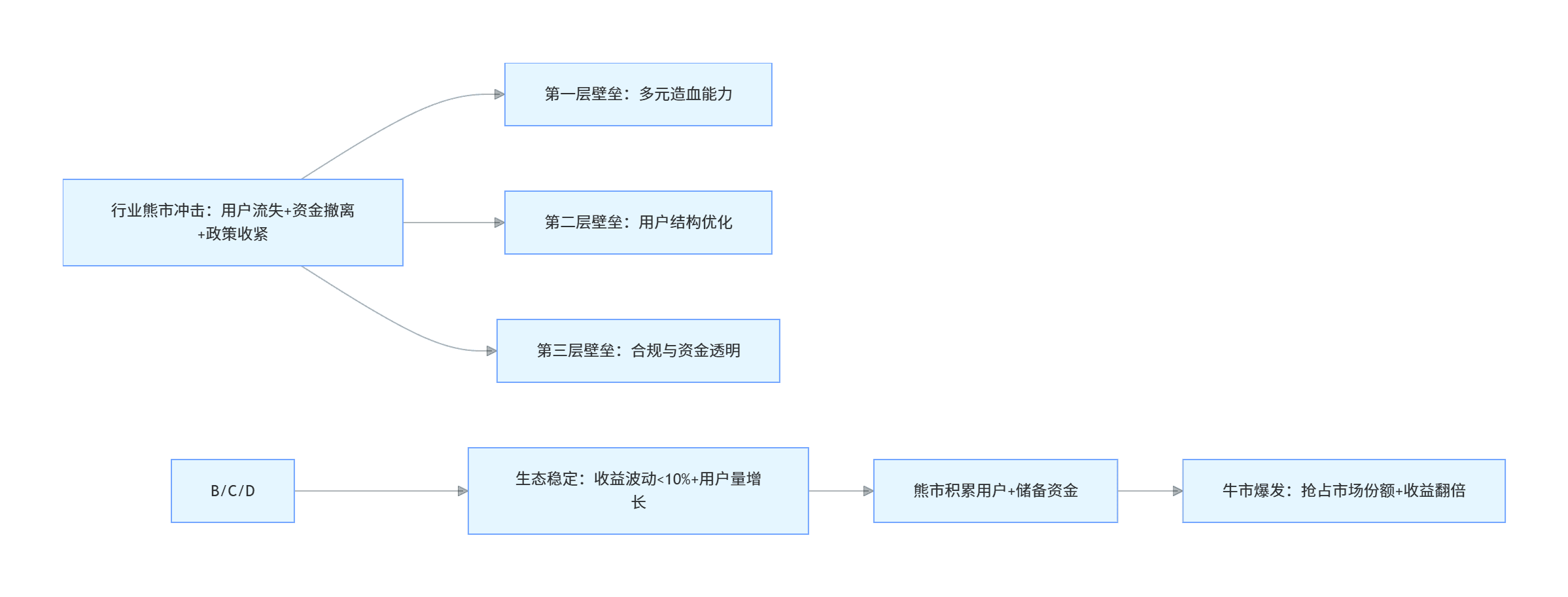
The first barrier is 'diversified revenue generation capability', freeing itself from dependence on a single income source. During a bear market, many blockchain games face funding chain breaks due to relying solely on in-game purchases as a revenue source, leading to user loss; however, the YGG ecosystem has four major revenue channels: Launchpad revenue sharing, brand collaborations, paid items, and maternal fund reinvestment. During the bear market in 2024, although in-game revenue decreased by 20%, Launchpad revenue sharing and maternal fund reinvestment increased by 30%, ensuring that the ecosystem pool funds not only did not decrease but instead increased by 5 million $YGG, stabilizing user earnings.
The second barrier is 'optimized user structure', which reduces reliance on short-term speculative users. Among YGG ecosystem users, 35% are long-term dedicated users, 45% are moderately engaged stable users, and only 20% are short-term speculative users. During a bear market, although 20% of short-term users may leave, long-term and moderate users continue to participate steadily. They value the long-term potential of the ecosystem rather than short-term fluctuations in returns. The continued participation of these core users not only ensures the basic activity level of the ecosystem but also provides a stable inflow of funds, allowing the ecosystem to operate normally during a bear market.
The third barrier is 'compliance and financial transparency', which builds user trust as a 'safety net'. During a bear market, users are most concerned about 'projects running away', while the YGG ecosystem has prioritized compliance from the very beginning, completing registrations in multiple countries, adhering to strict KYC processes, and ensuring that the flow of funds within the ecosystem is publicly available in real-time. Users can track the usage of every transaction through blockchain explorers. This 'transparent operation' allows users to maintain trust in the ecosystem even during a bear market, preventing large-scale withdrawals or losses. At the same time, compliant operations enable YGG to smoothly connect with institutional funds during a bear market, injecting new liquidity into the ecosystem.
The risk resistance capability of the YGG ecosystem is not innate, but is gradually built through 'diverse revenue generation, optimizing user structure, and compliance transparency'. In a bear market, these barriers allow YGG to not only stabilize its position but also to accumulate users and funds; when the industry enters a bull market, it can quickly seize market share with its accumulated user base and funding advantages, doubling user returns. For investors, an ecosystem with a 'strong risk resistance capability' is far more valuable than projects that rely solely on bull market dividends. The $YGG token, as the core token of the ecosystem, also highlights its risk resistance capability and appreciation potential.
