

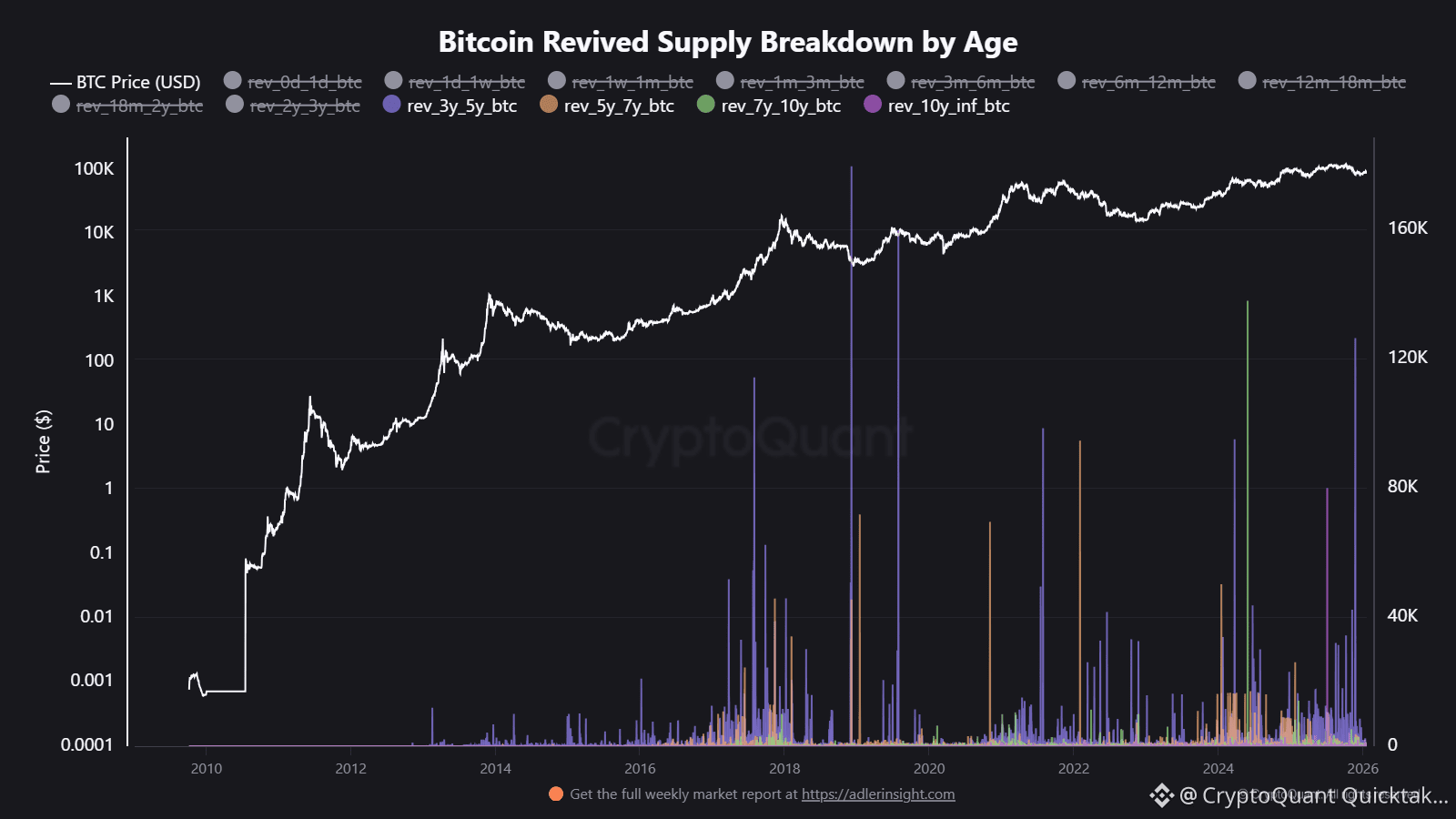
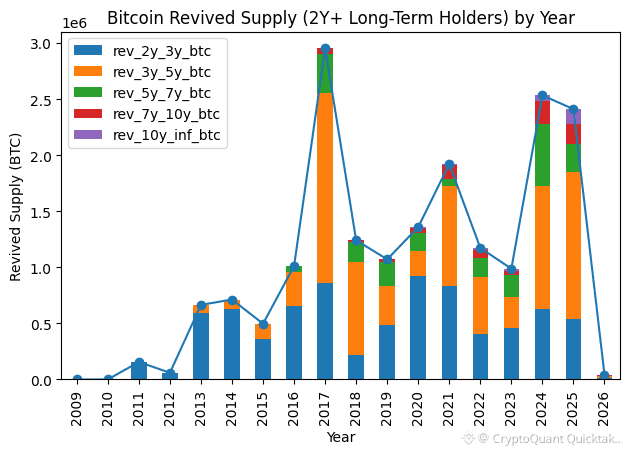
This chart shows Revived Supply by age, focusing on Bitcoin that had remained dormant for 2+ years before moving. Unlike short-term supply, these coins belong to long-term holders and typically move only during structural market transitions, not short-term volatility.
What stands out is that 2024 and 2025 record the highest annual revived supply from long-term holders in Bitcoin’s history. This is not just a repeat of 2017 or 2021. While those cycles saw revived supply rise alongside strong price momentum and speculative inflows, the current revival is happening with lower overall market noise but significantly older coins.
This suggests that the supply coming to market is increasingly driven by long-standing holders reassessing exposure, rather than short-term traders reacting to price.
From an on-chain perspective, this points to a gradual shift in market ownership. Early holders—traditionally focused on halving cycles, self-custody, and long-term scarcity—appear to be transferring supply to a new participant base that is more price-, macro-, and liquidity-driven.
Early 2026 data does not yet show a full reversal of this trend, but revived long-term supply has moderated compared to the peaks of 2024–2025. Whether this represents temporary exhaustion or the start of a new accumulation phase will become clearer as the year progresses.
Key takeaway:
Bitcoin is not only undergoing a price cycle, but potentially a transition in who holds it and why—and long-term holder supply behavior is one of the clearest on-chain signals of that shift.
Written by Kripto Mevsimi