

A strange thought crossed my mind while watching AI generate an answer in seconds. The response appeared almost effortlessly. A question went in, a polished answer came out, and the interaction ended. No visible machinery. N0 indication that anything meaningful had happened behind the scenes.. But the longer I sat with it.. the less convincing that illusion became. We have become so accustomed to AI .. outputs that we rarely stop to ask what actually happened between the prompt and the answer.
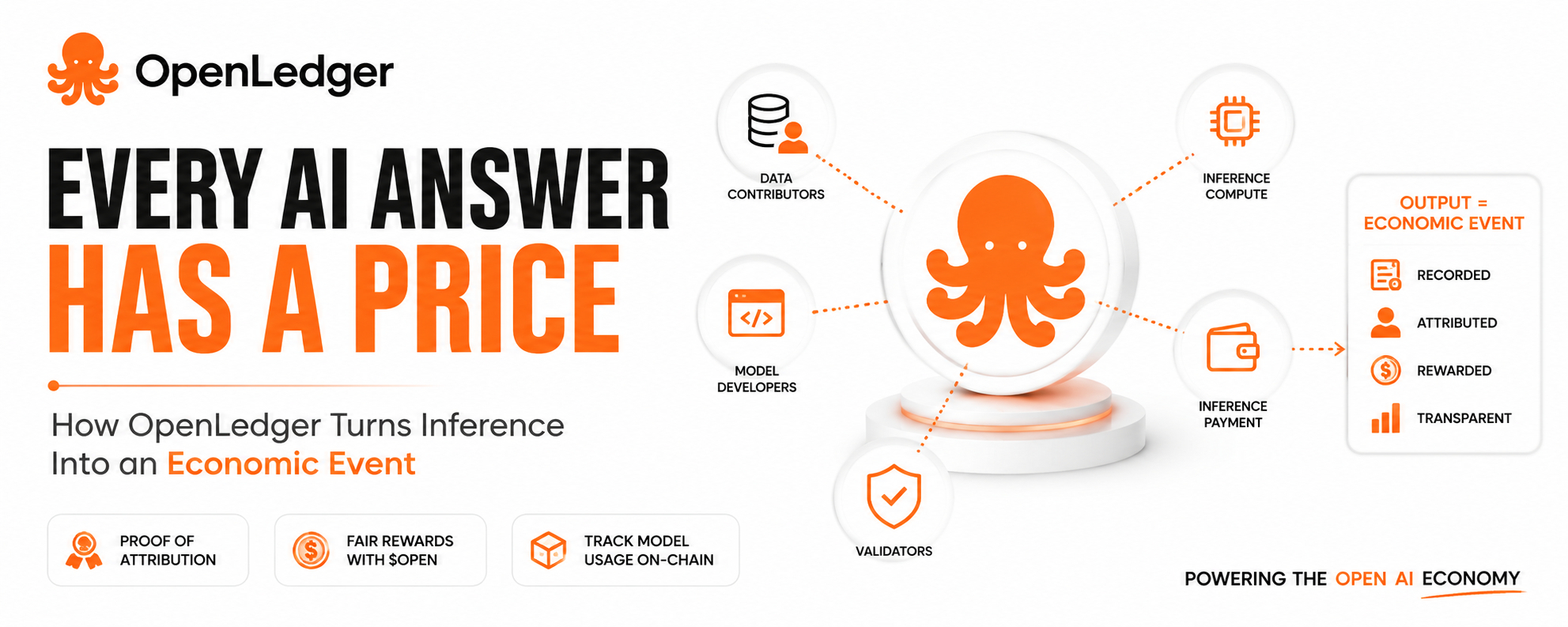
The obvious narrative is that AI creates value.. the moment it responds. Yet I am starting to think the response is only the final chapter of a much longer story. Behind every answer sits a hidden network of contributors..datasets.. model refinements.. validation work, infrastructure and computation. What feels like a single event is actually the result of countless actions performed by people most users will never know existed. The answer is visible. The chain of contribution is not.
That raises an uncomfortable question..If an AI output is built on the work 0f many participants, why do most systems behave as if nobody contributed at all? Data providers disappear. Fine-tuners disappear. Validators disappear. The output receives attention while the process that made it possible fades into the background. Value is created yet the path through which that value emerged becomes difficult to trace. The system remembers the answer but often forgets the people who helped shape it.
What caught my attention while exploring OpenLedger is its attempt to treat inference differently. Instead of viewing an AI response as an isolated output, it begins to look more like an economic event. An answer is no longer just information leaving a model. It becomes part of a larger record connected to contributors, attribution and usage. On the surface.. that sounds like infrastructure. Beneath the surface. it feels more like a shift in how value itself is understood.
The hidden tension is that most digital economies reward visibility rather than impact. People naturally optimize for what can be seen. Yet some of the most important contributions inside AI are almost invisible. A small improvement to a dataset may influence thousands of future outputs. A niche refinement may quietly solve a problem that affects an entire workflow. A validator may prevent errors that nobody notices because the failure never happens. These contributions rarely attract attention.. but they 0ften determine whether a system remains useful over time.
What fascinates me is how attribution changes behavior.. When contributors know their work can be connected to future outcomes.. they begin thinking differently. Quality becomes more important than volume.. Long-term usefulness becomes.. more valuable than short-term recognition. The conversation shifts from participation alone to meaningful contribution. It is a subtle change, but subtle changes often create the strongest incentives because they influence decisions long before rewards appear.
Of course, there are risks. Measuring contribution inside complex AI systems is difficult. Influence is rarely clean or perfectly measurable. A small dataset update might prove more valuable than a massive collection of average data. Attribution systems can create new incentives that people eventually learn to optimize around. Every framework designed to measure value faces the challenge of distinguishing genuine impact from activity that merely appears important.
The more I reflected on it, the less this felt like a story about AI answers and the more like a story about economic memory. Intelligence is becoming increasingly collaborative.. yet our systems still struggle to remember who helped create it. Perhaps the next stage of AI is not simply generating better outputs. Perhaps it is learning how to preserve the history behind those outputs. Because every answer carries a hidden record of human effort. The real question is whether future AI systems will finally learn to remember it.
