
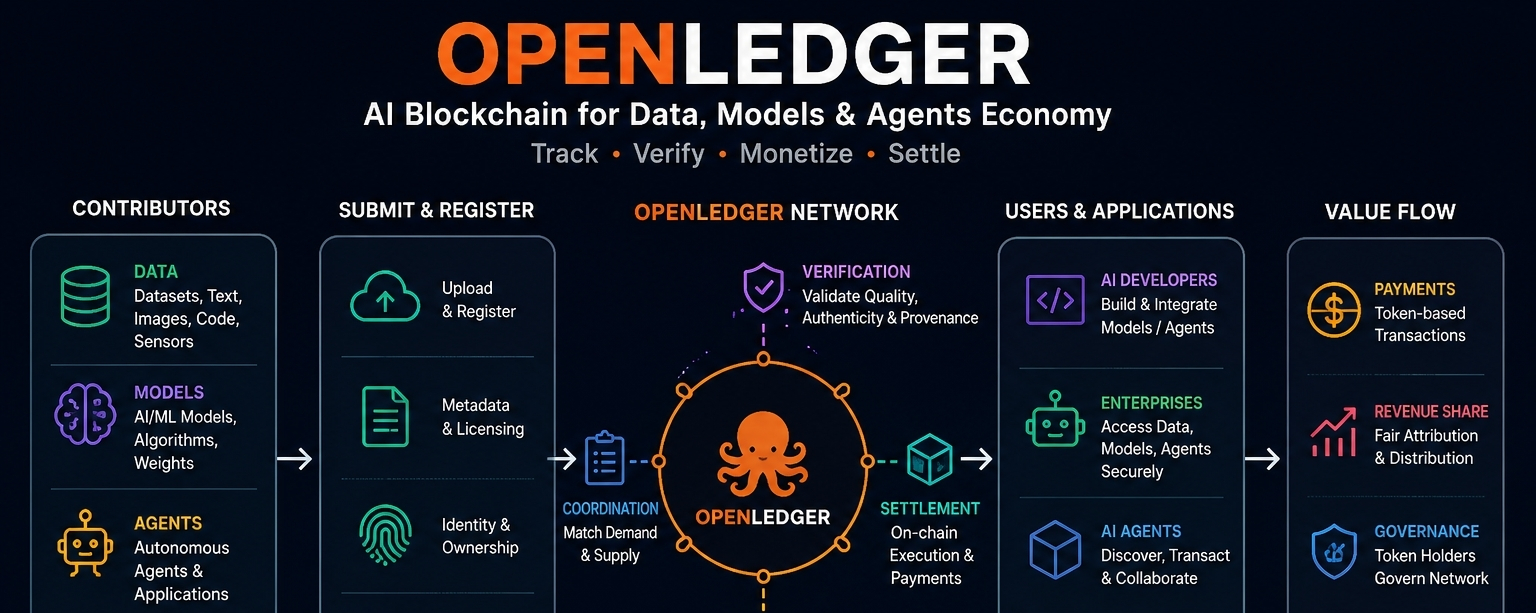
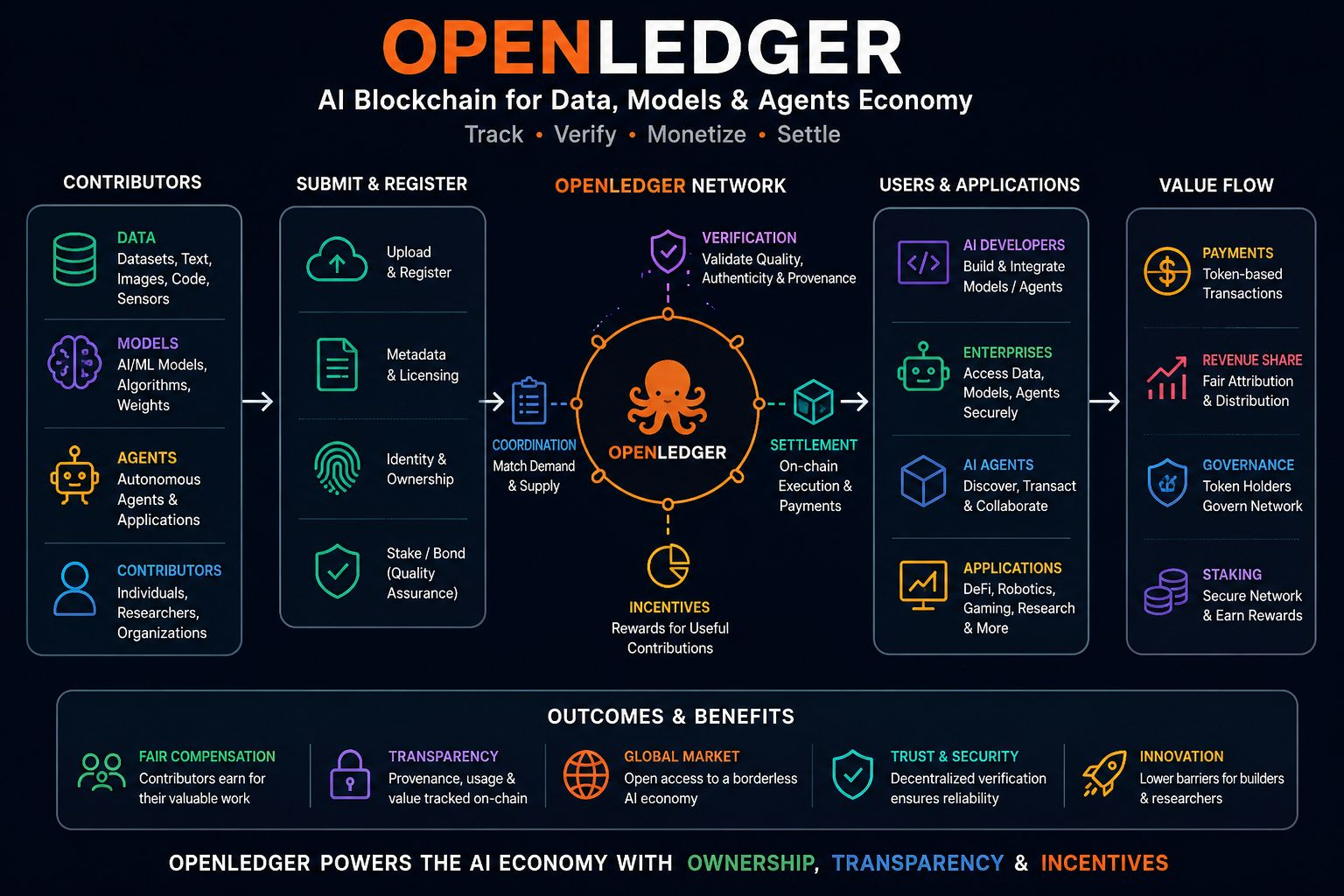
OpenLedger is selling a very modern anxiety.
The pitch goes something like this: AI companies are extracting value from everyone’s data while ordinary contributors get nothing back. Writers, artists, developers, researchers, even users generating feedback loops for machine learning systems — all feeding giant AI models while a small handful of companies capture the profits. OpenLedger says it wants to fix that by building a blockchain where data, models, and AI agents can be tracked, monetized, and traded.
Sounds fair. Almost noble.
And that’s exactly why people should slow down.
Look, I’ve been covering tech long enough to recognize a familiar pattern. Every few years, Silicon Valley discovers a real problem. Then crypto arrives with a token attached to it and claims the answer is “decentralized incentives.” The problem is usually real. The solution is usually where things get slippery.
OpenLedger’s core argument is that AI suffers from a compensation problem. Data creators don’t get paid. Smaller AI developers get squeezed out by giant firms with massive compute budgets. Valuable datasets sit inside private silos while a few dominant companies tighten their grip on the entire AI stack.
All true.
But here’s the part marketing decks glide past: proving ownership inside AI systems is unbelievably messy.
AI models don’t work like spreadsheets. You cannot neatly point to one paragraph, one image, or one dataset and say, “This created exactly 0.004% of the model’s intelligence.” Machine learning systems absorb patterns from millions or billions of interconnected inputs. Attribution becomes blurry very quickly.
That matters because OpenLedger’s entire economic story depends on attribution.
If you cannot reliably prove who contributed what, then the financial layer sitting on top starts looking shaky. Fast.
And this is where the crypto machinery enters the room.
The proposed fix involves blockchain verification, token incentives, decentralized coordination, staking systems, and programmable settlement. Which sounds impressive until you ask a very simple question: are they solving a problem or adding another layer of accounting complexity on top of an already chaotic system?
Because from where I’m sitting, a lot of this resembles financial engineering disguised as infrastructure.
Let’s be honest. Blockchain projects love situations where ownership is fuzzy and difficult to measure. Why? Because ambiguity creates room for narratives. Narratives attract speculation. Speculation attracts liquidity. Liquidity attracts traders. Traders attract token price movement. And once token price movement becomes the center of gravity, the original problem quietly moves into the background.
I’ve seen this movie before.
Remember when blockchain was supposed to fix cloud computing? Advertising? Supply chains? Gaming? Social media? Most of those sectors eventually discovered the same thing: decentralization sounds elegant until operational reality shows up carrying invoices, compliance paperwork, and customer support tickets.
OpenLedger claims decentralization gives contributors more control. Maybe. But control over what exactly?
If a dataset becomes valuable, who verifies that value? If an AI agent causes damage, who carries liability? If copyrighted material slips into the system, who gets sued? If the token collapses 70%, does the economic model still function? These are not side questions. These are the whole game.
And then there’s the centralization problem hiding underneath the decentralization branding.
The AI industry today is dominated by companies with gigantic infrastructure advantages. Massive compute clusters. Semiconductor supply relationships. Proprietary training pipelines. Distribution ecosystems with billions of users. OpenLedger does not erase those advantages. It simply attempts to build a marketplace around them.
That’s a very different thing.
In practice, the biggest AI companies may never need systems like this. They already own the infrastructure, the users, and increasingly the data pipelines. Why would they voluntarily expose core assets to decentralized markets if keeping those assets private strengthens their competitive position?
This is the uncomfortable reality many crypto-AI projects avoid discussing. The most valuable AI data in the world is not floating freely on open marketplaces waiting to be tokenized. It’s locked inside corporations, governments, healthcare systems, financial institutions, and cloud platforms.
Data becomes economically powerful precisely because it is exclusive.
OpenLedger’s vision depends on enough valuable contributors choosing openness over control. That is a very difficult bet.
Then comes the human problem. The one every technical white paper underestimates.
What happens when incentives get distorted?
Crypto systems have a habit of rewarding behavior nobody originally intended. If users are paid for contributing data, people will manufacture data. If reputation scores matter, reputation farming appears. If staking generates rewards, speculation overwhelms utility. Once tokens enter the picture, participants optimize for extraction. Not quality.
This becomes especially dangerous in AI systems because the internet is already filling up with synthetic garbage. AI-generated text trains on AI-generated text. Fake images pollute datasets. Low-quality information spreads faster than curated material because scale is cheaper than accuracy.
Now add token rewards to that environment.
What could possibly go wrong?
OpenLedger talks about creating economic coordination for AI agents and machine-to-machine ecosystems. That part is technically interesting. I’ll give them that. There is a legitimate future scenario where autonomous systems negotiate resources, purchase compute, exchange data, and settle transactions programmatically.
But we are nowhere near that world operationally.
Right now, most so-called AI agents are fragile software wrappers held together by APIs and optimism. They hallucinate. They break under edge cases. They leak information. They fail unpredictably. Yet crypto projects keep speaking about them as if fully autonomous machine economies are just around the corner.
They aren’t.
The gap between demo environments and industrial reliability is enormous. Much larger than most investors appreciate.
And here’s the catch the marketing teams rarely emphasize: complexity itself becomes a tax.
Every additional layer — blockchain settlement, token governance, staking economics, decentralized verification, smart contract execution — introduces friction. More attack surfaces. More regulatory exposure. More operational failure points.
Traditional enterprises hate this stuff.
Corporations do not wake up in the morning asking how to increase architectural complexity. They want systems that are stable, legally accountable, predictable, and boring. Boring infrastructure wins markets more often than revolutionary infrastructure does.
That’s another lesson the crypto industry keeps relearning the hard way.
Look at the language surrounding OpenLedger and you’ll notice something interesting. A huge amount of attention goes toward ecosystem growth, contributor rewards, decentralized coordination, and value accrual. Much less attention goes toward an uglier question: who actually captures sustainable revenue here if speculation disappears?
Because eventually every infrastructure project runs into the same brutal reality. Someone has to pay for the system continuously. Not emotionally. Economically.
And if the answer depends mostly on token appreciation, then the business model may not be as sophisticated as it first appears.
Maybe OpenLedger evolves into something meaningful. Stranger things have happened in technology. The internet itself looked chaotic and impractical in its early years. Open-source software was once dismissed as idealistic nonsense before becoming foundational infrastructure.
But there’s another possibility.
This could simply become another ambitious coordination layer searching for a real economy large enough to justify its existence while traders, venture funds, and early insiders extract value during the narrative phase.
That possibility hangs over almost every crypto-AI project right now.
And once you see it, it becomes very difficult to unsee.
