Been going through midnight again and… i think i initially underestimated how much of this design is really about coordination, not just privacy. the zk angle is obvious, but what caught my attention more is how many assumptions the system makes about actors behaving correctly around hidden data.
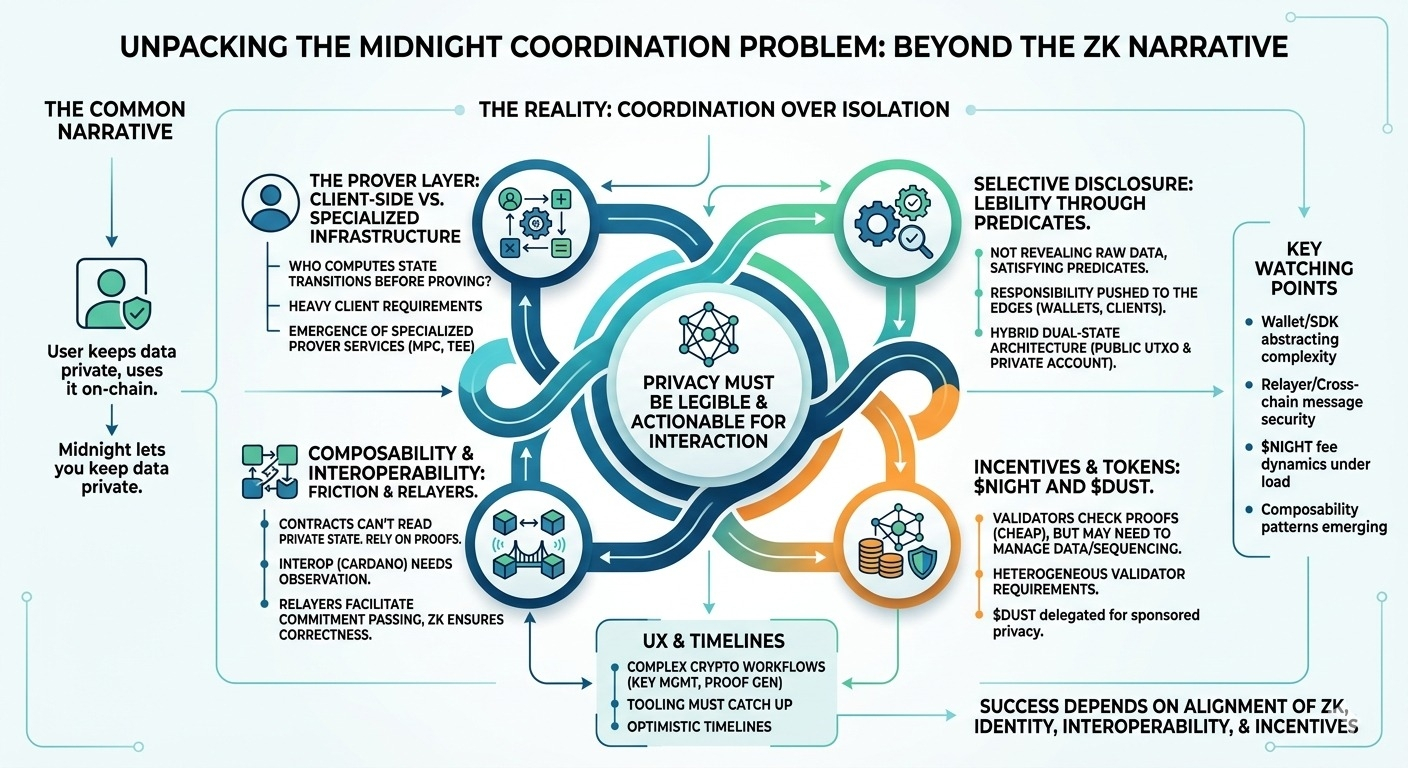
the common narrative is still “midnight lets you keep your data private while using it on-chain.” which sounds straightforward, but in practice it’s more like: “you can prove things about your data, and others will accept those proofs as sufficient.” that subtle shift matters. it’s not privacy in isolation—it’s privacy that still needs to be legible enough for other participants to interact with.
one piece is the selective disclosure model. instead of exposing raw state, users generate proofs that satisfy certain predicates. like proving you’re solvent without revealing balances. that’s fine conceptually, but it pushes a lot of responsibility to the edges—wallets, clients, maybe off-chain services. they’re the ones assembling proofs, managing keys, deciding what to reveal. the chain just verifies. so the “user owns their data” claim is true, but only if the surrounding tooling doesn’t fail them. and honestly… that’s a big if.
then there’s execution. midnight seems to rely on zk proofs for validating state transitions, but not necessarily for fully abstracting execution away. meaning someone still has to compute the transition before proving it. if that’s done client-side, you get heavy requirements on users. if it’s outsourced, you get a prover layer that starts to look like specialized infrastructure—maybe even gatekeeping access if costs aren’t trivial. i’m not entirely clear where they land on that spectrum yet.
interoperability is another layer that feels under-discussed. midnight doesn’t exist in a vacuum—it’s tied to cardano in some form. so assets or messages need to move across. that likely involves relayers or validators observing both sides and passing commitments around. zk can verify correctness of what’s proven, but it doesn’t guarantee that messages are delivered honestly or timely. there’s still a coordination layer that isn’t purely cryptographic.
and the $night token… i assume it’s used for fees and maybe staking, but the exact incentive design feels a bit hazy. if validators are mostly checking proofs, their job is cheap. but if they also handle data availability or sequencing, then costs go up. depending on how that’s structured, you either get a broad validator set or a smaller group with more resources. not clear which direction this pushes.
what’s not being talked about enough is how composability changes when everything is partially hidden. contracts can’t just read each other’s state anymore. they rely on proofs or pre-agreed interfaces. that introduces friction. maybe acceptable for certain verticals—identity, compliance, private finance—but it doesn’t map cleanly to the open composability people expect.
there’s also an implicit assumption that users (or apps) will manage fairly complex cryptographic workflows without much friction. key management, proof generation, selective disclosure policies… these are non-trivial. if any part of that UX breaks, the guarantees weaken quickly. privacy systems are kind of unforgiving like that.
timelines feel… optimistic. zk proving is improving, but developer tooling is still catching up. writing circuits, debugging them, integrating them into apps—it’s not something most teams can do comfortably yet. midnight seems to depend on that becoming normal sooner rather than later.
i don’t think the architecture is flawed, but it feels tightly coupled. zk, identity, interoperability, incentives—they all need to align. if one lags, the system still works, but maybe not well enough to attract real usage.
watching:
* whether wallets and SDKs abstract proof generation cleanly or leak complexity to users
* how relayers / cross-chain messaging are secured in practice
* actual fee dynamics with $night once there’s real load
* whether composability patterns emerge that don’t require constant disclosure
i keep wondering if privacy-first systems like this end up forming their own ecosystem rather than integrating deeply with existing ones. maybe that’s the path. but then… does that limit their reach by default?
$NIGHT @MidnightNetwork #night