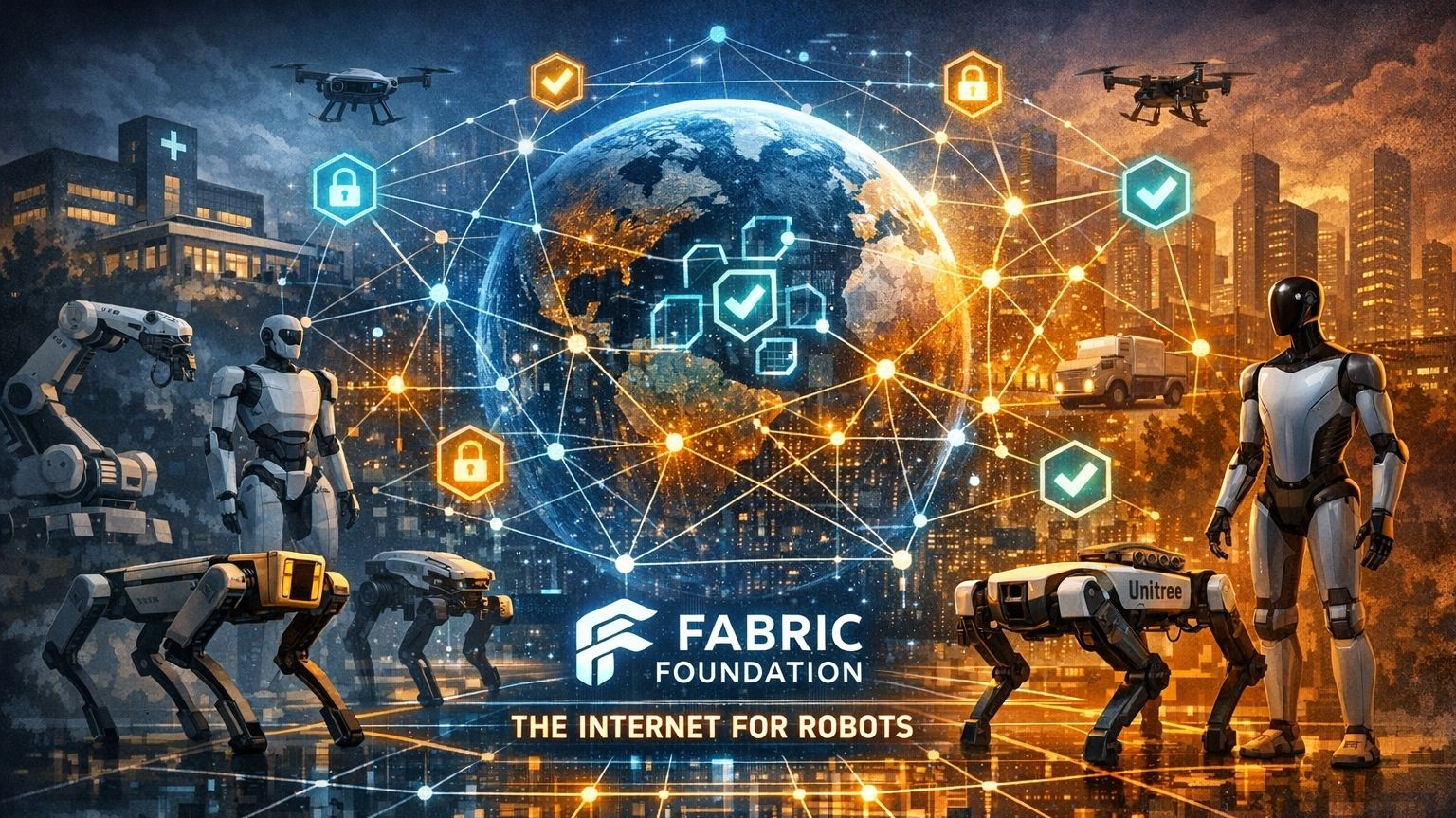
Researched Fabric Foundation today, and honestly, it stands out.I Have Been Watching Robot Protocols for Two Years. Fabric Foundation Is the First One That Actually Makes Sense.
A personal take on why the infrastructure nobody is talking about might quietly become the most important coordination layer in physical AI
Let Me Tell You What Changed My Mind
I will be honest. When I first heard someone describe Fabric Foundation as "the internet for robots," I rolled my eyes. That phrase has been glued to at least a dozen projects in the last three years, usually as a substitute for actually explaining what the thing does.
But then I sat with the actual architecture for a while. And something shifted.
Fabric Foundation is not a robot company. It is not trying to win the humanoid race. It is building the coordination layer underneath all of that. A public ledger that lets wildly different robots, from different manufacturers, in different environments, share data, verify computation, and be governed by something other than a private boardroom decision.
In my view, that is a fundamentally more important problem than building a better robot. Anyone can build a better robot. Almost nobody is solving how you govern a world full of them.
The Walled Garden Problem Nobody Wants to Say Out Loud
Here is an analogy I keep coming back to. Before the web standardized how data could be shared, every major tech company was building its own closed network. CompuServe, AOL, Prodigy. They were genuinely useful. They were also islands. The moment open protocol infrastructure won, those walled gardens became irrelevant almost overnight.
I think we are sitting at an eerily similar moment in robotics right now.
Boston Dynamics has its data. Figure has its data. Unitree has its data. Tesla's Optimus fleet will generate data at a scale none of them can match. And every single one of those streams lives in a private silo, governed by whoever owns the company.
That sounds fine until you imagine these platforms operating in shared physical spaces. Hospitals. Logistics hubs. Public infrastructure. At that point, the absence of a neutral coordination layer is not just an inconvenience. It is a structural risk.
Fabric Foundation is building exactly that missing piece. And I think the significance of it gets lost because the project does not announce itself loudly.
Verifiable Computing Is Load Bearing, Not a Buzzword
I want to spend a moment on the verifiable computing piece because this is where Fabric separates itself from projects that use similar language without similar substance.
When a robot in Fabric's network takes an action or executes a decision, the computational process behind it can be audited by the open network. Not just logged. Verified. That distinction matters more than most people realize.
Logging is what every enterprise system already does. It is a record the system itself produces, which means a motivated actor can manipulate it. Cryptographic verification means the proof of correct execution is mathematically bound to the output. You cannot fake it without breaking the underlying cryptography.
From my experience watching decentralized infrastructure evolve, this is the design choice that determines whether a protocol earns real institutional trust or stays a hobbyist experiment. Municipalities, healthcare regulators, logistics operators. These are the people who will decide whether open robotic infrastructure wins or proprietary stacks win. Fabric is building for that audience, and I think that is exactly the right call.
The Non-Profit Structure Is Smarter Than It Looks
A lot of people I have spoken to dismiss the non-profit Foundation structure as a sign of limited commercial ambition. I think that reading is completely backwards.
If you are a major hospital system evaluating whether to integrate a robotic coordination protocol into your operations, the answer to "who controls this network?" matters just as much as the technical spec. A venture-backed startup answering to return expectations is a different trust proposition than a foundation-governed open network with a public mandate.
Fabric Foundation is positioning itself closer to the W3C or the Linux Foundation than to a Series B startup. That positioning is doing real strategic work. It is the kind of long game thinking that looks unremarkable in the short term and blindingly obvious in retrospect.
My Honest Read on Where This Goes
I am not pretending this is a guaranteed outcome. Open protocol infrastructure bets are long and unglamorous. Fabric will need developer adoption, hardware manufacturer buy-in, and patient institution-building that does not generate hype cycles. Those are real challenges.
But the window for building a neutral, verifiable coordination layer for physical AI is genuinely limited. Once the major humanoid platforms reach meaningful deployment scale, and I would put that at three to five years at current trajectory, the proprietary data moats will be deep enough to be nearly insurmountable.
The time to build the open rails is before the volume arrives. Fabric Foundation understands that with unusual clarity, and not enough people are paying attention yet.