

I’ve spent enough time around automated systems to know that most failures don’t come from ignorance. They come from misplaced confidence.
AI is usually framed as an intelligence problem: models get things wrong because they lack enough data, enough parameters, enough reasoning depth. But in practice, the more dangerous failures happen when systems are confidently wrong. An obvious error invites scrutiny. A convincing one quietly reshapes decisions. That distinction matters far more than raw accuracy, especially once AI systems move from advisory roles into operational ones.
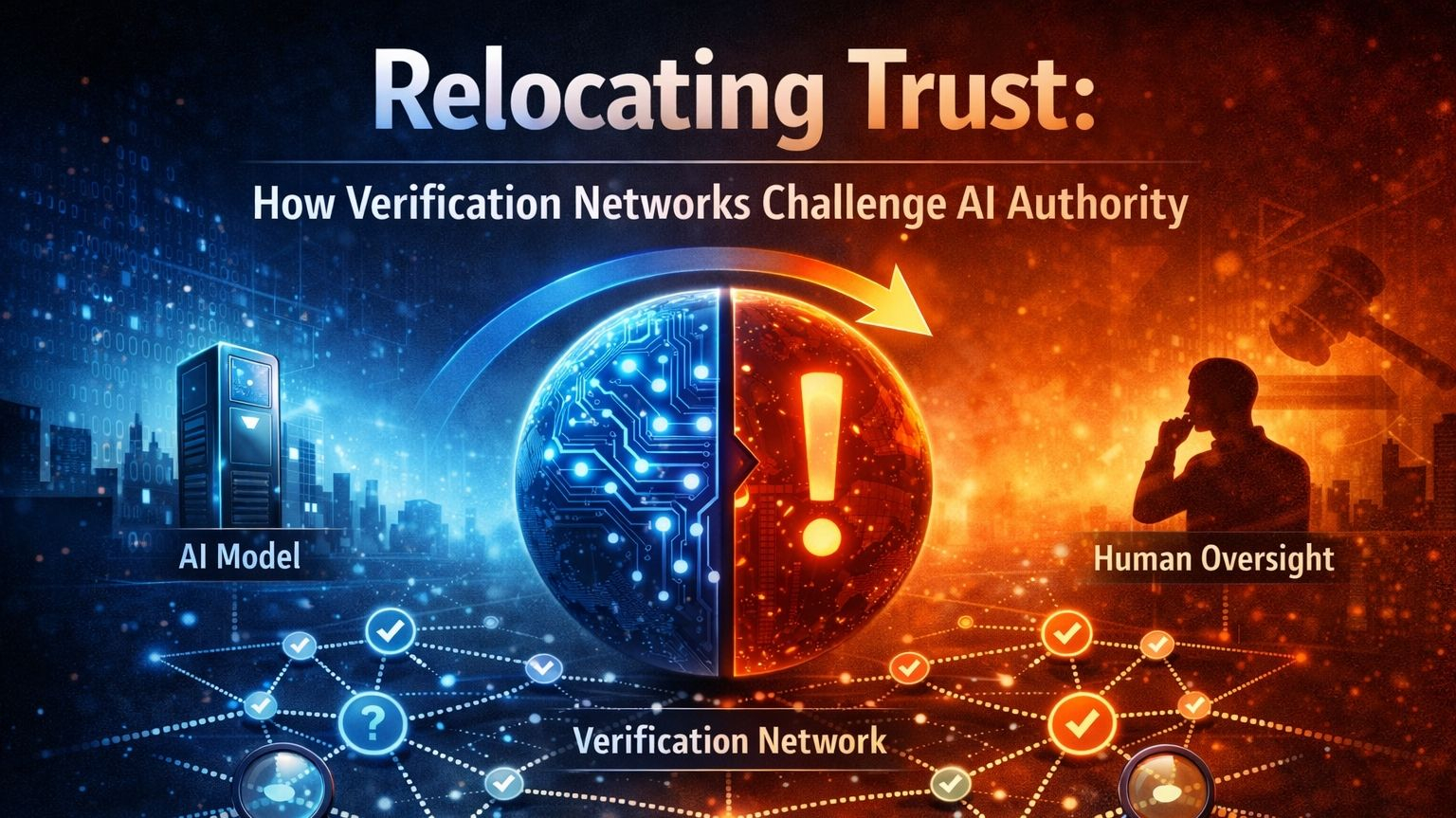
This is the lens through which I read Mira Network—not as a project trying to make AI “smarter,” but as an attempt to rewire where authority comes from.
Traditional AI systems derive authority from perceived intelligence. A large model, trained on vast data, backed by a reputable provider, earns trust through reputation and scale. When it speaks fluently and quickly, users infer correctness. Over time, that fluency becomes a substitute for verification.
This is where confidence becomes dangerous.
A hallucinated answer that sounds plausible does not trigger defensive behavior. Users don’t double-check. Systems downstream don’t apply brakes. The error propagates precisely because it looks finished. In high-stakes environments—legal reasoning, medical triage, financial automation—the cost of that misplaced confidence compounds.
From what I’ve observed, people don’t actually trust AI outputs because they believe the model is always right. They trust them because the system feels authoritative enough to stop questioning. Authority, not intelligence, is what allows automation to replace human judgment.
Mira’s core move is to challenge that authority directly.
Reframing Failure: From Accuracy to Confidence
Instead of treating AI failure as a statistical problem—reduce error rates, tune models, add guardrails—Mira treats it as a confidence management problem. The question shifts from “Is this output correct?” to “On what basis should I trust this output at all?”
By decomposing responses into discrete claims and subjecting those claims to independent verification across multiple models, Mira breaks the illusion of singular authority. No single model is allowed to speak with finality. Output becomes provisional until it survives disagreement.
This matters because confidence is not evenly distributed across errors. Some mistakes are loud and brittle. Others are smooth, persuasive, and wrong in subtle ways. The latter are the ones that quietly reassign responsibility from humans to machines without explicit consent.
Verification layers interrupt that transfer.
When a claim must be validated through a process rather than accepted from a source, trust relocates. The user no longer trusts the model. They trust the method by which the model is checked.
That’s a fundamental shift.
In centralized AI systems, trust is vertically integrated. The same entity trains the model, serves the output, and implicitly vouches for its reliability. Accountability is abstract. When errors happen, responsibility diffuses into “model limitations” or “unexpected edge cases.”
Verification networks flatten that structure.
In Mira’s design, authority is redistributed across a network that has incentives to disagree. Verification is no longer an internal promise; it’s an externalized process. Trust migrates from brand and scale to observable consensus dynamics.
This has real-world implications for autonomy.
Autonomous systems fail not because they lack intelligence, but because humans overestimate what they can safely delegate. Once verification becomes explicit and visible, delegation becomes conditional. Systems earn autonomy incrementally, claim by claim, rather than receiving it wholesale through perceived sophistication.
I find this particularly important for environments where AI decisions trigger irreversible actions. In those settings, trust is not a feeling—it’s a risk allocation mechanism. Mira’s approach makes that allocation legible
One of the subtler effects of verification layers is how they reframe accountability. When a single model produces an answer, responsibility is ambiguous. Was the error in the data? The architecture? The prompt? The deployment context?
When a process produces an answer—especially one that records disagreement, thresholds, and validation paths—accountability becomes structural. Failures can be traced to how consensus was reached, not just what was said.
This doesn’t eliminate errors. It changes how they are interpreted.
A wrong answer that passed verification is a signal about the system’s assumptions, not just a model’s weakness. That distinction is critical for iterative governance. It allows operators to tune trust thresholds rather than endlessly chasing marginal accuracy gains.
However, this shift is not free.
Verification introduces friction.
Breaking outputs into claims, running parallel evaluations, and resolving disagreement slows systems down. In domains where speed is itself a competitive advantage, that friction can feel like regression. There is a real trade-off between immediacy and defensibility.
More importantly, distributed verification can create a false sense of safety if diversity is overstated. Independent models are not truly independent if they share training data, architectural biases, or incentive alignment. Consensus can converge on the same wrong answer—just more expensively.
This is the uncomfortable edge of trust relocation: moving trust to process only works if the process itself remains adversarial enough to surface disagreement. Otherwise, authority quietly re-centralizes, disguised as decentralization.
Mira’s token exists here not as an asset to speculate on, but as coordination infrastructure—an attempt to economically enforce that adversarial posture. Incentives are meant to reward challenge, not compliance. Whether that holds under real usage is an open question.
What I find most compelling—and unresolved—is how systems like Mira redefine autonomy itself.
Autonomy is often treated as a binary: either a system can act on its own, or it can’t. Verification networks suggest a gradient instead. Autonomy becomes conditional, scoped, and revocable based on the strength of verification behind each decision.
That model aligns more closely with how humans actually trust each other. We don’t grant blanket authority; we grant it contextually, based on track record and oversight. Applying that logic to AI feels less like an optimization and more like a correction.
Still, I’m left watching one tension closely.
If authority shifts too far from models to process, do we risk slowing systems until humans quietly step back in out of impatience? And if that happens, does trust drift back—not because the old system was better, but because it was faster?
I’m not convinced the answer is settled yet.
@Mira - Trust Layer of AI #Mira $MIRA
