Stablecoins are no longer a future narrative.
Across emerging and developed markets alike, digital dollars are already used to store value, pay salaries, settle invoices, and move money across borders. From exporters and remote workers to merchants and institutions, stablecoins power real economic activity every day.
Yet despite this adoption, stablecoins have remained structurally constrained.
The limitation was never the asset.
It was the infrastructure around it.
Money does not move on smart contracts alone.
It moves on licensed entities, regulated custody, compliant exchange flows, and trusted payment rails.
This is where Plasma takes a fundamentally different approach.
Owning the Regulated Stack
Payments is one of the most heavily regulated industries in the world. Relying on rented access or third-party licenses introduces fragility into systems that are meant to move money reliably at scale.
For a global stablecoin network, that model breaks quickly.
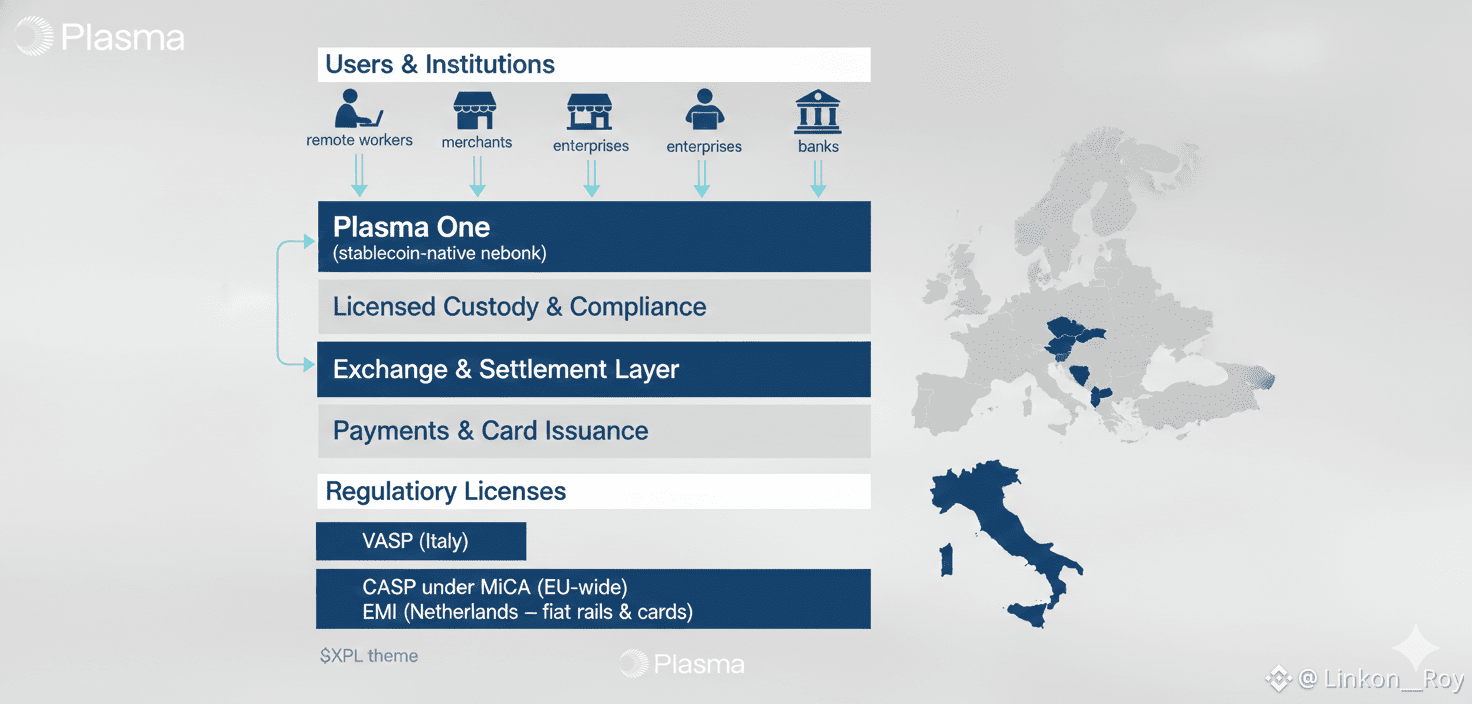
Plasma’s strategy is clear: own the regulated stack end-to-end.
To do this, Plasma has:
Acquired a VASP-licensed entity in Italy
Established a compliance and payments hub in the Netherlands
Begun the process for Crypto-Asset Service Provider (CASP) authorization under MiCA
Started preparation for an Electronic Money Institution (EMI) license to enable fiat connectivity and card issuance
Licenses are not an afterthought.
They are a core product primitive.
They determine who can custody assets, how funds are safeguarded, how users onboard, how fast settlement occurs, and which markets can be served with confidence.
Why Europe — and Why the Netherlands
Europe, under MiCA, offers a harmonized regulatory framework for crypto-native financial infrastructure. A CASP authorization enables compliant custody and exchange services across the region under a single standard.
Within Europe, the Netherlands stands out as a premier payments hub.
It is home to leading payment service providers, merchant acquirers, and sponsor banks that connect businesses to global card and alternative payment networks. Establishing Plasma’s compliance and payments operations there creates the foundation to pursue an EMI — the license that powers wallet accounts, card programs, stored-value balances, and direct access to local fiat rails.
This positioning allows Plasma to:
Serve priority global payment corridors
Meet strict data residency and compliance requirements
Offer institutions a predictable regulatory environment
Scale products without re-architecting for every jurisdiction
Why Licenses Matter for Global Money Movement
Licenses fundamentally change what a product can do.
They allow assets to be custodied under segregation and safeguarding rules.
They enable compliant exchange flows and card issuance.
They unlock fiat on-ramps and off-ramps directly integrated into stablecoin systems.
The result is:
Simpler onboarding
Fewer intermediaries
Faster settlement
Lower fees
Stronger consumer protections
A single operating standard for partners and builders
Instead of stitching together fragmented providers, institutions integrate once and inherit a full compliance and payments stack.
Distribution becomes coverage — at scale.
Plasma One: Turning Infrastructure into a Product
All of this regulated infrastructure powers Plasma One, Plasma’s stablecoin-native neobank.
Plasma One provides a trusted, compliant entry point into digital dollars and makes them usable every day:
Hold and safeguard stablecoin balances
Earn yield directly on digital dollars
Spend globally with a card
Send value instantly across borders
Because Plasma owns the licensing and compliance stack, it avoids the cost, delays, and fragility that come with third-party dependencies.
This is what allows Plasma One to become the cheapest, fastest, and most reliable way to use stablecoins.
Infrastructure That Compounds Across the Ecosystem
As Plasma One scales, the licensed payments stack does not remain siloed.
Builders and partners on Plasma will be able to leverage this infrastructure to launch:
Merchant acceptance and settlement solutions
Corridor-specific cash-in and cash-out
Payroll, payouts, and platform disbursements
Treasury and liquidity tools for businesses holding dollar balances
When licensed infrastructure is shared, balances connect cleanly across merchants and regions. Settlement accelerates. Liquidity becomes more efficient. Network effects emerge around digital dollars that actually move.
Conclusion: The Chain for Money
Plasma is not optimizing for short-term adoption metrics.
It is assembling the regulated capabilities that global money requires.
By owning licenses, embedding compliance, and wiring infrastructure directly into real payment corridors, Plasma transforms stablecoins from speculative instruments into dependable financial rails.
As the licensing stack deepens, partners gain a single, trusted standard for custody, exchange, settlement, and spend.
This is how digital dollars scale.
This is how trust is earned.
This is why Plasma is the chain for money.