
In finance, speed is valuable—but timing is everything.
Markets don’t run on immediacy alone. They run on schedules. Vesting plans unlock over years. Settlements happen after defined windows. Bonds mature on dates that cannot be rushed. Even trust itself is measured in time—how long capital is locked, how predictably agreements are honored, how reliably obligations unfold.
For a long time, blockchains struggled with this reality.
Smart contracts were excellent at instant reactions. If a condition is met, execute now. That logic powered DeFi’s early rise, but it also revealed a quiet limitation. Real-world finance rarely operates on “now.” It operates on later. On not yet. On when the time comes.
Dusk was built with that gap in mind.
Time-based smart contract execution on Dusk is not an add-on or a clever workaround. It is a structural choice—one that allows contracts to execute actions based on time, epochs, and block heights, the same way financial agreements operate in traditional systems. This design positions Dusk as a blockchain that doesn’t just move value, but understands financial timelines.
Why Time Is a First-Class Citizen in Financial Systems
Every mature financial system is built around time.
Interest is calculated per period. Compliance rules enforce holding durations. Settlement cycles exist to manage risk. Vesting schedules align incentives across months or years. None of these mechanisms are optional. They are the backbone of financial trust.
Yet many blockchains treat time as an approximation. Developers simulate schedules using block numbers, external keepers, or manual triggers. These approaches work—until they don’t. Execution becomes dependent on outside actors. Guarantees soften. Predictability fades.
Dusk takes a different path.
Instead of approximating time, Dusk anchors it directly into protocol behavior. Smart contracts on Dusk can reason about time natively, without outsourcing execution to off-chain services or human intervention. This seemingly small difference changes everything.
Epochs, Block Heights, and Deterministic Progression
At the core of Dusk’s time-based execution model is its structured view of chain progression.
Dusk organizes network activity into epochs—clearly defined periods that give the chain a shared sense of “where we are” in time. Epochs are not vague markers. They are deterministic boundaries that contracts can reference with certainty.
Alongside epochs, block height provides granular progression. Because block production follows protocol-defined rules, block height becomes a reliable clock. When a contract specifies that an action should occur after a certain block or epoch, that instruction is enforced by the chain itself.
There is no guessing. No external scheduling service. No “someone must remember to execute this.”
Time moves forward, and the contract moves with it.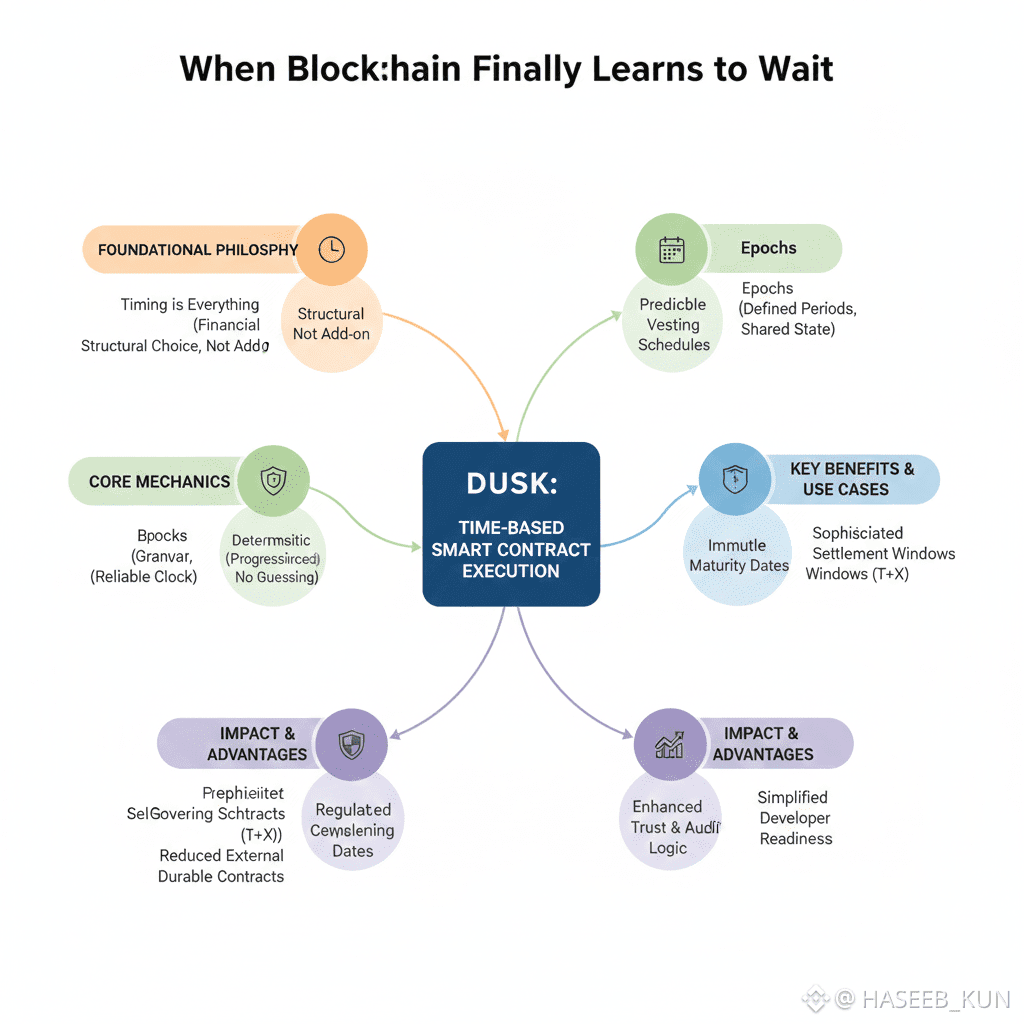
From Reactive Logic to Scheduled Behavior
Most smart contracts today are reactive. They wait. They listen. They act only when called.
But finance is not reactive by nature. It is scheduled.
A vesting agreement doesn’t wait for a request—it unlocks because time has passed. A settlement doesn’t finalize when someone clicks a button—it completes because the window has closed.
Dusk allows developers to encode this reality directly into contracts.
Instead of writing logic that says “if someone calls this function after X”, developers can write logic that understands “when X has arrived.” The distinction is subtle in syntax, but massive in consequence.
Contracts become self-governing over time. Execution aligns with expectation, not intervention.
Vesting That Feels Like Real Vesting
Token vesting is a perfect example of where time-based execution matters.
On many chains, vesting is technically enforced but practically manual. Tokens unlock only when someone claims them. Miss a claim, and the schedule becomes meaningless. From a financial perspective, this is fragile.
On Dusk, vesting can be written as a time-aware process.
Unlocks occur based on epochs or block thresholds. The contract doesn’t wait for permission. It follows the schedule. This mirrors how vesting works in traditional equity compensation—predictable, auditable, and independent of user behavior.
For founders, investors, and institutions, this predictability is not a luxury. It’s a requirement.
Settlement Windows That Reflect Real Markets
Instant settlement is impressive—but it’s not always desirable.
Traditional markets deliberately introduce settlement delays to manage counterparty risk, allow reconciliation, and meet regulatory obligations. T+1 and T+2 cycles exist for a reason.
Dusk’s time-based execution model allows these patterns to exist on-chain without distortion.
Trades can enter a pending phase. Settlement can occur at a defined epoch. Finality can be delayed until all protocol conditions are satisfied. This creates room for more sophisticated market structures—ones that feel familiar to institutions while retaining on-chain transparency.
Dusk doesn’t force finance to adapt to blockchain timing. It adapts blockchain timing to finance.
Maturity Dates That Cannot Be Manipulated
In financial agreements, maturity dates are sacred.
A bond does not mature early because someone wants liquidity. It does not mature late because someone forgot. It matures when the date arrives—no sooner, no later.
Dusk enables this level of certainty.
By tying maturity logic directly to chain progression, contracts cannot be rushed or stalled. Execution happens because the protocol has advanced to the defined point in time. This removes discretion, ambiguity, and risk.
For long-term financial instruments, this kind of immutability is essential.
Epoch-Based Logic as a Design Language
Epochs on Dusk are more than technical cycles. They are a language for financial logic.
Developers can structure contracts around epoch transitions—updating state, releasing funds, enforcing rules, or resetting conditions at known intervals. This aligns naturally with quarterly reporting, periodic settlements, and recurring obligations.
Instead of fighting the chain’s notion of time, contracts speak it fluently.
This makes code easier to reason about, easier to audit, and easier to trust.
Eliminating Dependency on External Executors
Many blockchains rely on external “keepers” to trigger time-based actions. While functional, this introduces a quiet risk: execution depends on someone else showing up.
Dusk removes this dependency.
Time-based execution is enforced by the protocol itself. Contracts progress because the chain progresses. There is no reliance on incentives, availability, or third-party infrastructure.
This makes Dusk particularly well-suited for regulated and institutional environments, where operational certainty matters as much as technical correctness.
Designing Contracts That Live for Years
Short-lived contracts can tolerate imperfections. Long-lived financial agreements cannot.
Dusk’s approach to time allows contracts to remain correct across long horizons. Vesting schedules that span years. Instruments with distant maturity dates. Compliance rules that must hold indefinitely.
Because time is protocol-defined, these contracts remain anchored. They do not drift. They do not degrade. They do not depend on changing off-chain assumptions.
This durability is what separates experimentation from infrastructure.
Human Expectations, Encoded Correctly
Behind every smart contract is a human expectation.
People expect funds to unlock when promised. Institutions expect settlements on schedule. Regulators expect rules to be enforced consistently.
Dusk’s time-based execution respects these expectations because it mirrors how people already think about financial time. This reduces friction, confusion, and mistrust—three of the biggest barriers to adoption.
When blockchain behavior feels familiar, trust follows naturally.
Time as a Tool for Compliance, Not Resistance
Compliance is often framed as a constraint. In reality, it is often about timing—how long assets are held, when reports are filed, when actions are allowed.
Dusk makes these rules enforceable by design.
Time-based conditions can be written directly into contracts, ensuring that compliance requirements are met automatically. This reduces manual oversight and lowers operational burden without sacrificing control.
For regulated finance, this is not optional. It is foundational.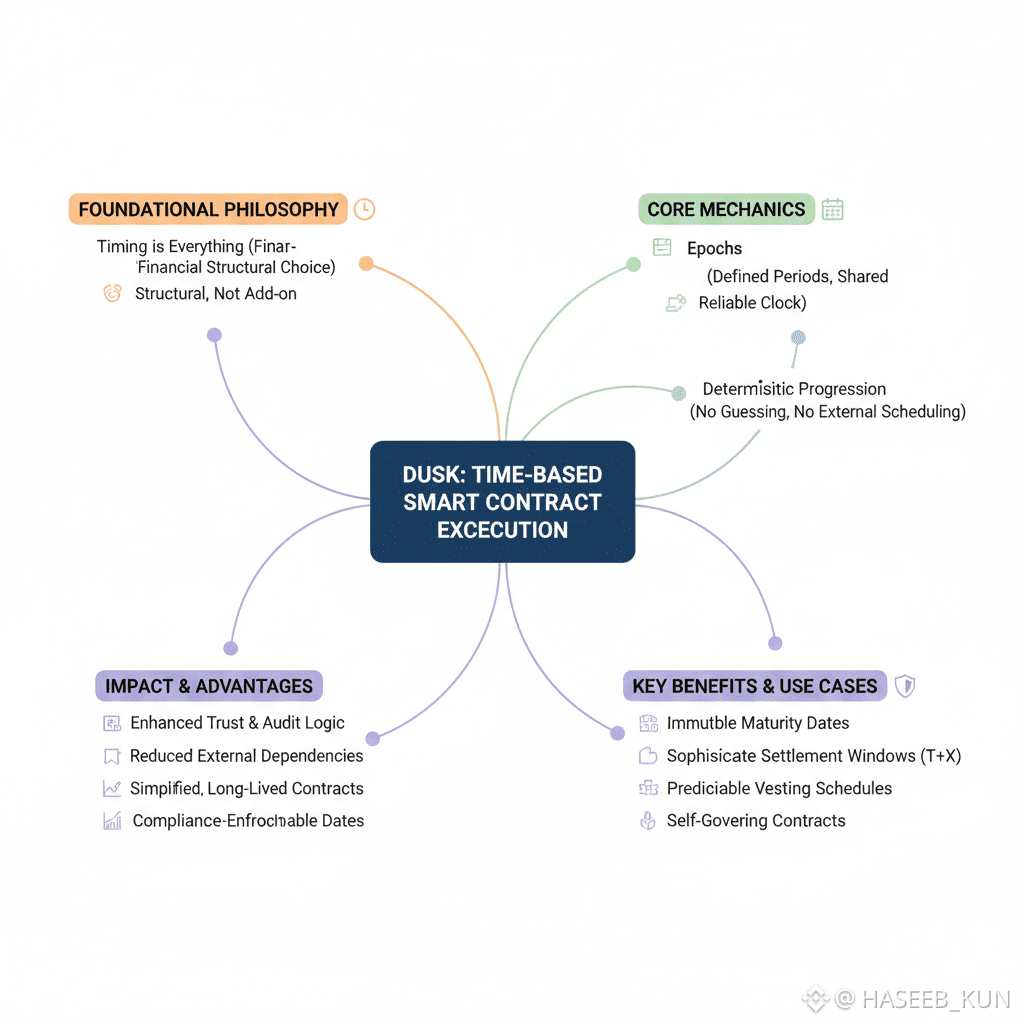
Why Time-Based Execution Defines Dusk’s Role in On-Chain Finance
Dusk is not trying to be the fastest blockchain in every metric. It is trying to be the right blockchain for financial reality.
By embedding time into smart contract execution, Dusk allows on-chain finance to mature—moving beyond instant reactions into scheduled, predictable, and enforceable agreements.
This is how blockchains graduate from tools to systems.
Final Reflection: When Time Becomes Trust
Trust in finance is built slowly. It compounds. It depends on things happening exactly when they are supposed to.
Dusk understands this.
By enabling smart contracts to execute based on time, epochs, and block heights—without external triggers or manual intervention—Dusk turns time into a guarantee.
Not an approximation.
Not a suggestion.
A promise enforced by the chain itself.
That is what real financial infrastructure looks like on-chain.
