
For years, Web3 storage has been stuck in a frustrating tradeoff. You either paid a lot for security and permanence, or you accepted lower costs at the expense of flexibility and performance. Projects like Filecoin and Arweave mastered their own lanes, but neither managed to escape the triangle of security, cost, and programmability.
Walrus enters this picture with a very different mindset.
Backed by Mysten Labs and supported by a $140M private round at a $2B valuation, Walrus isn’t trying to optimize what already exists. It’s trying to change how we think about decentralized storage altogether. Not as a passive data warehouse, but as active, programmable infrastructure, deeply integrated with the Sui ecosystem.
This is not a surface-level upgrade. It’s a structural shift—across technology, ecosystem design, and business models.

1. Technology: Escaping the Old Tradeoffs
Most storage protocols compete along a single axis. More redundancy means more security, but also more cost. Less redundancy lowers costs, but increases risk. Walrus breaks this loop by questioning a long-held assumption: that security must come from massive duplication.
Its RedStuff two-dimensional erasure coding does something smarter. Data is split both horizontally and vertically, with built-in verification at each layer. The result is striking—99.98% availability with only 4–5x redundancy, even if two-thirds of nodes go offline.
That’s not theory. In practice, this brings dramatic cost reductions. Storing 100GB of AI training data drops from roughly $12,000 on Filecoin to about $2,400 on Walrus. Compared to Arweave, the savings are even more extreme. For the first time, decentralized storage becomes cheaper than many centralized cloud options—without giving up security.
But the real breakthrough isn’t cost. It’s programmability.
By tightly coupling with Sui, Walrus turns stored data into on-chain objects that can be managed through Move smart contracts. That changes everything. NFT metadata can update in real time. AI datasets can have layered access controls. RWA documents can remain private yet verifiable.
During testnet, Decrypt Media used Walrus to automate revenue sharing for a 4K video library. What used to take days became near-instant. That’s not just storage—it’s infrastructure that participates in value flow.
There are tradeoffs. Walrus relies on Sui for consensus and execution. When Sui traffic spikes, storage latency increases. This dependency limits autonomy, and it’s a real risk the team will need to manage carefully.
2. Ecosystem: From Dependency to Mutual Growth
Most storage projects “integrate” with ecosystems in name only. They plug in, chase traffic, and remain replaceable. Walrus takes a different route—symbiosis.
Sui handles coordination, incentives, and execution. Walrus focuses purely on storage performance and programmability. Each strengthens the other. Sui gains a native solution for AI and RWA data. Walrus avoids the cost and complexity of running its own chain.
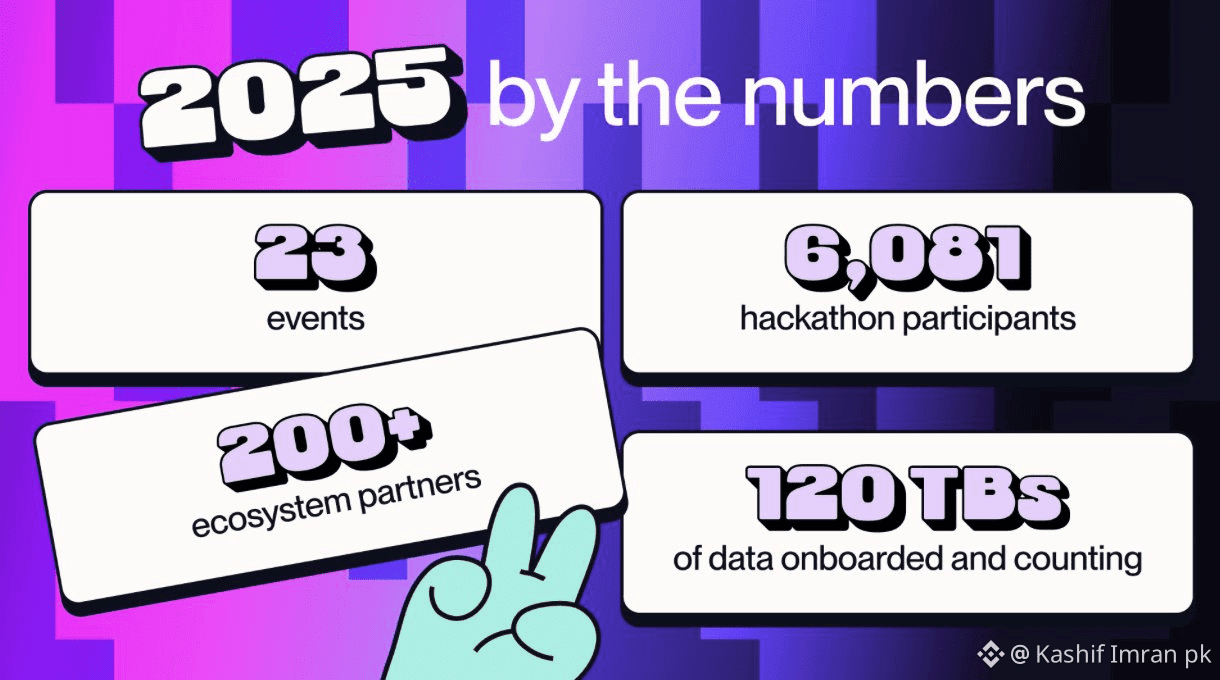
This design choice paid off fast. The Walrus testnet reached 14 million accounts, processed 5 million data blobs, and stored nearly 28TB of active data.
Capital was used strategically too. Over a third of funding supports Sui ecosystem builders—subsidizing AI teams, reducing RWA onboarding costs, and driving adoption from the inside out. Today, nearly 80% of Sui ecosystem projects use Walrus.
There’s also an economic loop. Storage usage consumes SUI as gas. At scale, this could meaningfully reduce circulating supply, aligning storage growth with ecosystem value.
Walrus isn’t stopping there. Ethereum and BSC integrations are underway, with a clear goal: reduce reliance on any single ecosystem. That said, Sui still dominates usage and revenue today. Expanding outward will be slower and harder than it looks.
3. Business: Moving Beyond “Pay Per GB”
Most storage protocols monetize one thing: capacity. Walrus monetizes outcomes.
For AI workloads, pricing adapts to how data is actually used. Frequently accessed data costs a bit more. Cold data costs less. Add-ons like data rights management and access control create extra revenue layers. Partnering with compute providers allows Walrus to earn from “storage + compute” bundles instead of storage alone.
For RWA, the model shifts again. Compliance reviews, long-term data guarantees, traceability services, and staking-based priority access turn storage into an end-to-end service. One commercial real estate RWA project alone generated nearly $200K in revenue, with strong margins.
AI and RWA now account for almost all core revenue. That focus brings clarity—and risk. Client concentration remains high, and enterprise adoption is still early.
Token design ties it together. WAL captures value through payments, staking, and governance. A portion of revenue goes directly into buybacks and burns, aligning token value with real business growth. SUI remains the execution layer, keeping friction low for users.
4. What This Means for Web3 Storage
Walrus proves something important: the old tradeoffs aren’t permanent.
Low cost doesn’t have to mean low security. Storage doesn’t have to be passive. Ecosystem integration doesn’t have to mean dependence. And monetization doesn’t have to stop at raw capacity.
This is why other projects are starting to move. Filecoin is pushing retrieval upgrades. Arweave is exploring lighter storage options. The bar has been raised.
That said, Walrus isn’t guaranteed success. Ecosystem reliance, scenario concentration, and cross-chain expansion are real challenges. Paradigm builders don’t fail because ideas are weak—they fail when execution falls out of balance.
Final Take
Walrus didn’t win by chasing metrics. It won by changing the frame.
By rethinking storage as programmable infrastructure, embedding itself deeply into an ecosystem, and designing business models around real use cases, it has set a new reference point for the industry.
If the team can maintain balance—between autonomy and integration, focus and expansion—Walrus may become more than a strong project. It could become the blueprint for what decentralized storage looks like in the next phase of Web3.

