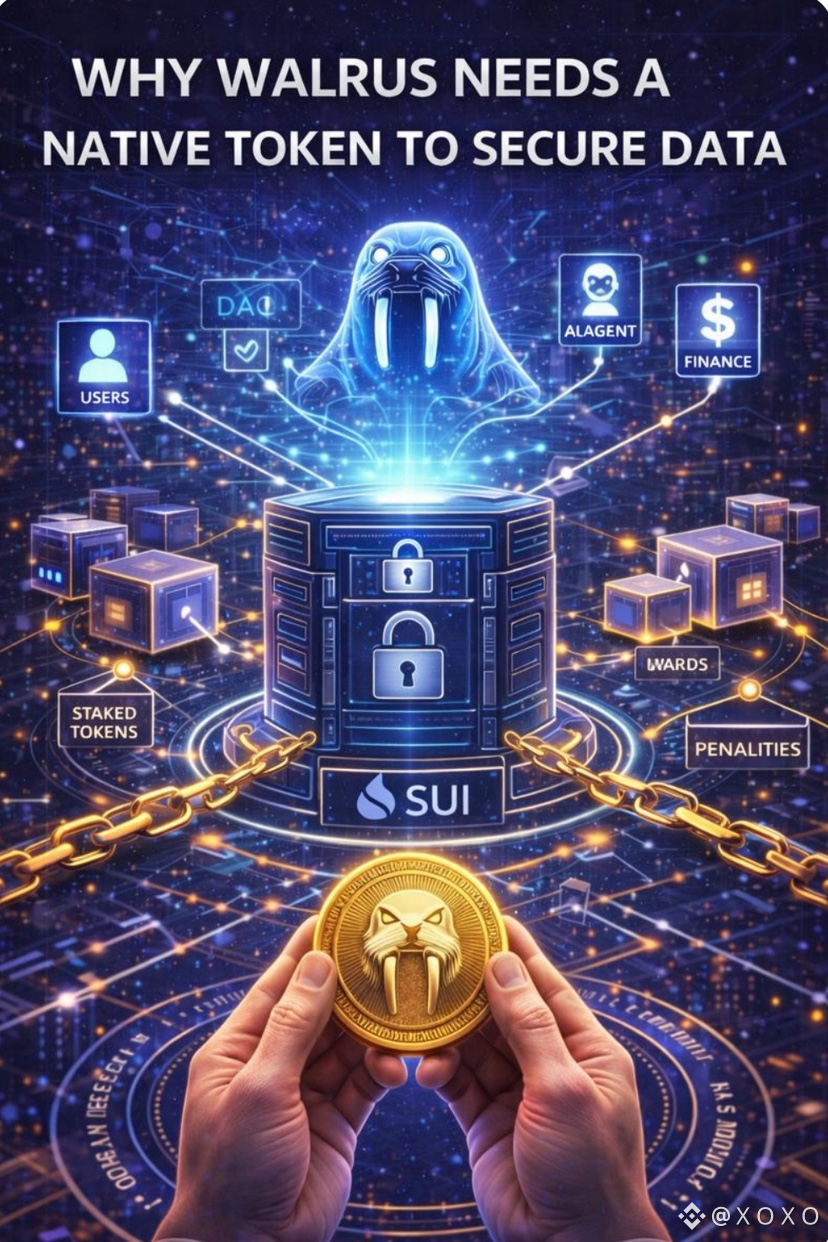
When people think about tokens in crypto, they usually think about speculation. Price charts, market caps, and hype cycles dominate the conversation. But the original purpose of a token was never trading. It was security. Tokens exist to coordinate behaviour in decentralised systems, to make people do the right thing even when they don’t know or trust each other.
@Walrus 🦭/acc is a perfect example of why that matters.
Walrus is not just storing files. It is storing memory for blockchains, AI agents, DAOs, games, and financial systems. It is turning data into something that smart contracts can own, verify, and depend on. That means data availability becomes part of the trust layer of Web3. And whenever something becomes part of the trust layer, it must be secured economically.
That is what a native token is for.
Data is only valuable if it is there
At the heart of Walrus is a simple promise: if you store data, it will be there when you need it.
That sounds trivial, but in decentralized systems it is incredibly hard to guarantee. Storage nodes are not owned by Walrus. They are independent operators with their own incentives, costs, and motivations. They have to pay for hardware, bandwidth, and electricity. If storing your data stops being profitable, they could simply drop it.
Without a token, there is no way to make this promise credible.
A native token allows Walrus to turn storage into an economic contract. Storage providers stake tokens to participate. They earn tokens for holding and serving data. They lose tokens if they fail to do their job. This creates a powerful feedback loop. The more valuable the data, the more valuable the token. The more valuable the token, the stronger the incentive to keep the data safe.
This is how Walrus transforms a network of strangers into a reliable infrastructure layer.
Why fees alone are not enough
Some people ask why Walrus cannot just use simple payments. Users pay for storage, providers get paid, and everything works. That logic misses the most important part of decentralized security.
Payments reward behavior after it happens. Staking and slashing control behavior before it happens.
If a storage provider only gets paid for serving data, they can always walk away when it becomes inconvenient. There is no penalty for disappearing. In a system where data might be needed months or years later, that is unacceptable.
A native token allows Walrus to require providers to put something at risk. They must lock up value that they lose if they break the rules. That transforms the network from a marketplace into a security system.
Data becomes protected not just by goodwill or short-term profit, but by long-term economic alignment.
Making availability provable
Walrus uses cryptographic proofs to verify that data is actually being stored. But proofs alone do not enforce behavior. They only reveal it.
The token is what gives those proofs teeth.
When a provider submits a valid proof, they earn rewards. When they fail to do so, they are penalized. This makes data availability measurable and enforceable. It turns storage into something the blockchain can reason about.
This is critical for applications that depend on Walrus. An AI agent cannot function if its training data disappears. A DAO cannot govern if its records vanish. A financial protocol cannot operate if its history is lost.
The token ensures that all of these systems can trust the storage layer without trusting individual operators.
Aligning users, providers, and applications
The beauty of a native token is that it aligns every participant in the system.
Users want their data to be safe. Providers want to earn rewards. Applications want reliable infrastructure.
The token connects all three.
Users pay in the token to store data. Providers earn the token for serving it. Applications build on top of the network, increasing demand for both storage and the token. This creates a circular economy where growth reinforces security.
As more valuable data is stored, the token becomes more valuable. As the token becomes more valuable, providers have more incentive to protect the data. This positive feedback loop is what turns Walrus into a long-term foundation instead of a temporary service.
Why this matters more than storage
Walrus is not just about files. It is about turning data into a first-class on-chain resource.
Once data becomes part of smart contracts, governance, AI, and finance, it becomes as important as money. You would never run a financial system on an unsecured ledger. You should not run a data-driven Web3 on an unsecured storage layer.
The native token is what makes Walrus secure enough to be trusted with that responsibility.
It is not a speculative asset. It is the backbone of a decentralized memory layer for the internet.
And in a future where everything depends on data, that might be one of the most important roles a token can play.