


Most people grow up believing that if something breaks, it is lost. A glass shatters, a drive fails, a server goes offline, and whatever was inside disappears. That way of thinking still shapes how much of the internet works. We copy files. We make backups. We hope the copies are enough. However hope is not a system and as digital life grows more complex, that old approach keeps showing its limits.
@Walrus 🦭/acc was designed by people who no longer trust hope. They trust mathematics.
Before talking about fountain codes, it helps to understand the emotional problem they solve. In a decentralized network, no one can promise that a machine will stay online. Operators go away. Data centers close. Incentives change. Even the most honest participant can disappear overnight. If storage depends on machines behaving forever, it will fail. Walrus begins with the opposite assumption. Everything will fail eventually. Therefore recovery must be built into the fabric of the system.
This is where fountain codes come in.
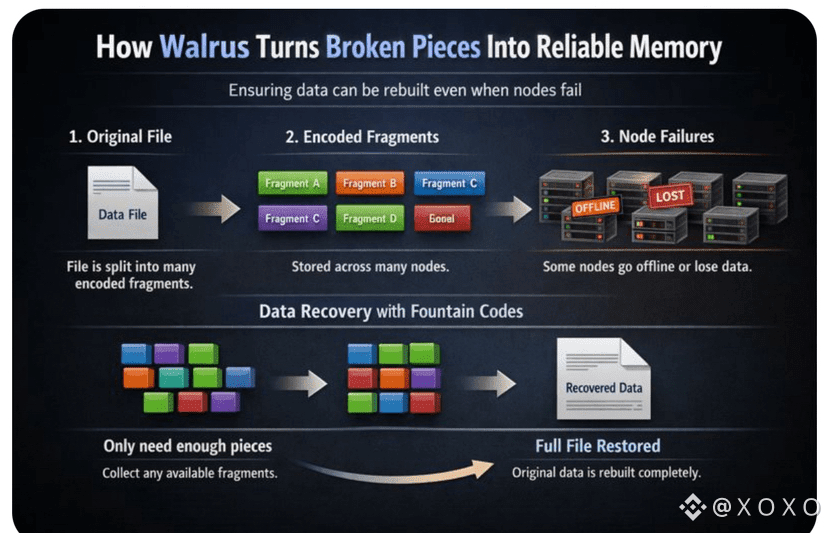
At a high level, a fountain code is a way of breaking data into many small pieces in such a way that any subset of them can be used to reconstruct the original. Imagine you pour water from a fountain into many cups. You do not need every cup to get a full glass again. You only need enough of them. The system does not care which cups they are. It only cares that there are enough.
In Walrus, a file is transformed into many encoded fragments. If the original file is one gigabyte, it might be turned into something like fifty fragments, where any twenty five of them are enough to rebuild the file. Those fragments are then distributed across many independent storage nodes. Some nodes will go offline. Some will behave badly. Some will leave. However as long as enough fragments remain, the data survives.
What makes this powerful is that recovery does not depend on any particular node. It depends on the network as a whole. You do not have to know which fragments you lost. You just gather what is available and rebuild from there. This is very different from traditional backup systems where losing a specific copy can break everything.
Moreover fountain codes allow Walrus to keep costs low while staying safe. Instead of storing ten or twenty full copies of a file, the network stores a mathematically optimized set of fragments that only adds about five times overhead. That means a one gigabyte file might require about five gigabytes of network storage. In exchange, it gains the ability to survive massive node failures.
From a quantitative perspective, this gives Walrus a failure tolerance that would be impossible with simple replication. If the network is configured so that half the fragments can disappear and data is still recoverable, then fifty percent of the storage nodes could go offline without losing the file. That is not a theoretical edge case. In decentralized networks, churn at that level is normal over long periods.
However fountain codes are only part of the story. Walrus also continuously checks that nodes are still holding their assigned fragments. Nodes must produce cryptographic proofs that they have the data. If they fail to do so, they are replaced. Missing fragments are regenerated from the remaining ones and redistributed. This creates a loop where the network constantly repairs itself.
What makes fountain codes special in this context is that they make repair easy. You do not need the original file. You only need enough fragments. The network can rebuild lost pieces without any single point of knowledge. Recovery becomes routine rather than exceptional.
This has deep implications for how applications are built. A game world stored on Walrus does not depend on one server or one company. If some nodes disappear, the world still exists. An AI dataset does not depend on a particular provider. It exists as long as the network holds enough fragments. A DAO archive does not disappear because a team dissolves.
In other words, fountain codes turn storage into something closer to a living organism. Pieces are lost and regrown. The whole remains intact.
What I find most striking is how this changes the emotional relationship between builders and infrastructure. Instead of worrying about whether a server is still running, they can rely on a system that expects failure and absorbs it. That kind of quiet reliability is what allows people to build long term systems without constantly looking over their shoulder.
My take is that fountain codes are one of the most underappreciated ideas in Web3. They do not make headlines. They do not attract speculation. However they are the reason a decentralized storage network can behave like real infrastructure rather than a fragile experiment. Walrus has chosen to build on mathematics that understands brokenness, and in doing so it has made something that stays whole even when everything around it changes.