
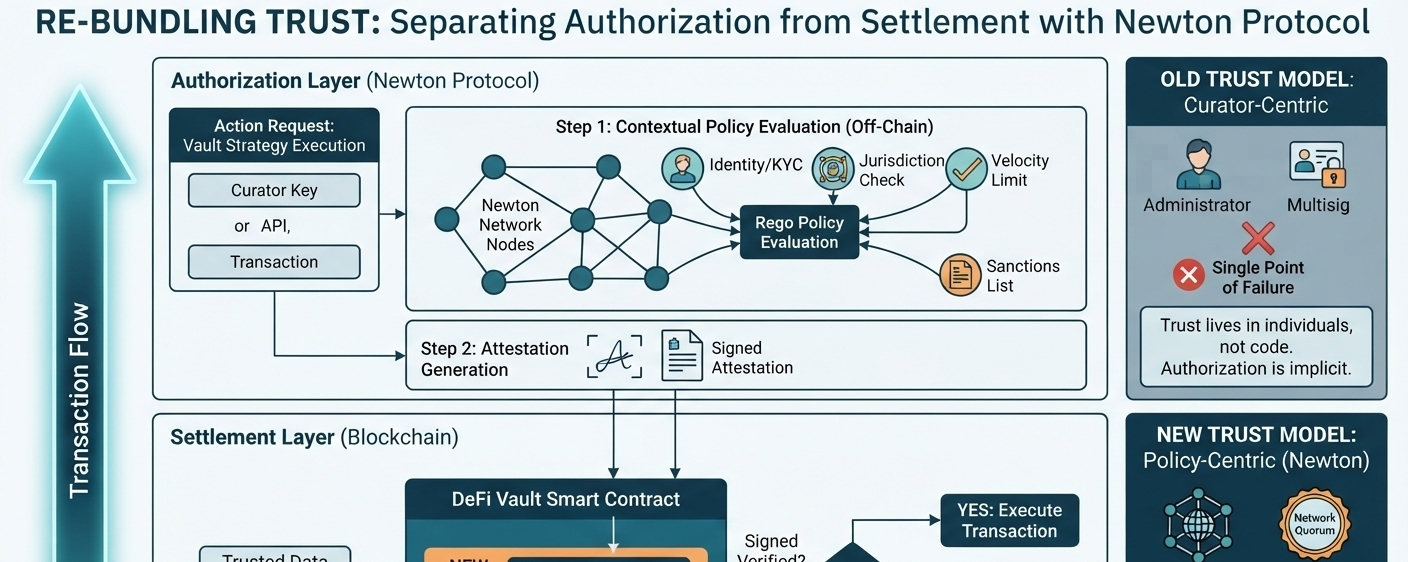

Newton Protocol is the name I keep coming back to whenever I think about a question that quietly bothers me: who actually decides what a smart contract is allowed to do, in the moment it's doing it?
I've been thinking about something lately. We talk about DeFi vaults like they're these neutral, self-running machines. You deposit funds, a curator manages a strategy, and code executes the rest. But when I look closer, most of that trust doesn't actually live in the code. It lives in a person. A curator with admin keys. A multisig with five signers who could, in theory, move funds somewhere they shouldn't. A frontend that quietly blocks certain wallets, while the underlying contract would happily let them through if they just called it directly.
That gap has always felt strange to me. We built these systems to remove trust, and somewhere along the way we just relocated it. It didn't disappear.
Here's the problem in plain terms. A vault has rules on paper who can withdraw, what counterparties are safe, what limits apply. But those rules often live outside the contract. They live in a compliance team's spreadsheet, or a curator's judgment, or a frontend's filter. None of that is enforced at the moment the transaction actually executes. So if someone bypasses the interface and talks to the contract directly, or if a key gets compromised, or if a curator simply makes a bad call, there's nothing stopping the money from moving. The rule existed. It just wasn't enforced where it mattered.
I think this is why so many "hacks" in this space aren't really hacks in the technical sense. They're authorization failures. A key that shouldn't have had that much power did. A check that should have run at execution time didn't. We keep calling these incidents exploits, but a lot of them are really just missing authorization layers.
Traditional finance solved a version of this problem a long time ago. When you swipe a card, the payment doesn't just settle. It gets checked first fraud rules, balance, identity and only then does the network say yes. Settlement and authorization are two separate steps. Onchain finance mostly skipped that separation. We went straight to settlement, assuming good code was enough.
This is where Newton Protocol's idea sits with me. Instead of trusting a curator's word, or a frontend's filters, or a static onchain limit that can't adapt to context, Newton lets a vault require a policy check before a sensitive action actually executes. The vault doesn't just ask "does this transaction match the code's syntax." It asks "has this action been evaluated against the rules we agreed on, and did it pass." That check produces a signed attestation a proof, not a promise that gets verified onchain before the action goes through.
What I find interesting is how this shifts where the trust actually sits. The policy itself is written in a language called Rego, the same one used in enterprise cloud systems, so it's not some opaque black box it's readable, composable logic. Sanctions screening, jurisdiction limits, velocity caps, source-of-funds checks these become rules a network of independent operators evaluate and sign off on collectively, with actual stake at risk if they get it wrong. So a vault isn't relying on one curator's honesty anymore. It's relying on a quorum of economically accountable parties agreeing that a specific action satisfied a specific policy, with a way to challenge them if they didn't.
The real-world impact, if I'm honest with myself, isn't flashy. It's boring in the way infrastructure is supposed to be boring. A tokenized asset vault could enforce that only eligible investors ever touch certain functions, regardless of who holds the admin key. A stablecoin transfer could be gated on sanctions checks that happen at the transaction level, not the onboarding level. An AI agent managing a treasury could be constrained by machine-speed rules instead of a human review queue that can't keep up with it anyway.
What feels strong to me is the separation of concerns letting settlement stay decentralized and fast while authorization becomes its own accountable layer. What feels uncertain is adoption. Policy layers only matter if builders actually choose to require them, and that means giving up some convenience for accountability, which isn't always an easy sell.
If this kind of thinking becomes normal, I imagine vaults where "trust the curator" stops being the whole security model, and starts being just one input among several enforced conditions. That's a quieter kind of progress, but maybe a more honest one.
So I keep asking myself are we actually building trustless systems, or did we just build systems that trust different people than before? Does a vault need a policy layer to be real DeFi, or is that just compliance wearing a new outfit? And if code alone was never enough to keep funds safe, what does that say about everything we've already built on top of it?
My honest takeaway, without trying to sell anyone on anything: the interesting problems in crypto right now aren't about faster chains or bigger yields. They're about where authority actually lives inside a system that claims to have none. That's worth sitting with.