There comes a point where spending enough years around crypto changes the way you react to new projects. You stop getting excited by countdown timers, polished launch videos, influencer threads filled with rocket emojis, and founders promising they're about to "redefine finance." You've heard every version of that story already. A new blockchain appears every few months. Every token claims to unlock some revolutionary economy. Every market cycle somehow convinces people that this time is different, right until it isn't.
Now AI has become the latest ingredient that gets sprinkled onto almost everything. Apparently every protocol has AI now. Every wallet is becoming "intelligent." Every decentralized application wants to be autonomous. Sometimes it feels less like innovation and more like watching the same movie with different actors. Honestly, after enough cycles, skepticism becomes less of a personality trait and more of a survival mechanism.
That's probably why Newton Protocol caught my attention—not because I suddenly became optimistic, but because it wasn't trying to sell me another digital utopia.
The first thing I kept asking myself was surprisingly simple: is this solving an actual problem, or is it just creating another token looking for a reason to exist?
That question matters more than ever because crypto has become very good at manufacturing demand for things nobody asked for. We've built endless infrastructure that mostly serves other infrastructure. We've launched protocols that exist because another protocol exists. Somewhere along the way, the technology started serving itself instead of people.
Newton Protocol doesn't completely escape that concern, but at least the problem it's pointing at feels real.
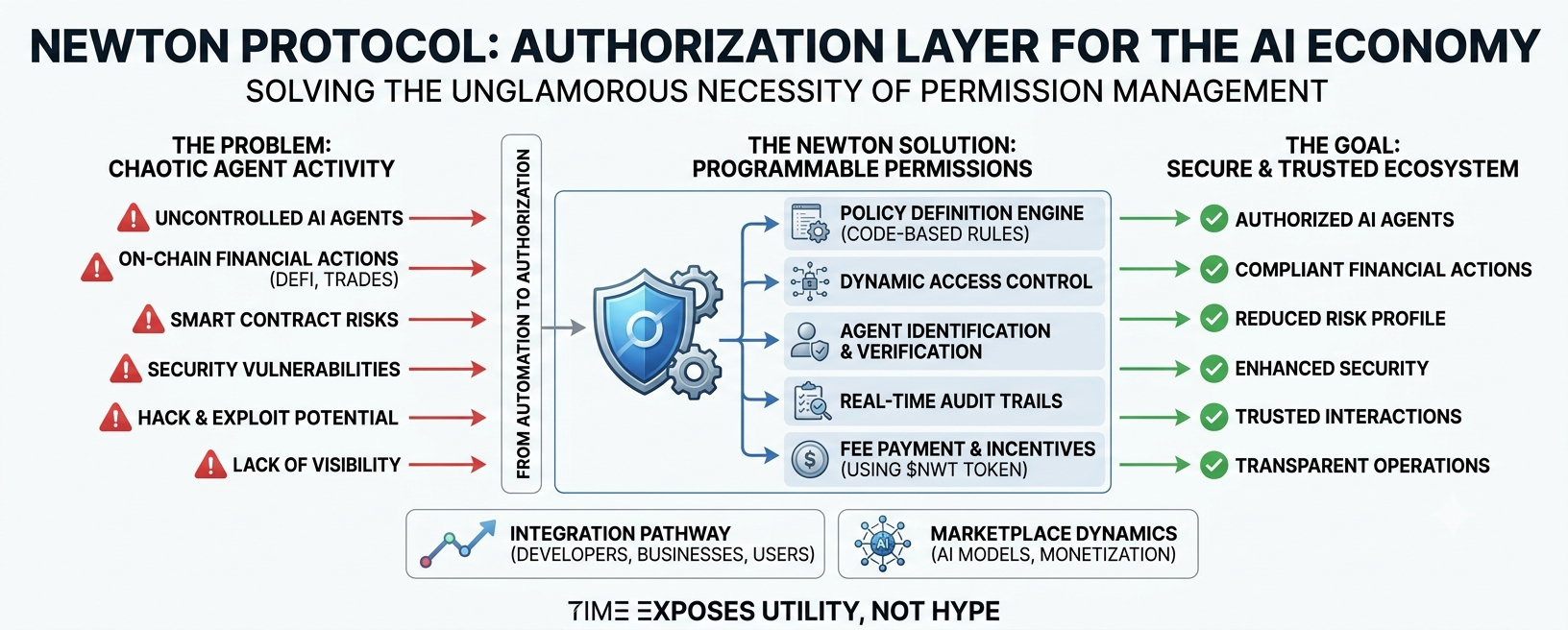
If AI agents are eventually trusted to move money, execute trades, manage assets, or interact with decentralized finance on behalf of users, someone has to decide what those agents are actually allowed to do. That sounds painfully boring compared to flashy AI demos, but boring problems often turn out to be the important ones.
The crypto industry has spent years talking about automation. What it hasn't spent nearly enough time talking about is authorization.
Those aren't the same thing.
Automating bad decisions simply means mistakes happen faster.
Giving software access to financial assets without meaningful guardrails sounds exciting until something inevitably goes wrong. And history suggests things always go wrong eventually.
That's the part that worries me.
We've already watched bridges get hacked, multisigs fail, smart contracts exploited, centralized exchanges collapse, stablecoins lose their peg, and protocols discover "unexpected edge cases" that somehow cost hundreds of millions of dollars.
Now we're supposed to trust AI to participate in financial systems?
Maybe someday.
But trust isn't something you add with marketing.
It's something you earn over time.
That makes Newton's overall direction more interesting than its buzzwords.
Instead of trying to convince everyone AI is magically trustworthy, the protocol seems focused on building ways to define permissions before actions actually happen. In theory, that sounds much healthier than pretending autonomous systems will simply make perfect decisions because they use machine learning.
Whether that works in practice is an entirely different conversation.
Crypto has never struggled with ideas.
Execution has always been the difficult part.
That's where reality usually starts punching holes through the pitch deck.
Because once you leave conference presentations and Twitter spaces behind, adoption becomes brutally difficult.
Developers have to integrate it.
Businesses have to trust it.
Users have to understand why it matters.
None of those things happen automatically.
Infrastructure projects often suffer from a strange curse. They're essential if successful, yet almost invisible to ordinary users. Nobody wakes up excited about authorization layers. Nobody posts memes about transaction policies. Nobody buys coffee because a protocol improved permission management.
Infrastructure is rarely glamorous.
It's plumbing.
And yet civilization tends to notice plumbing only after it breaks.
Maybe blockchain isn't much different.
The AI marketplace angle also leaves me with mixed feelings.
The idea itself makes sense. If developers build useful AI models, there should probably be some way for them to distribute and monetize those models inside decentralized ecosystems.
But marketplaces are incredibly difficult to build.
Not technically.
Economically.
People don't join marketplaces because they exist.
They join because everyone else is already there.
That's a chicken-and-egg problem that has quietly buried countless crypto projects over the years.
Building technology is difficult.
Building network effects is significantly harder.
That uncertainty hangs over Newton just as much as any other protocol trying to create an ecosystem instead of simply launching software.
Then there's the token.
I always find myself asking the same uncomfortable question.
Does this really need one?
Crypto rarely asks that question honestly.
Every project naturally believes its token is essential.
Investors naturally hope demand keeps growing.
Reality usually lands somewhere in between.
If the token genuinely secures the network, aligns incentives, pays for services, and encourages long-term participation, then maybe it earns its place.
If it mostly exists because every protocol feels obligated to launch one, that's a different story.
Time usually exposes which category a project belongs to.
Not launch week.
Not the first exchange listing.
Certainly not social media excitement.
Time.
Another thing I've learned after multiple market cycles is that good technology doesn't automatically win.
Sometimes mediocre products with incredible marketing dominate entire narratives.
Sometimes genuinely useful infrastructure disappears because it wasn't exciting enough for speculators.
Crypto has never been particularly fair about rewarding utility.
Narratives usually arrive first.
Reality catches up much later.
Or doesn't.
That's another reason I find it difficult to become either extremely bullish or extremely dismissive about Newton Protocol.
Both reactions feel premature.
There is clearly a legitimate problem hiding underneath the AI narrative.
Permission management matters.
Security matters.
Clear rules for automated systems matter.
Those problems aren't invented.
They're becoming increasingly important as more financial activity moves on-chain.
But recognizing a problem doesn't guarantee you'll become the solution.
That's a lesson this industry keeps teaching over and over again.
Honestly, I almost prefer projects like this over another meme coin pretending to be the future of finance.
At least the conversation feels grounded in something tangible instead of pure speculation.
That doesn't mean success is inevitable.
Far from it.
Competition is relentless.
Adoption is uncertain.
Technology changes quickly.
AI itself is evolving so fast that today's assumptions could look outdated surprisingly soon.
Maybe Newton grows alongside that evolution.
Maybe larger ecosystems simply build similar capabilities themselves.
Maybe users never notice the difference.
Maybe they don't need to.
That's the uncomfortable reality with infrastructure.
When it works, people often forget it exists.
After spending enough years watching crypto repeat itself, I've become less interested in revolutionary promises and more interested in quiet necessity.
Newton Protocol doesn't strike me as revolutionary.
And strangely, that's probably its biggest strength.
It feels like one of those projects attempting to solve an unglamorous problem that everyone eventually realizes they should have cared about earlier.
Maybe it succeeds.
Maybe it fades into the long list of technically impressive ideas that couldn't find lasting adoption.
I honestly don't know.
And I'm perfectly comfortable admitting that.
Crypto has humbled enough people over the years that certainty feels far more dangerous than skepticism.
So I'll keep watching Newton Protocol the same way I watch every infrastructure project these days—with cautious curiosity, realistic expectations, and absolutely no interest in pretending I already know how the story ends.