
@NewtonProtocol I was reading a Newton Rego policy that looked almost too simple to fail.
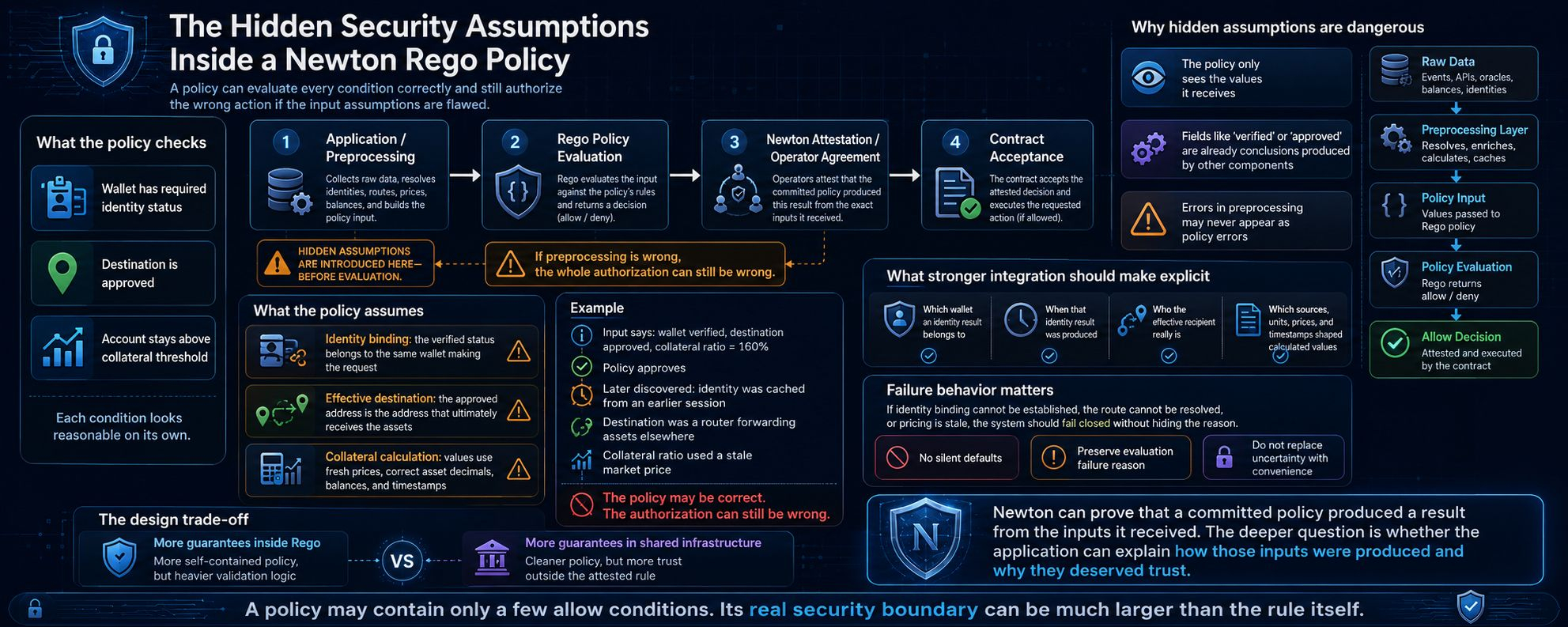
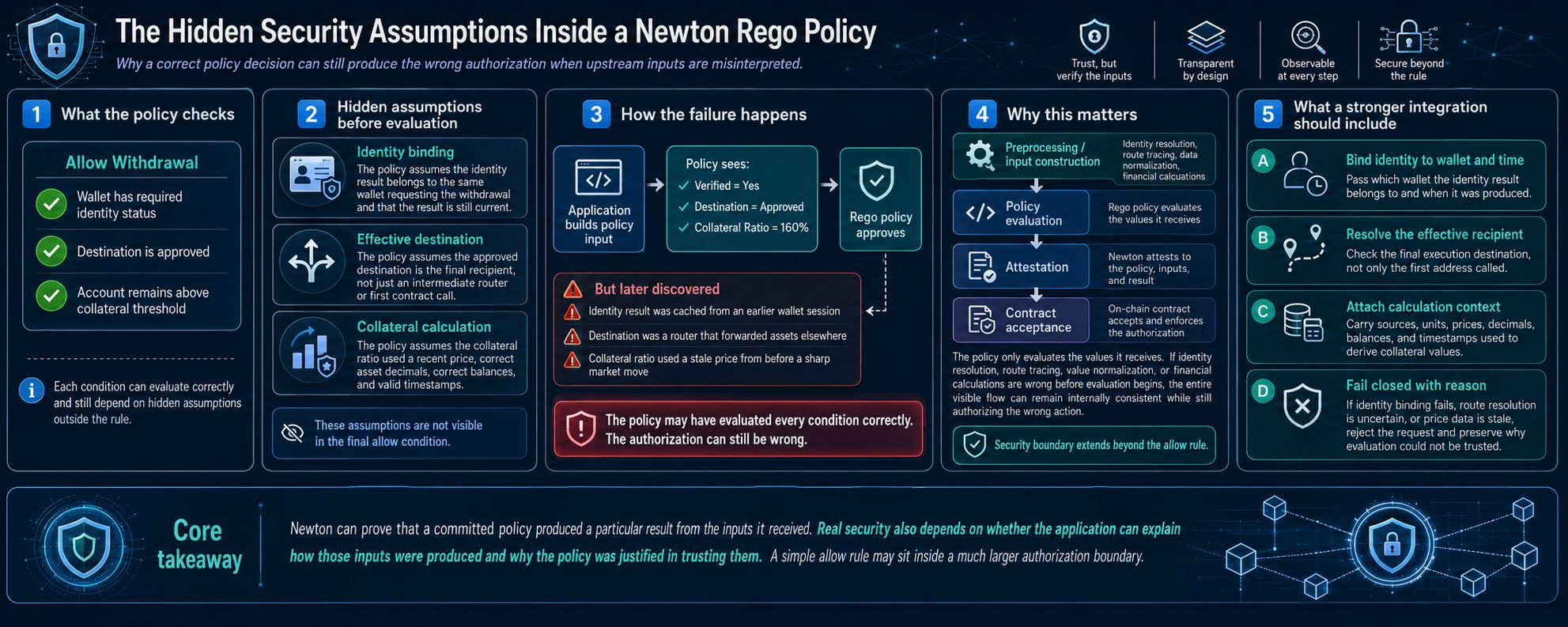
It allowed a withdrawal when the wallet had the required identity status, the destination was approved, and the account remained above its collateral threshold.
Every condition made sense.
The part that concerned me was everything the policy expected the surrounding system to get right before evaluation began.
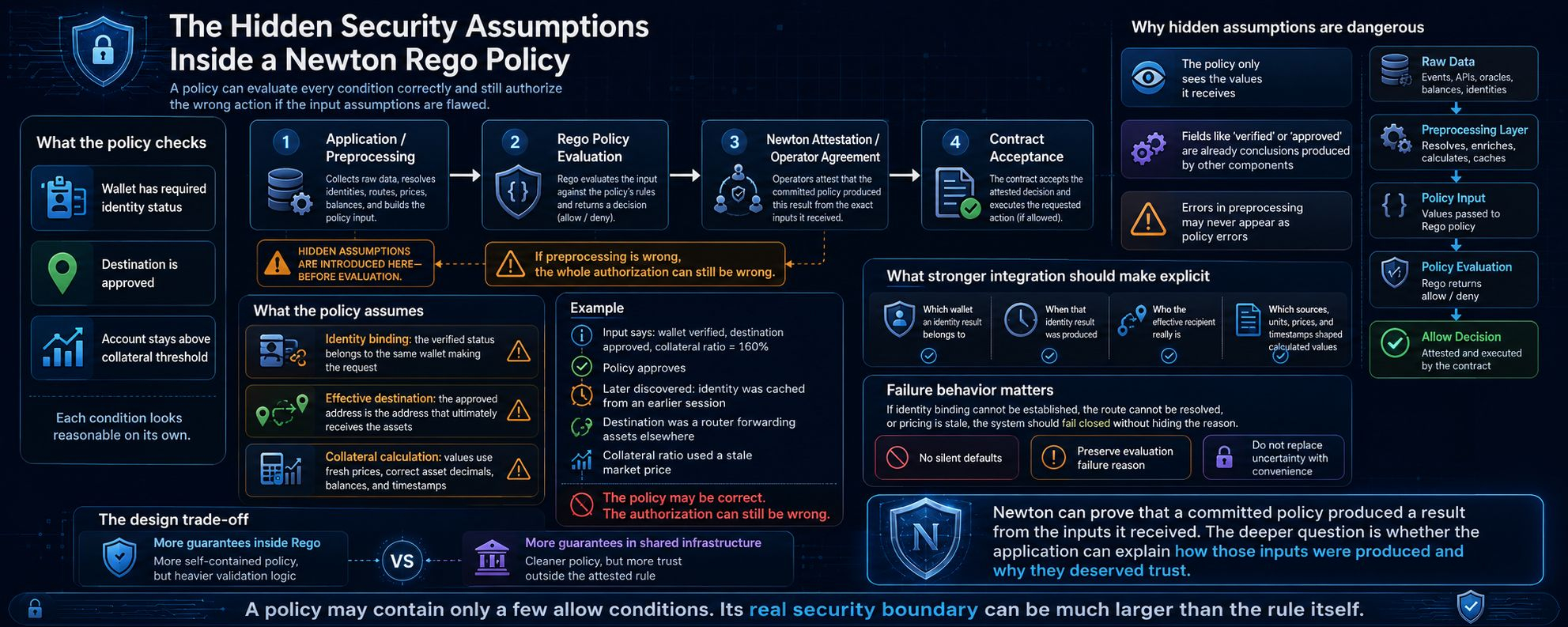
The rule assumed that the identity status belonged to the same wallet requesting the withdrawal. It assumed the approved destination was the address that would ultimately receive the assets. It assumed the collateral value had been calculated using a recent price and the correct asset decimals.
None of those assumptions appeared in the final allow condition.
The policy only saw the values it received.
Imagine an application submits a request showing that the wallet is verified, the destination is approved, and the collateral ratio is 160%.
The policy approves it.
Later, someone discovers that the identity result had been cached from an earlier wallet session. The destination was a router that forwarded the assets elsewhere. The collateral ratio used a price update from before a sharp market move.
The Rego policy may have evaluated every condition correctly.
The authorization can still be wrong.
That is what makes hidden assumptions dangerous. They sit outside the visible rule while controlling what the rule actually means.
A field called "verified" does not prove which identity record produced it. An address appearing on an approved list does not prove that it represents the final execution destination. A collateral ratio does not reveal which balances, prices, units, or timestamps were used to calculate it.
The policy is evaluating conclusions that may already contain decisions made by other components.
This creates a dependency on preprocessing.
If the application resolves wallet identity, normalizes token values, follows execution routes, and calculates financial state before building the policy input, then that preprocessing layer becomes part of the authorization system.
A mistake there may never appear as a policy error.
The operators can agree on the result. The attestation can verify. The contract can accept it. Every visible part of the Newton flow can behave consistently with an input that was interpreted incorrectly before evaluation started.
A stronger @NewtonProtocol integration therefore needs to make those upstream assumptions explicit.
The policy should know which wallet the identity result belongs to and when it was produced. Destination checks should reflect the effective recipient rather than only the first contract called. Calculated values should carry enough context to show which sources, units, and timestamps shaped them.
Failure behavior also matters.
If the identity binding cannot be established, the route cannot be resolved, or the price has become stale, the application should not replace uncertainty with a convenient default. The request may need to fail closed, but the system should still preserve why evaluation could not be trusted.
The difficult design choice is deciding where these guarantees belong.
Keeping them inside Rego makes the policy more self-contained but can turn one authorization rule into a large collection of validation logic. Moving them into shared application infrastructure keeps the policy readable but places more trust outside the rule that operators attest to.
Newton can prove that a committed policy produced a particular result from the inputs it received.
The question I keep coming back to is whether the application can also explain how those inputs were produced and why the policy was justified in trusting them.
A policy may contain only a few allow conditions.
Its real security boundary can be much larger than the rule itself.
#JapanKoreaStocksCloseUpDespiteSeoulSelloff