
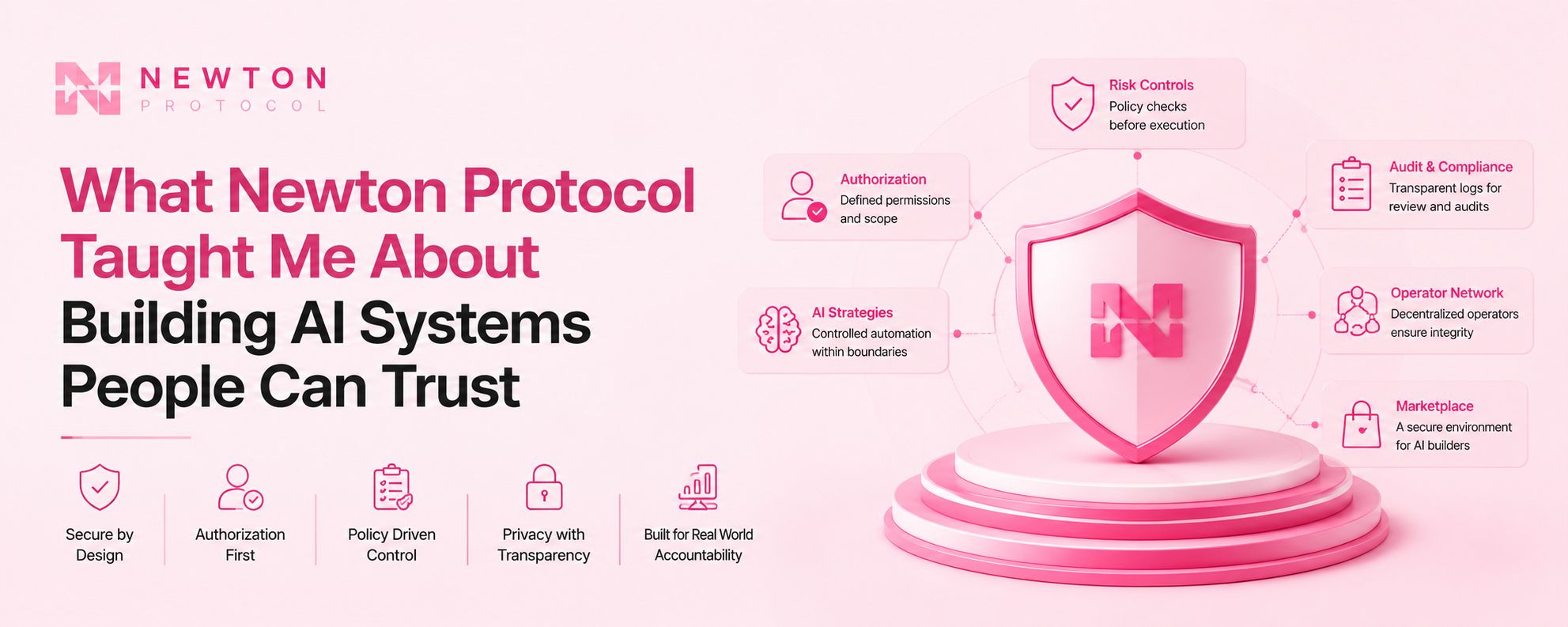

When I first came across Newton Protocol, I expected to spend most of my time reading about AI agents, automated trading, and execution speed. Those topics are almost impossible to avoid in today's crypto industry.
Instead, I found myself thinking about something much less exciting but probably much more important.
Authorization.
The more I read, the more I realized that building intelligent systems is only half the challenge. The harder question is deciding what those systems should be allowed to do once they are running.
I don't think the next wave of AI infrastructure will earn trust simply because it automates more tasks. It will earn trust if organizations know exactly where automation begins, where it ends, and who remains accountable along the way.
That feels like the problem Newton Protocol is trying to address.
What stood out to me wasn't the promise of automation. It was the emphasis on putting clear rules around automation before anything actually happens.
That may sound like a small detail, but I don't think it is.
In financial systems, the biggest operational problems rarely happen because software suddenly stops working. More often, everything works exactly as designed until someone realizes a permission should have expired, a policy was never updated, or an automated process continued operating under assumptions that were no longer true.
Those situations are difficult because nothing appears broken at first.
The risk builds quietly.
Reading about Newton Protocol reminded me that reliable infrastructure is often defined by the things people don't notice. It's the policies that are enforced consistently. It's the permissions that remain controlled. It's the ability to understand why a particular action was accepted or rejected without turning every incident into a lengthy investigation.
Those aren't glamorous features.
They're simply the kind of details that matter once real money, real users, and real accountability enter the picture.
I also found myself appreciating how much attention is given to operational discipline.
Developers don't just need powerful systems. They need systems they can understand.
Operators don't just need dashboards. They need monitoring they can rely on when something unexpected happens.
Compliance teams don't just need policies written on paper. They need confidence that those policies are actually being applied consistently.
Auditors don't just look for successful transactions. They look for evidence that decisions followed documented rules.
None of that makes headlines, yet all of it determines whether infrastructure can survive long after launch.
Another thing I kept coming back to was predictability.
Predictability isn't exciting, but it's incredibly valuable.
When APIs behave consistently, developers make fewer mistakes.
When defaults encourage safer behavior, operational risk becomes easier to manage.
When systems produce reliable logs and clear monitoring, operators spend less time guessing what happened during an incident.
Those are the kinds of improvements people only notice when they're missing.
Privacy and transparency also seem to be approached in a practical way.
Rather than treating them as competing ideas, the design focuses on making automated decisions understandable while keeping authorization under controlled boundaries.
That balance matters because organizations increasingly need both. They need systems that protect sensitive operations while still providing enough visibility for audits, reviews, and regulatory obligations.
As I finished reading, I realized I had spent surprisingly little time thinking about AI itself.
Instead, I kept thinking about operations.
About the people who review permissions before deployments.
About the engineers responding to late-night alerts.
About compliance teams preparing for audits.
About developers trying to build systems that behave consistently every single day—not just under ideal conditions.
Those are the people who quietly determine whether infrastructure succeeds over the long term.
Maybe that's why Newton Protocol stayed with me.
Not because it promises more automation, but because it recognizes that automation without clear boundaries eventually creates new forms of operational risk.
For me, that's the more interesting conversation.
Technology will continue to become more capable.
The real challenge is making sure it also becomes more predictable, more accountable, and easier for people to trust when the pressure is highest.
In the end, I think the strongest infrastructure isn't remembered because it was the fastest. It's remembered because people could depend on it when scrutiny, audits, and real-world complexity became part of everyday operations.
