
That perspective has become so common that it is rarely questioned.
Yet as autonomous AI agents become capable of executing trades, managing treasuries, interacting with smart contracts, and coordinating with other software, another question starts to overshadow the data narrative. The challenge is no longer finding information. The challenge is determining which actions deserve permission, which contributions deserve recognition, and which participants deserve economic rewards.
This distinction may appear subtle, but it changes how an AI economy should be designed.
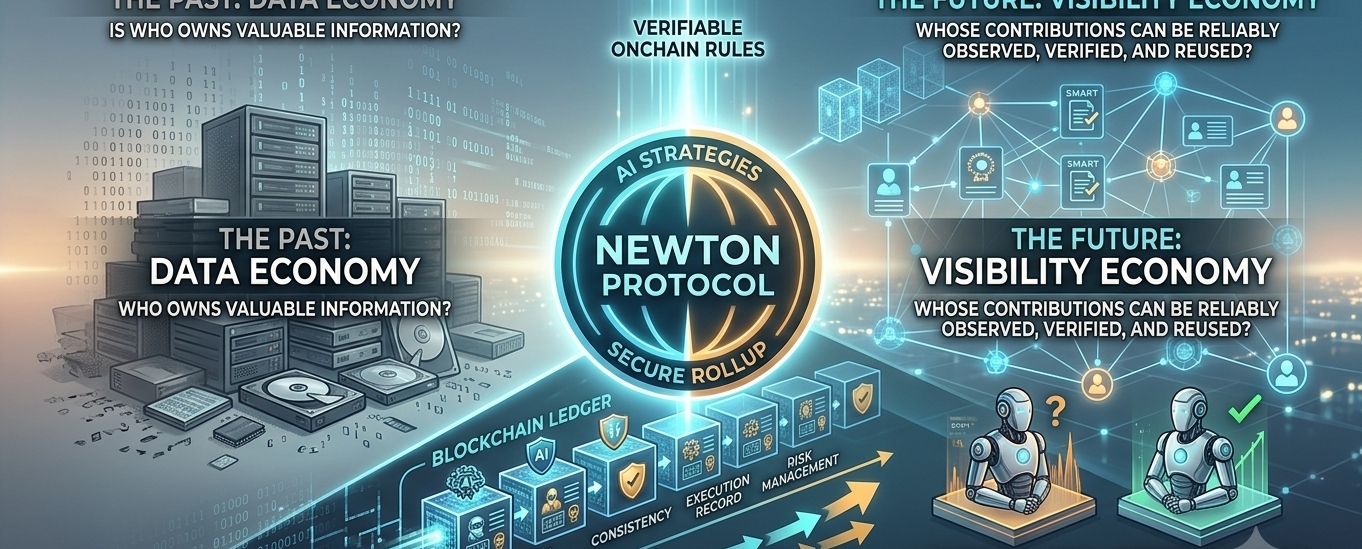
Newton Protocol introduces an interesting lens through which to examine this shift. Rather than thinking only about AI execution, Newton combines a secure rollup for AI-driven strategies, automated financial activity, and a marketplace where developers can publish AI agents. That architecture suggests the protocol is attempting to solve a problem that sits between intelligence and execution: establishing verifiable rules around how autonomous systems participate onchain.
Viewed this way, Newton may represent something more significant than another AI marketplace.
It may be experimenting with a visibility economy.
The difference between a data economy and a visibility economy is profound.
A data economy asks, "Who owns valuable information?"
A visibility economy asks, "Whose contributions can be reliably observed, verified, and reused?"
Those questions are not interchangeable.
Data often becomes obsolete after it is consumed. Visibility compounds over time. Every verified action creates additional context for future decisions. Every successful contribution becomes evidence that can influence trust, eligibility, and reputation.
This becomes increasingly important when AI systems begin making financial decisions independently.
Imagine two autonomous trading agents generating identical returns. Traditional metrics would treat them equally. But what if one consistently followed predefined risk policies, documented every decision, respected spending limits, and executed within governance constraints, while the other achieved similar performance through excessive leverage and unpredictable behavior?
Performance alone cannot explain the difference.
The surrounding record becomes part of the value.
That record is more than transaction history. It is evidence of behavior.
In this framework, contribution is no longer measured simply by output. It is measured by observable reliability.
This is where Newton's architecture becomes particularly interesting.
A secure rollup dedicated to AI execution is not merely about improving throughput. It creates an environment where policies, permissions, and execution logic become programmable components rather than external assumptions. Instead of asking whether an AI can perform an action, the protocol encourages participants to define under what conditions that action should occur.
That shift matters because autonomous systems reduce human oversight.
When humans approve every transaction, trust depends on individuals.
When software acts continuously, trust depends on transparent rules.
This transforms governance from an administrative process into operational infrastructure.
Traditional AI marketplaces generally emphasize discovery. Developers publish models. Users purchase access. Ratings and usage statistics determine visibility.
The marketplace functions similarly to an application store.
But that framing has limitations.
Choosing an AI agent is rarely only about capability.
It is increasingly about predictability.
A highly capable model with inconsistent behavior may be less valuable than a slightly weaker model whose decisions remain understandable, auditable, and policy-compliant.
Visibility therefore becomes part of utility.
Developers are no longer competing solely on intelligence.
They compete on observable trust.
This creates an entirely different incentive structure.
Instead of rewarding attention alone, protocols can begin rewarding evidence.
Instead of emphasizing popularity, they can emphasize verifiable contribution histories.
That distinction becomes even more relevant when considering incentive gaming.
Every economic system eventually teaches participants how to maximize rewards.
Social platforms optimized for engagement produced clickbait.
Search engines produced keyword manipulation.
Liquidity mining encouraged temporary capital that disappeared once incentives ended.
AI marketplaces face similar risks.
If rewards depend only on downloads, developers optimize marketing.
If rewards depend only on usage, developers optimize addictive behavior.
If rewards depend only on transaction volume, automation may generate unnecessary activity.
Each metric creates its own distortion.
A visibility economy attempts to reduce these distortions by expanding what counts as meaningful contribution.
Consistency.
Policy adherence.
Successful execution.
Risk management.
Reusable workflows.
Collaborative improvements.
Transparent histories.
These qualities become economically visible rather than remaining invisible operational details.
Of course, visibility introduces its own challenges.
Not everything that matters can be measured.
Some of the most valuable contributions happen quietly.
Infrastructure maintenance rarely receives the same recognition as product launches.
Security improvements often prevent events that never become visible.
Good governance is frequently mistaken for inactivity because successful prevention produces no dramatic headlines.
Protocols therefore face an important balancing act.
Making contributions visible should not encourage performative behavior.
Participants should not optimize appearances instead of outcomes.
This is where proof becomes more meaningful than disclosure.
Disclosure depends on what someone claims.
Proof depends on what the system can verify.
The distinction is becoming increasingly important as AI-generated content expands.
Claims become cheaper.
Evidence becomes more valuable.
An ecosystem capable of preserving verifiable contribution records may eventually become more resilient than one relying primarily on self-reporting.
Another overlooked dimension concerns builder dependency.
Most AI discussions assume developers remain permanently tied to centralized platforms that control distribution, monetization, and reputation.
History suggests that dependency eventually creates bottlenecks.
Platform incentives change.
Policies evolve.
Visibility algorithms shift.
Builders lose direct ownership of their economic relationships.
A protocol-native marketplace offers an alternative possibility.
Instead of reputation existing inside a single application, contribution histories could become portable assets that accompany developers across the ecosystem.
Reputation becomes infrastructure rather than platform property.
This possibility deserves careful consideration because it affects long-term network effects.
Applications can disappear.
Verified contribution records may persist.
If contributors own reusable evidence of their work, switching between marketplaces becomes easier without rebuilding trust from zero.
That could gradually redistribute power away from individual interfaces and toward shared verification layers.
Whether Newton ultimately achieves this vision remains uncertain.
Technical architecture alone cannot guarantee sustainable incentives.
Every protocol must eventually answer difficult questions about governance, decentralization, validator participation, developer adoption, and token utility.
Likewise, the $NEWT token should not be evaluated purely through speculative expectations.
Its long-term significance depends on whether it becomes integral to coordinating permissions, incentives, marketplace participation, and economic verification rather than functioning only as another transferable asset.
That distinction is critical.
Many tokens facilitate transactions.
Far fewer coordinate trust.
If autonomous AI becomes a meaningful participant in digital finance, coordination mechanisms may prove more valuable than execution speed alone.
The protocols that survive may not be those processing the greatest number of transactions.
They may be those producing the highest quality evidence.
Perhaps the most compelling aspect of Newton is not that it introduces another marketplace for AI developers.
It is that it invites a different conversation about what future AI economies actually reward.
For years, blockchain has focused on ownership.
AI has focused on capability.
The next phase may depend just as much on visibility.
Not visibility in the social sense of attracting attention, but visibility in the economic sense of making meaningful contributions durable, verifiable, and reusable.
If that transition occurs, value creation will become less about possessing information and more about preserving credible evidence of participation.
That would redefine how builders establish trust, how AI agents earn permission, and how decentralized economies allocate rewards.
Whether Newton becomes the protocol that proves this model is still an open question.
But the idea itself deserves attention.
Because the future of AI may not belong to the systems that simply generate the most intelligence.
It may belong to the ecosystems that make trustworthy contribution impossible to ignore.#Newt $NEWT @NewtonProtocol