
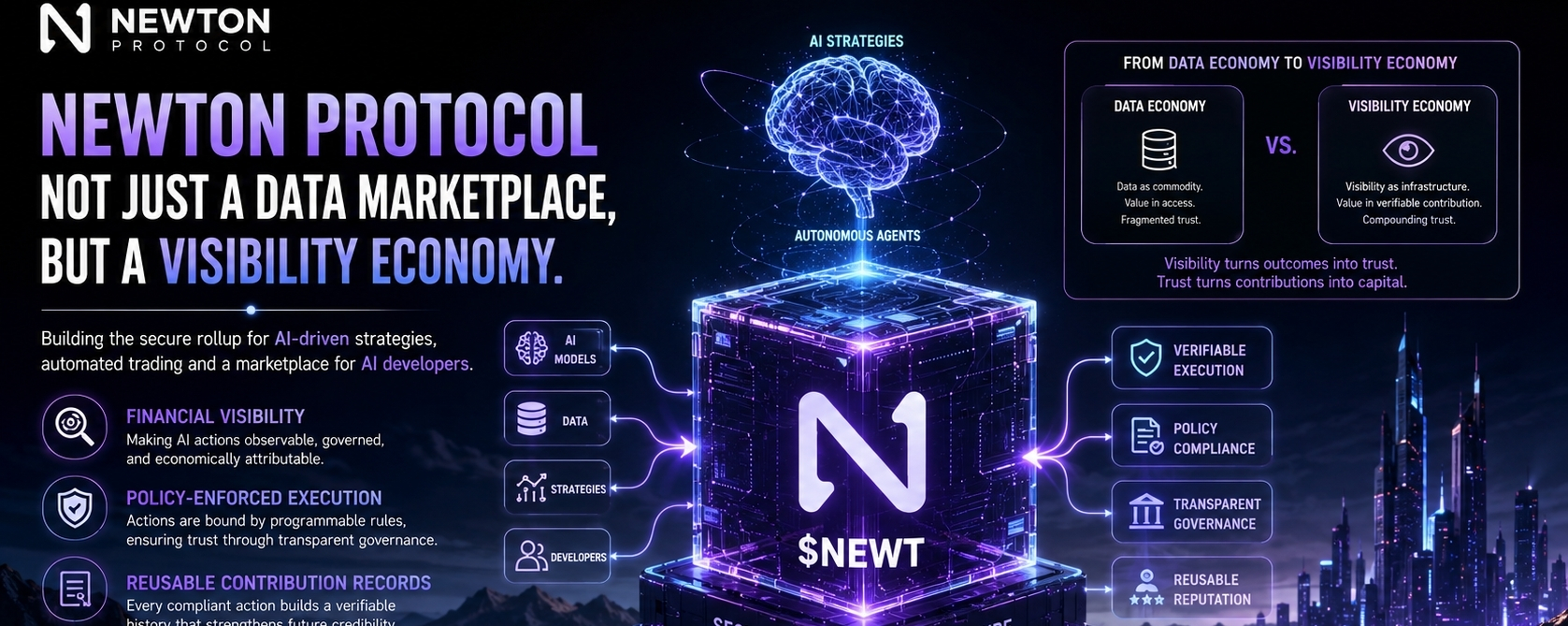
Crypto loves to turn ordinary ideas into grand promises. That gets tiring fast. Most of the time, the pitch is louder than the product, and the product is messier than the pitch. Newton Protocol is different for one simple reason: it starts from a real problem.
The problem is not hard to spot. Smart contracts are excellent at execution, but execution is not the same thing as judgment. A contract can move funds, trigger a trade, or authorize an action instantly. It cannot care whether the destination wallet is risky, whether a policy has been violated, or whether an autonomous agent is about to make a terrible decision. It only follows instructions. That speed is useful, but speed without restraint is just a faster way to create damage.
That is the gap Newton is trying to fill. It is not selling a fantasy about making crypto magically safe. It is trying to add a decision layer before execution, so policy is enforced at the point where it actually matters: before the transaction is finalized. That distinction matters more than people like to admit. In practice, many systems still depend on manual review, offchain controls, or trust assumptions that do not hold up once the volume rises or the stakes get serious.
Newton’s core idea is straightforward: put authorization rules into the transaction flow itself. Spend limits, sanctions screening, fraud controls, risk checks, and other policy constraints should not sit on the sidelines as after-the-fact paperwork. They should be part of the machinery. If a transaction should not happen, the network should be able to stop it before funds move. That is the basic promise, and it is a sensible one.
The project describes itself as a decentralized policy engine for onchain transaction authorization, built as an EigenLayer AVS. The technical label is useful, but the plain version is even better: it is infrastructure for making rules enforceable. Not suggested. Not documented. Enforced.
What makes that interesting is that Newton does not pretend the world is neat. It is not. Identity is messy. Compliance is messy. AI agents are messy. Market behavior is messy. A lot of crypto products seem designed as if all of those problems can be ignored until a token exists. That is wishful thinking. If you want autonomous systems to handle funds, routing, trading, or treasury actions, then guardrails are not optional. They are the product.
The policy-pack approach is one of the more practical parts of the design. Instead of one giant opaque control layer, Newton uses smaller checks that each do a specific job. That is not flashy, but it is smart. A vault can be screened against risk data. A wallet can be checked against sanctions lists. A trade can be assessed against market conditions. Systems like that are boring in the best way. Boring tends to survive production.
The AI angle makes the case even stronger. Everyone is excited about autonomous agents, but very few people seem excited about the consequences of letting them touch money. That is strange. If an agent can move assets, then it also needs to be constrained. Otherwise autonomy becomes a polite word for expensive mistakes. Newton is trying to sit in the middle and decide whether an action should proceed at all. That is more useful than another “AI-powered” slogan.
The token model is also fairly standard, but at least it is clear. NEWT is the native token and is used for staking, fees, governance, and security. The supply is fixed at one billion. Validators or operators stake it, penalties can be applied for bad behavior, and governance is expected to become more distributed over time. That structure fits the role the network is supposed to play. If the system is making policy decisions, then the people securing it should have real economic exposure.
Another point in Newton’s favor is that it seems to care about verifiability. It talks about signed onchain proofs, policy decisions that can be checked, and privacy-preserving enforcement rather than exposing sensitive information everywhere. That matters. A lot of compliance systems are basically closed boxes with expensive paperwork attached. Newton is at least aiming for something inspectable, where the outcome can be verified without leaking the whole process.
The launch is not theoretical either. The mainnet beta is already live, and DeFi vault enforcement is the first major use case. That is a sensible place to start. Vaults hold capital, move quickly, and need guardrails more than most systems do. If Newton can work there, it has a real shot at becoming useful infrastructure. If it fails there, the rest does not matter much.
The team structure also suggests a project that is trying to build something durable rather than just noisy. There is a foundation, there are named contributors, and there is a stated path toward decentralization instead of pretending the network is already fully distributed when it clearly is not. That is better than the usual marketing language where “community-owned” often means “a small group still controls everything important.”
So Newton is not compelling because it is flashy. It is compelling because it targets a piece of crypto that has been ignored for too long: the decision to stop a bad transaction before it happens. Everyone likes talking about faster systems. Very few people want to talk about the fact that faster systems without guardrails just create bigger losses more quickly.
Newton’s real pitch is simple. Rules should be part of the machinery, not an apology written after the damage is done. In a space full of noise, that kind of idea stands out precisely because it sounds like common sense.#Newt $NEWT @NewtonProtocol