
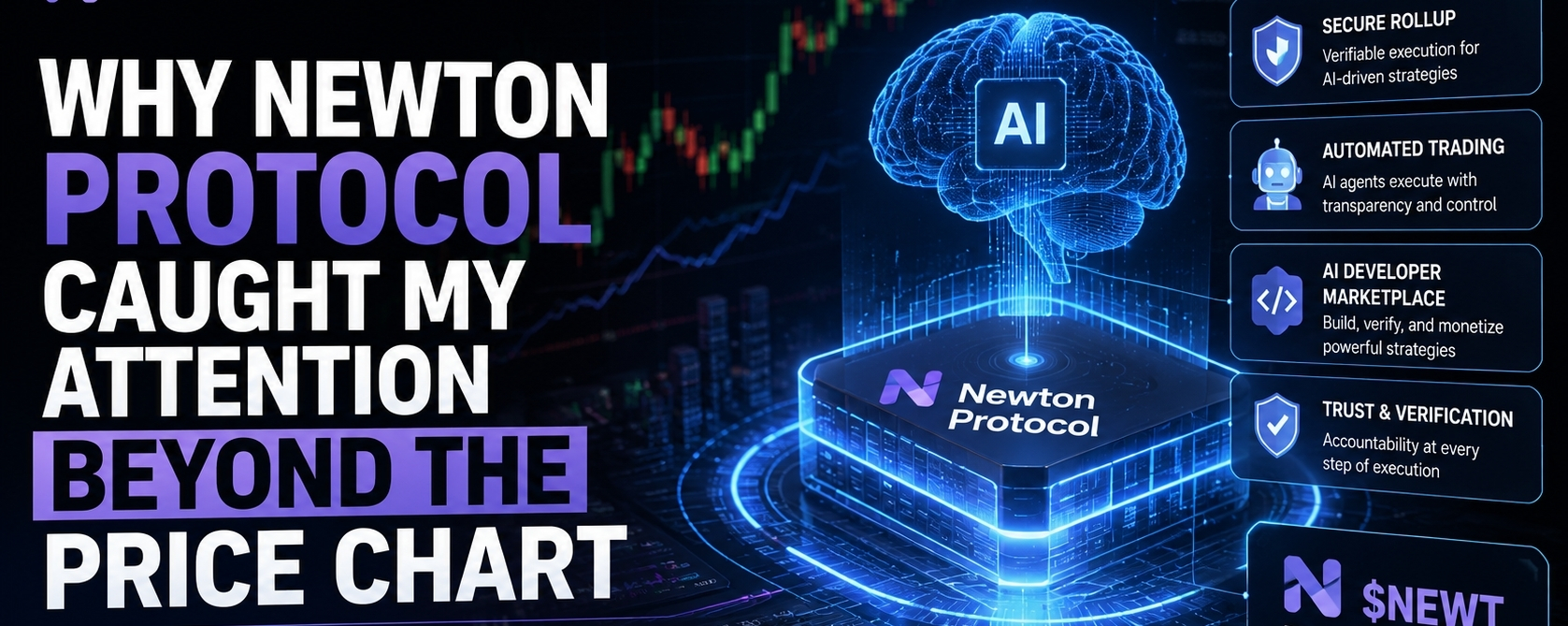
I've been paying closer attention to the quiet parts of the market lately. I've found myself spending less time reacting to price and more time wondering why certain ideas keep resurfacing. I've noticed that every few weeks another AI project appears with bigger promises, but only a handful make me stop and think beyond the chart. I've caught myself returning to Newton Protocol more than once, not because I expect certainty, but because the questions it raises haven't disappeared.
I keep coming back to the same thought. AI is becoming faster every month, but trust isn't following the same curve. Markets seem comfortable celebrating intelligence while almost ignoring the path that intelligence takes before it reaches someone's capital. That gap feels larger than people admit. An AI model can identify opportunities, execute trades, rebalance positions, or react to volatility within seconds, but none of that answers whether the process itself deserves confidence.
Newton Protocol seems to begin where that uncertainty starts instead of pretending it doesn't exist. The idea of placing AI-driven strategies inside a secure rollup feels less like another feature and more like an attempt to solve an uncomfortable problem that has been sitting in plain sight. If an autonomous system is going to manage real financial decisions, then execution cannot simply be accepted because the outcome happened to be profitable. The process has to remain observable, verifiable, and resistant to shortcuts even when nobody is looking.
That is where I think a lot of conversations become strangely shallow. Everyone talks about smarter models. Fewer people spend time discussing what happens after those models decide to act. A strategy that exists only as a black box eventually asks users for something expensive. It asks for trust without offering enough evidence in return. That trade feels acceptable during calm markets because almost everything appears to work when conditions are easy. Stress usually arrives before transparency does.
Automated trading has always carried that contradiction. The more automation increases, the less visibility many users actually have into what is happening underneath. Speed slowly replaces understanding. Eventually people stop asking why something worked and become satisfied that it simply did. That mindset feels dangerous if AI agents become responsible for increasingly meaningful financial activity.
A marketplace for AI developers also makes me think about incentives instead of features. Once developers begin creating strategies that others can use, reputation alone probably stops being enough. There has to be a way for users to distinguish between genuine performance, selective reporting, and systems that simply benefited from a favorable market. Infrastructure quietly becomes more important than marketing because the quality of the marketplace depends on whether participants can verify what they are actually interacting with.
I also wonder how these systems behave when conditions stop cooperating. Trending markets make almost every strategy appear intelligent. Sideways markets expose different weaknesses. Sudden volatility exposes even more. Infrastructure rarely gets judged during comfortable periods. It gets judged when execution slows, assumptions fail, liquidity disappears, or models receive conflicting signals at the exact moment decisions become expensive. Those moments tend to reveal whether architecture was built for demonstrations or for reality.
The more I think about it, the less this feels like a conversation about AI itself. It feels like a conversation about accountability. Intelligence without accountability eventually becomes another source of uncertainty, and financial markets already produce enough uncertainty on their own. Adding autonomous decision-making without improving verification feels like increasing complexity while hoping confidence somehow appears afterward.
I do not know whether Newton Protocol becomes the standard for this direction, and I think pretending otherwise would miss the point. What keeps my attention is that it seems to focus on a layer many projects treat as secondary. Execution, verification, incentives, and trust rarely dominate headlines because they are harder to simplify into short narratives, yet they are often the pieces that decide whether an ecosystem survives beyond its first wave of attention.
I keep finding myself less interested in whether AI can trade faster than people and more interested in whether people will eventually care how those trades are produced, validated, and challenged. Markets have a habit of rewarding convenience first and demanding proof later, and somewhere between those two moments is where ideas either become infrastructure or slowly disappear from the conversation.
