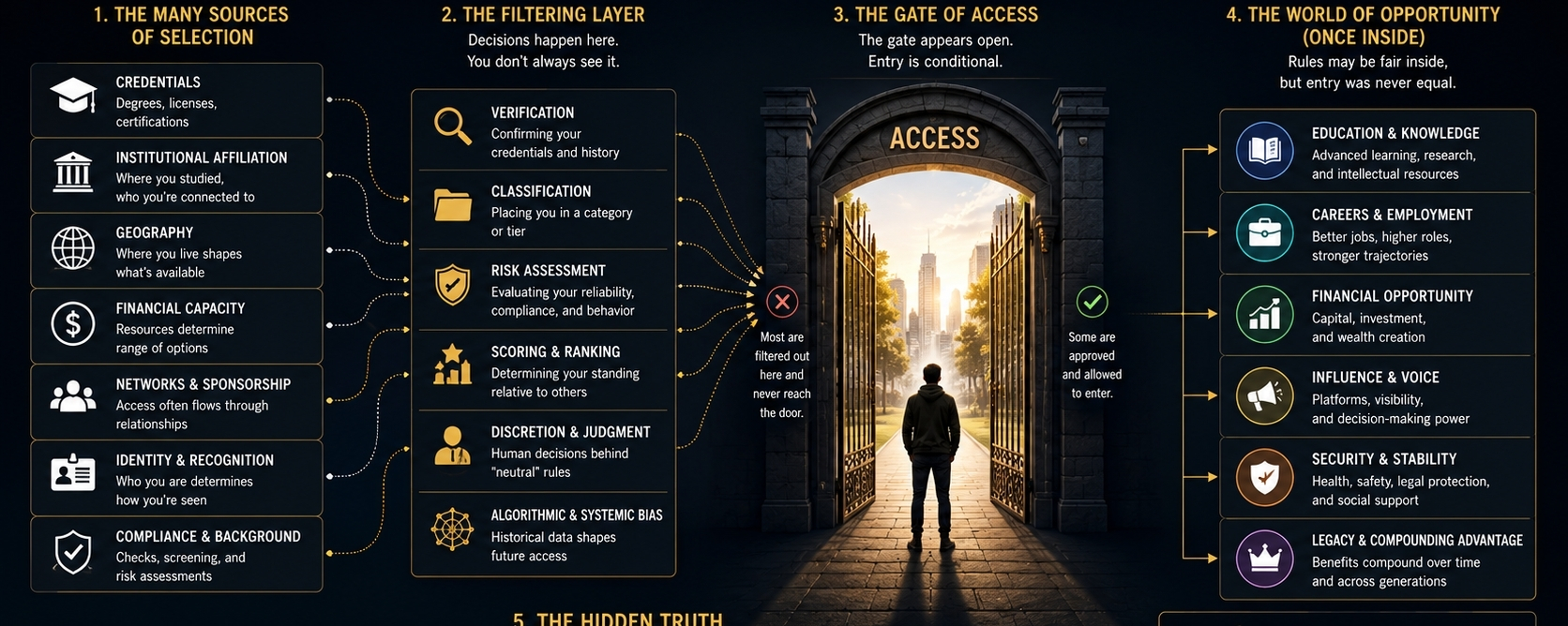
Most systems of power no longer announce themselves through force. They rarely arrive with barriers, uniforms, checkpoints, or visible restrictions. Instead, they appear as convenience. Access feels immediate. Participation feels voluntary. Movement feels unrestricted. The experience is designed to create the impression of freedom while the conditions governing that freedom remain largely out of sight.
Modern societies often describe themselves as open systems. Opportunities appear available to anyone willing to pursue them. Information seems accessible. Markets appear competitive. Institutions present themselves as neutral administrators rather than gatekeepers. Yet beneath this appearance exists an intricate architecture of permissions, classifications, certifications, and approvals that quietly determines how far any individual can travel through the system.
What makes this architecture difficult to notice is that it rarely operates through direct prohibition. Exclusion is no longer primarily achieved by saying "no." More often, it is achieved by requiring a sequence of qualifications before a meaningful "yes" becomes possible. The pathway remains technically open, but the conditions for entering it become increasingly specific.
A person may possess talent, ambition, and capability, yet still encounter obstacles that have little to do with any of those qualities. Access may depend on credentials, institutional affiliations, geographic location, professional networks, financial standing, or administrative recognition. The individual sees an open door. What remains less visible is the long chain of decisions determining who is allowed to reach that door in the first place.
This creates a peculiar relationship between equality and access. Rules are often applied uniformly once participation begins. Standards may genuinely be consistent. Procedures may be transparent. Yet the journey required to qualify for participation can vary dramatically between individuals. Equality exists within the system while inequality shapes entry into it.
The distinction matters because systems increasingly derive legitimacy from openness. Closed structures are easy to identify and often easy to criticize. Open structures enjoy a different kind of authority. When opportunities appear available to everyone, outcomes can be interpreted as reflections of merit rather than consequences of access. The process gains credibility because exclusion becomes harder to see.
What emerges is a form of power that operates through selection rather than command. It determines participation before decisions are made, influence before actions are taken, visibility before ideas are heard. The most consequential choices often occur long before any public process begins.
Institutions rarely describe their role in these terms. Selection is presented as quality control. Classification becomes risk management. Verification becomes accountability. Each individual mechanism appears reasonable when viewed in isolation. The broader pattern only becomes visible when they are examined together.
The cumulative effect is the creation of a landscape where opportunities are neither entirely open nor entirely closed. Instead, they exist within layers of recognition. Progress depends not only on ability but on being recognized as someone whose ability is considered legitimate. The distinction is subtle but significant. Capability alone is often insufficient. It must be accompanied by validation from structures already possessing authority.
This dynamic extends far beyond economics or politics. It shapes education, employment, culture, media, and professional advancement. Entire systems are organized around determining which voices deserve attention, which credentials deserve trust, and which participants deserve entry. These decisions are rarely presented as exercises of power. They are framed as administrative necessities. Yet administration itself can become one of the most effective forms of influence precisely because it appears neutral.
The paradox of modern power is that it becomes stronger as it becomes less visible. Direct control invites resistance. Invisible control often passes unnoticed. When limitations are experienced as procedures rather than restrictions, they generate less opposition. Compliance emerges naturally because the system appears to be functioning according to objective rules rather than subjective judgments.
This does not imply the existence of a conspiracy or a centralized authority directing outcomes from behind the scenes. The architecture is often decentralized, distributed across countless institutions and decision-makers. No single actor controls it entirely. Its strength comes from coordination without coordination, from independent systems producing compatible forms of recognition and exclusion.
The result is a world in which freedom and constraint coexist in unexpected ways. Individuals are often free to act, speak, compete, and participate. Yet the conditions determining whose actions matter, whose voices are amplified, whose competition is recognized, and whose participation is valued remain unevenly distributed.
Perhaps the defining feature of contemporary society is not the disappearance of barriers but their transformation. Walls have become procedures. Gates have become criteria. Restrictions have become classifications. Power has not retreated from public life. It has embedded itself within the mechanisms that determine access to it.
The most influential structures are often not those that command behavior directly, but those that quietly shape the range of possibilities available before any decision is made. By the time choices appear, much of the landscape in which those choices occur has already been arranged.
And that arrangement, precisely because it feels natural, may be the most powerful form of influence of all.