
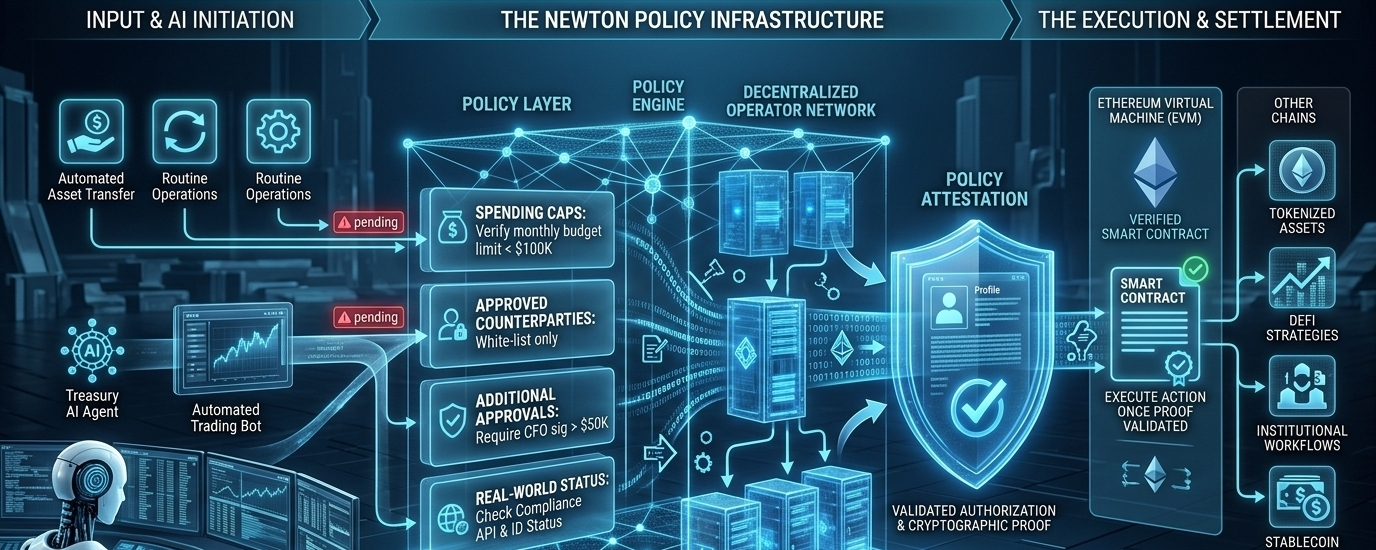
The more I read about AI agents handling financial tasks, the less I worry about whether they can execute transactions. That part already feels inevitable. The question that keeps coming back is much simpler: who decides whether an action should happen in the first place?
Crypto has spent years making transactions faster and more composable. AI promises to automate those transactions even further. Yet speed alone doesn't solve the harder problem. Once software begins acting with greater autonomy, every mistake also becomes automated. A wallet, trading strategy, or treasury tool can execute instructions instantly, but someone still needs confidence that those instructions remain within agreed boundaries. That's where I think Newton Protocol offers an interesting perspective.
Rather than focusing on making AI agents more capable, Newton is designed around something less glamorous but arguably more important: authorization. Instead of asking only whether a transaction is technically valid, it introduces a policy layer that evaluates whether the transaction satisfies predefined conditions before execution. That distinction sounds subtle until you consider how autonomous systems actually operate.
Traditional smart contracts are deterministic, but they generally don't understand much about the world outside the blockchain. They cannot easily account for changing compliance requirements, identity status, spending policies, or other external conditions without relying on additional infrastructure. Newton attempts to bridge that gap by allowing policies to incorporate off-chain information while producing cryptographic attestations that smart contracts can verify before carrying out an action.
I think this changes the conversation around AI in crypto. Most discussions revolve around what an autonomous agent can do. A more practical question is what it should be allowed to do.
Imagine delegating routine treasury operations to software. The challenge isn't necessarily teaching the software how to transfer assets. The difficult part is expressing limits clearly enough that those transfers remain acceptable under changing circumstances. Spending caps, approved counterparties, additional approval thresholds, or other business rules become part of the decision itself instead of an afterthought layered onto the interface.
That design also separates authorization from custody in an interesting way. Newton isn't positioned as another wallet or another settlement network. Instead, it aims to function more like an authorization layer that evaluates whether predefined policies have been satisfied before execution proceeds. The comparison that came to my mind wasn't another blockchain protocol but the payment systems many people already use every day, where authorization and settlement are distinct processes.
The AI angle becomes more compelling when viewed through that lens. Autonomous agents don't necessarily need unlimited freedom. In many real-world environments, they'll probably need programmable restrictions that scale alongside their responsibilities. An AI handling routine operations may have permission to execute ordinary actions automatically, while exceptional cases require additional verification or human involvement. That's a governance question as much as a technical one.
Another aspect worth paying attention to is how trust is produced. Newton's architecture relies on decentralized operators that evaluate policies and generate attestations backed by cryptographic signatures, rather than asking users to rely solely on a centralized approval service. The objective is not merely faster automation but verifiable decision-making that applications can independently validate.
Of course, designing the framework is only one part of the challenge.
The difficult test comes when policies become increasingly sophisticated. External information changes constantly. Market conditions evolve. Compliance requirements differ across jurisdictions. AI systems themselves continue learning and adapting. A policy engine therefore has to remain flexible without becoming unpredictable. Too many restrictions create friction that discourages adoption; too few reduce the value of having guardrails in the first place.
That balance may ultimately determine whether this approach succeeds.
Developers also face a practical consideration. Adding another authorization layer introduces additional design decisions into application development. The value has to outweigh the complexity. If policy creation, integration, and verification become straightforward enough, developers gain another security primitive. If the process feels cumbersome, adoption naturally slows regardless of how elegant the architecture appears on paper.
This is why I think Newton is easier to evaluate by watching its developer experience than by following narratives around AI itself. AI headlines change every week. Infrastructure tends to reveal its quality much more slowly, through implementation, integration, and reliability.
The protocol also reaches beyond AI-only scenarios. The same policy-based approach can support applications involving stablecoins, tokenized assets, institutional workflows, and automated DeFi strategies where predefined operational rules matter just as much as transaction execution. The common thread isn't artificial intelligence—it's making on-chain actions accountable to rules that users establish before funds move.
For me, that's the most useful way to think about Newton Protocol. It isn't simply another attempt to combine AI and blockchain because both are popular narratives. Instead, it starts from a practical observation: automation becomes more valuable when its boundaries are just as programmable as its actions.
Crypto has become remarkably efficient at executing transactions. The next stage may depend less on making those transactions faster and more on making their authorization transparent, verifiable, and adaptable. If autonomous software becomes a normal participant in on-chain finance, the infrastructure that decides when not to act could end up being just as important as the infrastructure that makes action possible.
#Newt $NEWT #newt @NewtonProtocol
