📘 TRON DEFI SUMMER S1: WHY USDD IS A STRATEGIC FOUNDATION FOR ON-CHAIN YIELD
DeFi is often associated with innovation, capital efficiency, and high-yield opportunities.
But beneath every sustainable decentralized financial system lies a more fundamental requirement:
Stability.
Without reliable stable assets, lending markets become harder to price, liquidity becomes more volatile, and users face greater difficulty managing risk.
As a decentralized, over-collateralized stablecoin, USDD provides an important foundation for users exploring yield, liquidity, and broader DeFi opportunities across the TRON ecosystem.
1️⃣ WHY STABLECOINS ARE ESSENTIAL TO DEFI
Crypto assets such as TRX, BTC, and ETH can offer significant upside potential, but their prices can also fluctuate rapidly.
DeFi users therefore need assets that can serve as relatively stable units of account, settlement instruments, and liquidity reserves.
Stablecoins help users:
• Manage exposure to market volatility • Move value between protocols • Supply assets to lending markets • Participate in liquidity strategies • Settle payments and transactions • Preserve on-chain capital without fully exiting Web3
This makes stablecoins more than digital representations of fiat value.
They are a critical liquidity layer for decentralized finance.
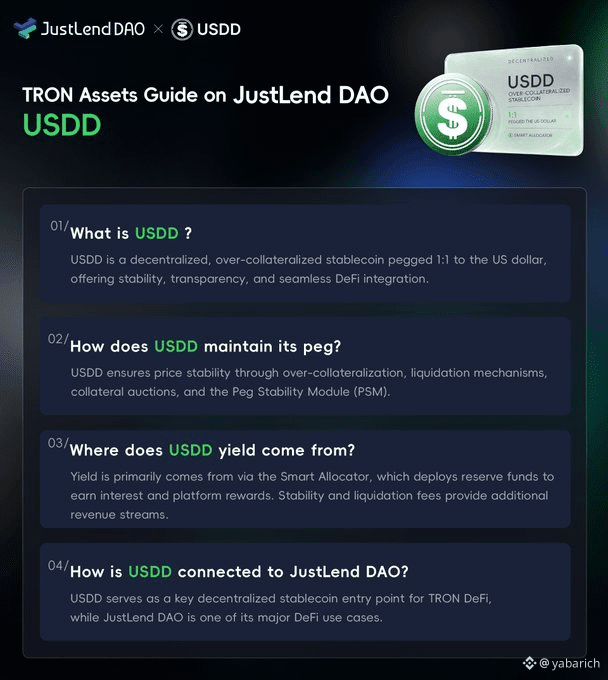
2️⃣ WHAT IS USDD?
USDD is a decentralized stablecoin designed to maintain a value close to the US dollar.
Its over-collateralized structure means that the value of assets supporting the system is intended to exceed the value of USDD in circulation.
This additional collateral buffer is important because crypto markets can be highly volatile.
When collateral values fluctuate, over-collateralization can help strengthen the system’s ability to absorb market stress.
USDD therefore combines several important Web3 principles:
• Decentralized financial infrastructure • On-chain transparency • Collateral-backed value • Smart contract-based execution • Composability across DeFi protocols
Rather than functioning only as a payment token, USDD can also operate as productive capital across the TRON ecosystem.
3️⃣ HOW DOES USDD MAINTAIN ITS PEG?
A stablecoin is only useful when users understand the mechanisms supporting its stability.
USDD’s price stability is connected to several layers, including collateralization, liquidity, market activity, and economic incentives.
Over-collateralization provides the underlying asset support.
Deep liquidity helps users enter and exit positions more efficiently without creating excessive price impact.
When the market price moves away from its intended value, trading and arbitrage activity may help bring the price closer to equilibrium.
The strength of a stablecoin does not come from a single mechanism.
It depends on how effectively collateral, liquidity, market incentives, and risk-management systems work together.
For users, this means evaluating more than the headline price.
It also means understanding collateral quality, reserve transparency, liquidity depth, and market resilience.
4️⃣ WHERE DOES USDD YIELD COME FROM?
Stablecoins do not generate returns automatically.
Yield must come from identifiable economic activity.
Depending on the platform and strategy, USDD yield may be supported by:
• Borrowing demand in lending markets • Interest paid by borrowers • Trading fees from liquidity pools • Protocol-based asset strategies • Ecosystem incentive programs • Limited-time Boost APR rewards
This distinction is important.
Sustainable yield is generally connected to real capital demand, protocol usage, or measurable revenue. Incentive-driven yield may provide attractive short-term returns, but it can change when the campaign ends.
Before participating, users should understand the difference between:
Base yield generated by protocol activity
and
Additional yield created by temporary incentives
TRON DeFi Summer S1 gives users the opportunity to explore both layers through supported USDD strategies and Boost APR incentives.
5️⃣ HOW DOES USDD WORK WITH JUSTLEND DAO?
JustLend DAO is one of the core lending protocols within the TRON ecosystem.
It allows users to supply supported assets to lending markets and potentially earn yield from borrower demand. Eligible users may also use collateral to access liquidity without immediately selling their underlying assets.
Within this system, USDD can serve several functions:
• A stable asset for portfolio allocation • A supply asset in lending markets • A source of liquidity for borrowing activity • A settlement asset for DeFi strategies • A building block for capital-efficient positions
This relationship transforms USDD from a passive wallet balance into a programmable financial asset.
When supplied through JustLend DAO, stablecoin capital can contribute to lending-market liquidity while potentially generating returns for the supplier.
This is one of DeFi’s central innovations:
Assets can remain under user-controlled, transparent rules while being deployed productively across the financial ecosystem.
6️⃣ WHY USDD MATTERS IN TRON DEFI SUMMER S1
TRON DeFi Summer S1 creates a simplified entry point for users who want to explore TRON-based DeFi opportunities through Binance Wallet and JustLend DAO.
USDD is particularly relevant for participants who prefer a stablecoin-based strategy rather than direct exposure to more volatile assets.
Through the campaign, users can learn how to:
• Transfer assets into the TRON ecosystem • Access JustLend DAO through a Web3 wallet • Supply USDD to an eligible strategy • Understand base yield and Boost APR • Track positions and receipt assets • Redeem funds according to protocol rules
This makes the campaign more than a reward program.
It also functions as a practical introduction to on-chain lending, stablecoin utility, and DeFi capital management.
7️⃣ STABILITY CAN IMPROVE CAPITAL EFFICIENCY
Holding stablecoins provides price stability, but DeFi makes it possible for those assets to become productive.
Instead of remaining idle, USDD can potentially be deployed into lending or other supported strategies.
This creates a balance between two objectives:
Reducing exposure to market volatility
and
Maintaining access to on-chain yield opportunities
For users managing a diversified crypto portfolio, this can be strategically valuable.
Volatile assets may serve as growth exposure, while stablecoin positions can provide liquidity, flexibility, and yield-generation capacity.
USDD can therefore function as both a defensive asset and an active DeFi instrument.
8️⃣ USDD STRENGTHENS THE TRON DEFI LIQUIDITY LAYER
A mature blockchain ecosystem requires more than fast transactions and low fees.
It also needs assets that can support lending, payments, settlement, and liquidity across multiple protocols.
USDD contributes to this structure by connecting:
• Stablecoin users • JustLend DAO lending markets • Binance Wallet distribution • TRON’s settlement infrastructure • Broader DeFi applications
As these components become more integrated, capital can move more efficiently across the ecosystem.
This creates stronger network effects.
More stablecoin liquidity can support deeper lending markets. Deeper markets can attract more users. More users can generate greater protocol activity, which can further strengthen the ecosystem.
9️⃣ USERS SHOULD STILL EVALUATE RISK
Stablecoin strategies may reduce price volatility, but they are not risk-free.
Participants should consider:
• Stablecoin depegging risk • Smart contract vulnerabilities • Protocol liquidity conditions • Variable interest rates • Campaign eligibility requirements • Boost APR duration • Redemption procedures • Wallet and network risks
High displayed yields should never replace proper due diligence.
Users should understand where returns come from, how funds can be withdrawn, and what conditions could affect the value or accessibility of their assets.
Responsible DeFi participation begins with understanding the system before deploying capital.
🔟 USDD IS A PRACTICAL ENTRY POINT INTO TRON DEFI
For users beginning their DeFi journey, starting with a stable asset can make the ecosystem easier to understand.
USDD provides a pathway to explore lending, yield generation, wallet interaction, and on-chain liquidity without relying entirely on volatile asset exposure.
For more experienced users, it can become part of a broader strategy involving capital preservation, portfolio rebalancing, and liquidity management.
TRON DeFi Summer S1 gives the community an opportunity to explore this role in practice.
Whether you are building a stablecoin strategy or entering TRON DeFi for the first time, understanding USDD is an important step toward understanding how decentralized capital moves across the ecosystem.
🔗 Join TRON DeFi Summer S1: https://cf-workers-proxy-cyt.pages.dev/events/defi-tron-2026
@justinsuntron
#TRONEcoStar