
Every crypto cycle produces a familiar character.
There's always a project that claims the next wave of technology can't succeed without its infrastructure. During one cycle it was faster blockchains. Then it was cross-chain bridges. Then decentralized storage. Then modular networks. Now artificial intelligence has taken center stage, and Newton Protocol wants to be the security layer that keeps autonomous AI from making expensive mistakes.
It sounds tidy.
On paper, at least.
But I've seen this movie before.
Every generation of crypto believes it has finally identified the missing piece. The missing piece usually turns out to be another protocol asking everyone else to build on top of it.
Newton's argument is simple enough. AI agents are becoming more capable. Soon they'll manage wallets, execute trades, allocate capital, and interact with decentralized finance without waiting for human approval. If software starts controlling money, someone needs to make sure it doesn't do something reckless.
Reasonable argument.
The question isn't whether the problem exists.
The question is whether Newton's answer creates as many problems as it solves.
Let's start with the problem they claim to fix.
Imagine an AI agent managing a portfolio worth millions of dollars. It notices an arbitrage opportunity, borrows funds from one protocol, swaps assets across three others, and repays the loan within seconds. Humans could never react that quickly. Machines can.
Now imagine the market shifts halfway through that process.
Or liquidity disappears.
Or one protocol suddenly pauses withdrawals.
Or an oracle reports incorrect prices.
The AI isn't necessarily "wrong." It's simply operating with information that stopped being accurate a fraction of a second earlier. Computers don't panic. They continue following instructions.
That's where Newton steps in.
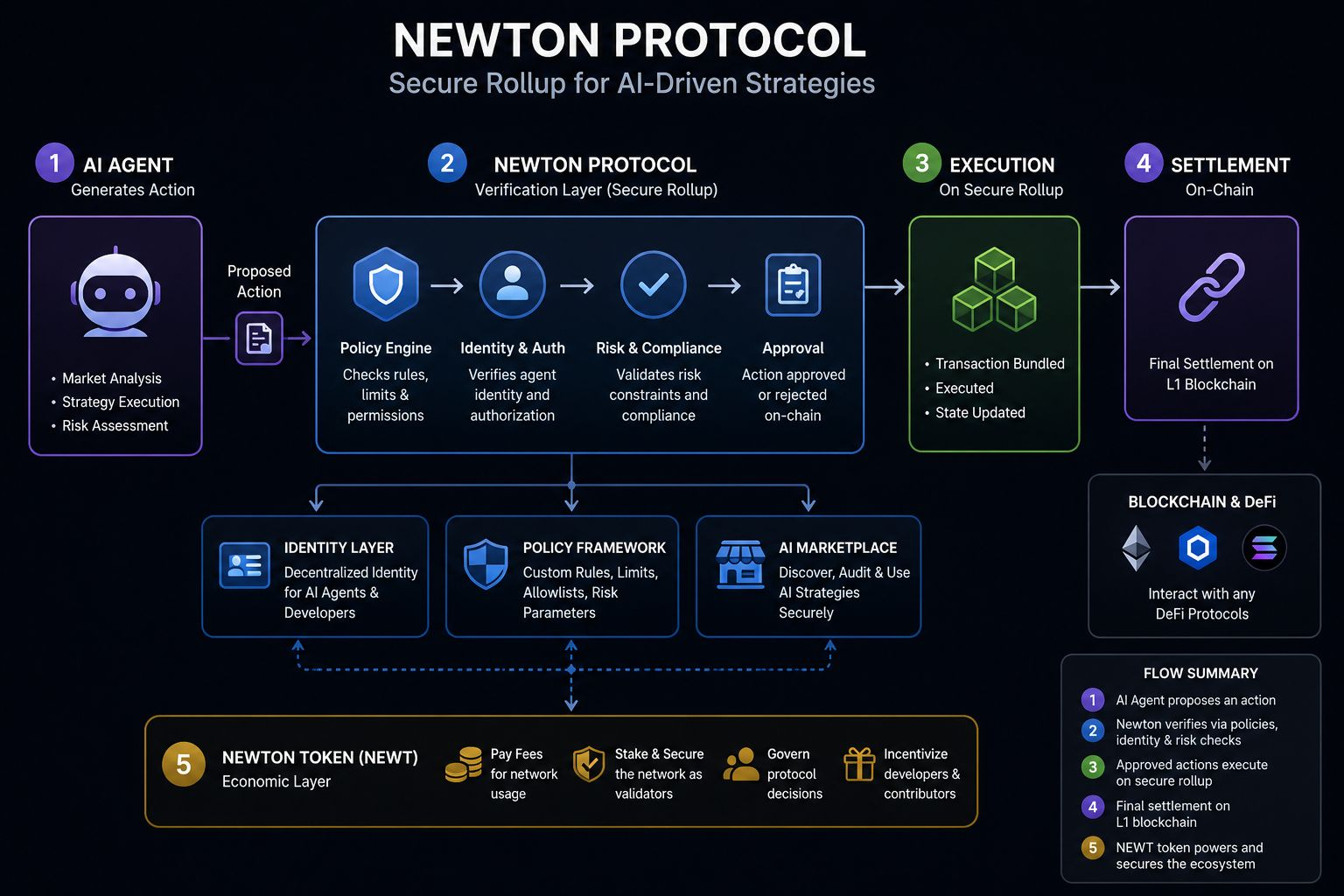
Instead of letting AI interact directly with blockchains, Newton wants every action filtered through its own verification layer. Policies are checked. Permissions are verified. Rules are enforced before transactions are approved.
It sounds reassuring.
Security always does.
But security systems have an awkward habit of becoming the weakest point in the chain.
Look, crypto doesn't have a shortage of security infrastructure. It has a shortage of security that survives contact with reality.
Every few months another protocol announces multiple audits, formal verification, bug bounties, and military-grade cryptography. Then someone discovers an unexpected exploit hiding in a tiny corner of the codebase.
The postmortem always sounds familiar.
Nobody anticipated this edge case.
Newton assumes adding another verification layer reduces risk.
Sometimes it does.
Sometimes it simply creates another target.
That's the uncomfortable part most marketing material quietly walks around.
Every additional protocol means additional smart contracts.
Additional validators.
Additional governance.
Additional software updates.
Additional attack surfaces.
Complexity doesn't disappear.
It compounds.
I've covered technology long enough to know that every engineer believes their layer simplifies the stack. Then five years later somebody draws the architecture diagram and nobody in the room can explain every moving part anymore.
There's another question worth asking.
Who exactly benefits if Newton succeeds?
Developers gain another platform.
Validators earn rewards.
Token holders hope the network grows.
Founders gain an ecosystem.
Investors gain another narrative tied to artificial intelligence.
Those incentives are perfectly normal. Every blockchain project has them.
But notice who carries most of the operational risk.
The users.
If something fails inside the infrastructure, they're the ones whose assets are exposed.
That brings us to decentralization.
Crypto likes that word.
Sometimes a little too much.
Newton presents itself as infrastructure for autonomous systems, but infrastructure has a tendency to accumulate influence. If thousands of AI agents eventually rely on one verification network before executing transactions, that network becomes an extraordinarily important point of coordination.
What happens if governance changes the rules?
What happens if validators disagree?
What happens if regulators decide that infrastructure controlling autonomous financial activity should follow banking-style oversight?
These aren't hypothetical questions.
Financial infrastructure attracts regulation because that's where systemic risk lives.
The more successful Newton becomes, the more attention it invites.
There's also the small matter of human behavior.
Technology people often assume users will carefully configure permissions, establish sensible spending limits, review security policies, and monitor autonomous agents.
Let's be honest.
Most people barely read software updates before clicking "accept."
Expecting average users to design airtight governance policies for AI agents feels optimistic.
People misconfigure cloud servers.
People expose private keys.
People click phishing links.
Adding programmable security doesn't magically remove human error. Sometimes it just gives people more sophisticated ways to make mistakes.
Then there's the token.
Every infrastructure protocol eventually reaches the same crossroads.
Is the token genuinely necessary?
Or is it simply how the project finances itself?
Newton argues its token supports governance, validator incentives, and network operations.
That's plausible.
The harder question is whether those functions require a separate asset whose value fluctuates with crypto markets.
Infrastructure works best when it's boring.
Reliable.
Predictable.
Financial security systems generally don't benefit from speculative volatility.
Finally, there's the assumption sitting underneath the entire project.
Newton assumes AI-controlled finance will become commonplace.
Maybe it will.
Maybe it won't.
History is full of technologies that looked inevitable until businesses calculated the operational costs, legal risks, insurance requirements, compliance burdens, and maintenance expenses.
The technology wasn't impossible.
It just wasn't practical.
I've seen this movie before.
The promise begins with removing friction.
The reality often ends with another dashboard, another governance vote, another token, another audit, another dependency, and another system that itself needs protecting.
Newton Protocol may solve a genuine problem.
Or it may become another reminder that in crypto, every solution has a remarkable talent for inventing a brand-new problem nobody noticed until the software was already running.