

I was watching $EVAA today, and the candles were moving like the market had no patience.
One push looked strong. Then the next pullback made the setup feel weak again. Price kept flipping fast enough to remind me why crypto traders respect volatility even when they think they understand the chart.
That move gave me a simple thought:
If this speed can confuse a human trader, what happens when automated strategies start moving capital inside the same kind of market?
A bot does not panic.
That is useful.
But a bot also does not hesitate.
That can be dangerous.
Most people talk about automation like speed is the whole advantage. Faster entries, faster exits, faster rebalancing, faster execution.
I get it. In trading, delay can cost money.
But speed is only good when the rules around it are clear.
A fast wrong action is still wrong. It just reaches the loss quicker.
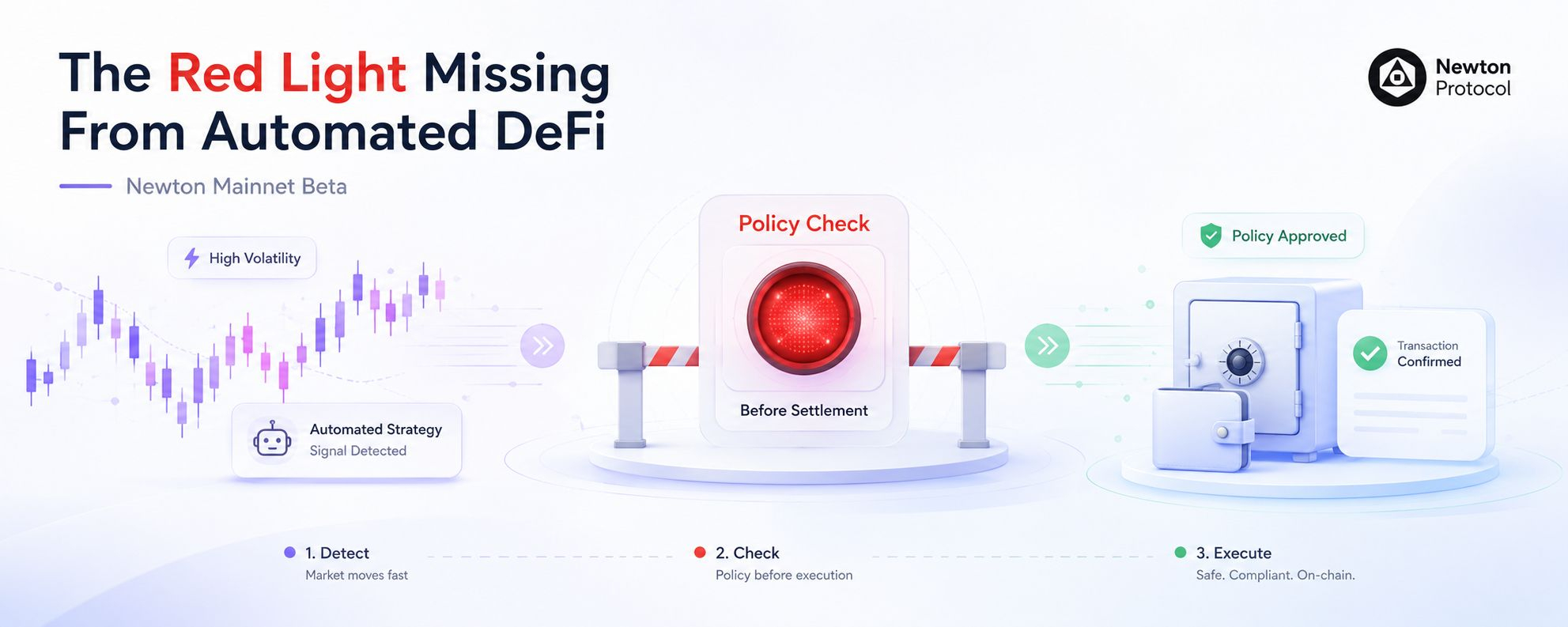
That is where @NewtonProtocol Mainnet Beta connects with this observation for me.
Newton’s main idea is not "make DeFi move faster." DeFi already moves fast.
The missing part is the check before the move clears.
If an automated strategy is about to add size during a wild candle, the important question should not only be “can it execute?”
It should be:
Is this action still allowed?
That one question changes the whole conversation.
Maybe the strategy is trying to touch an asset it should not touch. Maybe the risk limit is already crossed. Maybe the price feed is not healthy enough. Maybe the user gave permission yesterday, but today’s market conditions no longer fit the rule.
In normal DeFi, these problems are often discovered after the action.
Newton is trying to move that decision earlier.
As an onchain authorization layer for DeFi, Newton checks actions against active policies before settlement and returns a signed pass or fail result onchain.
That is the red light I mean.
Not a red light that kills automation.
A red light that stops automation from becoming blind speed.
This matters because automated DeFi is not only about trading bots. Vaults, stablecoin flows, RWAs, and AI agents can all involve actions happening faster than users can manually review.
If those actions touch real capital, "we will check later" is not enough.
For $NEWT , the real test is not whether the idea sounds smart. The test is whether apps actually use Newton when markets are moving fast and risk decisions matter in the moment.
If policies are weak or apps ignore them, the red light becomes decoration.
But if the checks are used where capital actually moves, Newton becomes much more practical.
EVAA’s candles were just the reminder for me.
Crypto does not need more blind speed.
It needs a way to ask "should this move clear?" before the money is already gone.