
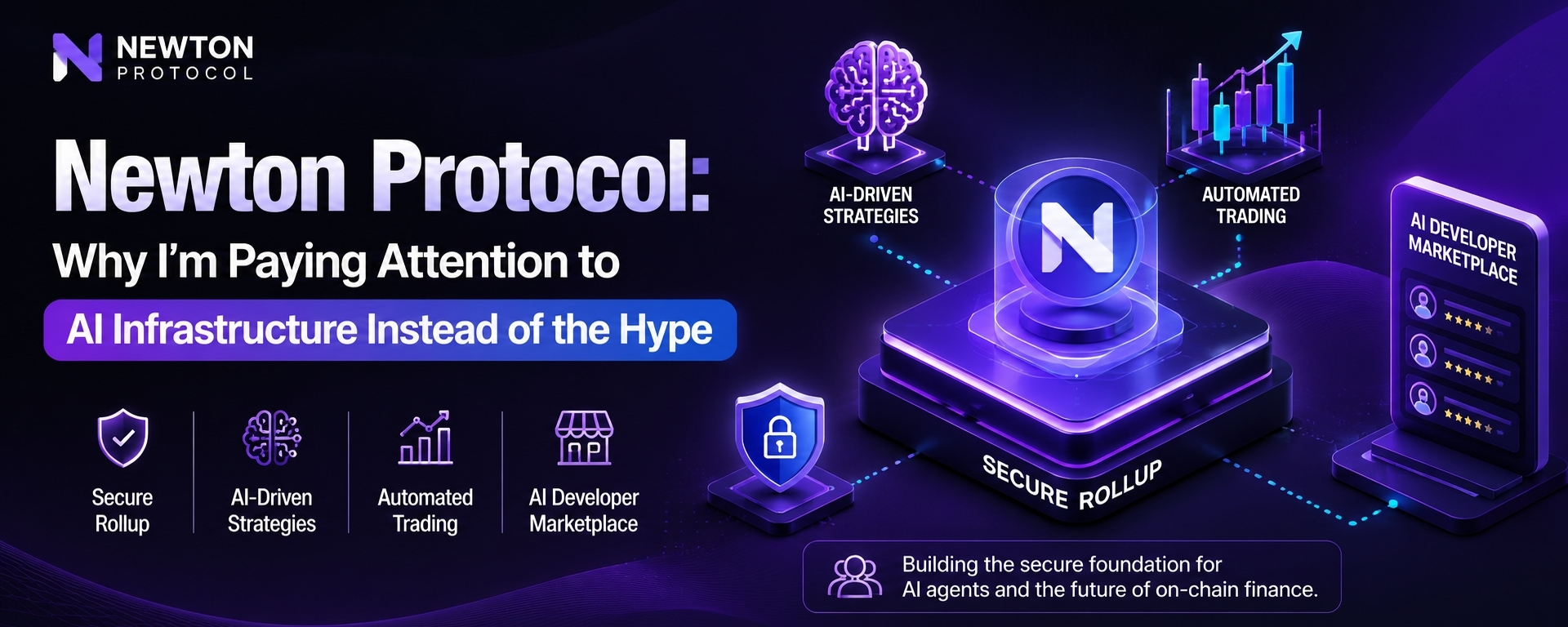

I've been looking at Newton Protocol on and off over the last few days, and I kept asking myself the same question: if AI is going to make more decisions on-chain, what kind of infrastructure is actually built for that future? It's easy to get caught up in the excitement around AI, but I think the more interesting conversation is about what happens behind the scenes. That's where Newton Protocol started to make sense to me.
Most projects talk about AI as if adding it to a blockchain automatically creates something valuable. I don't really see it that way. AI can generate ideas, analyze data, and even execute strategies, but none of that matters if the environment it's operating in isn't secure or transparent. From what I've researched, Newton Protocol is putting more attention on that foundation instead of treating AI as another feature to advertise.
The secure rollup is probably the part that stood out the most. I don't look at it as just another scaling solution. I see it as an attempt to create a place where AI agents can operate with clearer rules and better accountability. If software is making decisions involving real assets, there should be a reliable way to verify what happened. That feels like a practical problem worth solving.
I also spent some time thinking about the marketplace for AI developers. The idea itself isn't revolutionary, but the timing is interesting. There are going to be thousands of AI models competing for attention over the next few years. Giving developers a place to publish their work while letting users decide what actually delivers value sounds reasonable. Whether that ecosystem becomes active is something only time can answer, but I like that the project is thinking beyond a single application.
At the same time, I'm not ready to assume everything will work exactly as planned. Crypto has no shortage of ambitious roadmaps, and we've all seen projects with impressive ideas struggle once real users arrive. Newton Protocol still has to prove it can attract developers, support useful applications, and build enough trust for people to let AI handle meaningful financial activity. Those are difficult challenges, and I think it's fair to acknowledge them.
Another thing I've learned over the years is that good infrastructure usually doesn't create the loudest headlines. It grows quietly while developers keep building on top of it. If Newton Protocol is successful, I doubt it'll be because of hype. It'll be because builders decide it's reliable enough to keep using, and users feel comfortable relying on the applications that come from it.
After spending time researching the project, I walked away with more curiosity than certainty, and I actually think that's a good place to be. There are still unanswered questions, but there also seems to be a clear understanding of the problem the team wants to solve. In a space where many projects chase attention, I tend to appreciate the ones trying to build infrastructure that could still matter years from now.
I'll keep watching Newton Protocol, not because I expect overnight success, but because I want to see whether its ideas hold up when they're tested by real developers, real users, and real market conditions. For me, that's always a better measure than promises on paper.This version reads much more like a real person's observations and avoids the polished, AI-generated feel.