
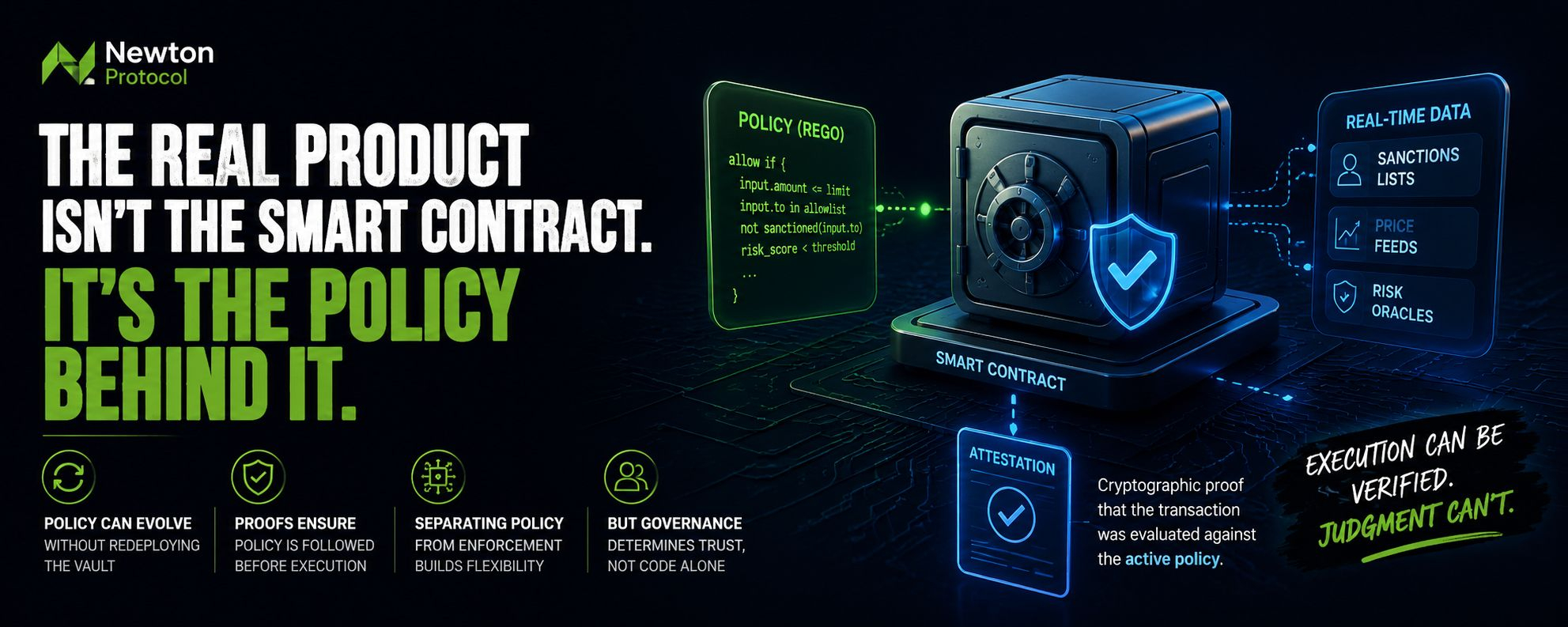
I opened the funding dashboard this morning expecting to find a trade.
Instead, I found... nothing.
No obvious squeeze. No extreme positioning. Just another screen full of numbers pretending something important was happening.
So I closed the charts and went back to reading Newton Protocol documentation. Funny enough, I probably learned more about the future of onchain finance than I would have from staring at funding rates all day.
One sentence from the mainnet announcement had been stuck in my head:
A sanctions-list update or a revised risk threshold can take effect without rewriting or redeploying the vault contract.
At first, I dismissed it as a nice quality-of-life feature for developers.
Then it clicked.
I don't think this is just a developer convenience. I think it's one of the biggest architectural ideas hiding inside Newton.
Most smart contracts work like a fixed rulebook. If the rules change, the contract usually has to change too. That often means upgrades, migrations, governance votes, or deploying an entirely new contract.
Newton approaches the problem differently.
The contract stays where it is, acting as the enforcement layer, while the policy itself can evolve separately. Spending limits, allowlists, sanctions checks, expiration rules, and risk thresholds can all be updated without rebuilding the vault from scratch.
That may sound technical, but the real-world impact is surprisingly simple.
Financial systems live in a world that changes every day.
Sanctions lists get updated.
Counterparties become riskier.
Stablecoins can lose their peg overnight.
Regulations evolve.
If every one of those changes required redeploying an entire contract, protocols would constantly be chasing reality instead of keeping up with it.
What really impressed me wasn't the flexibility itself.
It was the separation of responsibilities.
The vault doesn't need to understand every sanctions provider, every identity system, every price feed, or every risk model. It simply needs to know Newton's verified answer before execution.
That feels like a cleaner way to build programmable finance.
But the more I thought about it, the more I realized something else.
The biggest security question quietly moves away from the smart contract.
It moves to the people controlling the policy.
That's where I think many people will miss the bigger picture.
Newton can cryptographically prove that a transaction was evaluated against the active policy before execution. It can generate receipts and attestations showing the rules were followed exactly as configured.
What cryptography cannot prove is whether the policy itself was a good one.
It cannot tell me whether the person raising a risk limit made the right decision.
It cannot tell me whether an update key was compromised.
It cannot tell me whether someone quietly weakened a vault's original mandate while everything still looked perfectly valid onchain.
That's not a failure of Newton.
I actually think it's an unavoidable reality.
Technology can verify execution.
It cannot replace judgment.
Someone still has to decide whether a risk threshold should move from 20% to 40%. Someone still decides which assets belong on an allowlist. Someone still determines how conservative or aggressive a vault should become when market conditions change.
That responsibility doesn't disappear because the proofs are cryptographic.
It simply becomes more visible.
If I were allocating capital into a managed vault built on Newton, I wouldn't stop at asking whether it uses Newton Protocol.
I'd want to know who owns the PolicyClient.
Is policy administration protected by a multisig?
Is there a timelock before major changes?
How are updates communicated to users?
Can depositors exit before a materially different policy takes effect?
Those questions may become just as important as the smart contract audit itself.
The more I think about it, the more I believe we've been asking the wrong security question.
For years, crypto has obsessed over whether contracts are immutable.
Maybe the better question is whether governance around adaptable policies is trustworthy.
Because in a financial system that needs to respond to a changing world, perfect immutability isn't always the goal.
Responsible adaptability might be.
I started the day looking for a trading setup.
I ended it thinking about governance.
The charts will eventually move again. They always do.
But the infrastructure quietly being built underneath them may matter far more than today's price action. And if Newton's model gains traction, the market may eventually realize that proving transactions is only half the story.
The other half is proving we can trust the people writing the rules.
