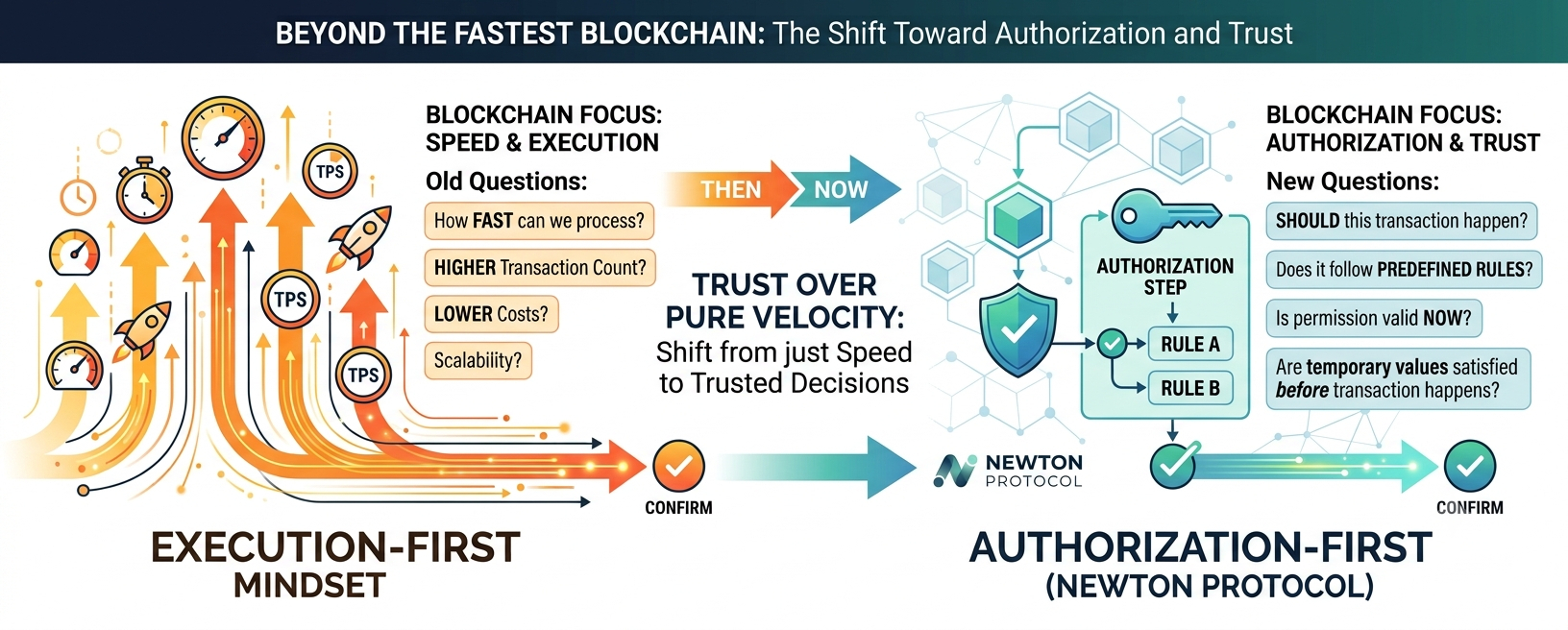

For a long time I believed the future of blockchain was all about speed. Every new project promised faster transactions lower costs and better performance. I followed those discussions because they felt like the obvious direction for the industry. Faster usually sounds better.
Then I came across Newton Protocol and found myself thinking about something I had never really questioned before.
What if speed is not the biggest problem anymore?
Blockchains are incredibly good at processing valid transactions. If everything checks out the network does exactly what it was built to do. The transaction is confirmed and the process moves on. It never asks whether that action still makes sense or whether the permission behind it should still exist.
That simple idea stayed in my mind.
The more I looked at how crypto is changing the more I realized that we are entering a world where more actions happen automatically. Wallets interact with applications across different networks and many processes require less manual input than they did a few years ago. That makes everything more convenient but it also creates new questions.
Convenience is valuable but trust becomes even more valuable.
That is where Newton Protocol started making sense to me.
Its biggest idea is surprisingly simple. Instead of only checking whether a transaction is technically valid it asks whether the action satisfies predefined rules before anything happens.
At first I thought that sounded like a small improvement.
After spending more time reading about it I changed my mind.
It actually changes the order of how decisions are made.
Most systems focus on execution first. Newton focuses on authorization first. That difference may seem small on paper but it changes the entire way I think about blockchain security.
It reminds me of something we see in everyday life.
Having the ability to do something does not automatically mean you should be allowed to do it. Banks businesses and even simple online accounts all work with permissions. Access is given for a reason and those permissions can change over time.
Why should blockchain be any different?
Another part that caught my attention was Newton's approach to privacy.
Most conversations about privacy focus on protecting stored information. Newton looks at the problem from another angle.
Sometimes information only needs to exist for a single moment.
A temporary value.
A one time condition.
Information that is useful for one decision but has no reason to remain available forever.
That way of thinking felt surprisingly practical to me.
Not every piece of information needs a permanent place inside a system. Sometimes the safest information is the information that disappears once its job is finished.
Of course some information should remain available. Identity records compliance data and trusted credentials often need continuity. Newton does not ignore that reality. Instead it separates temporary information from long term information and treats both differently depending on what they are meant to achieve.
I also found myself paying more attention to the NEWT token.
At first I assumed its different use cases were simply there to make the ecosystem sound complete. After looking deeper I started seeing a different picture.
Network activity creates fees.
Staking encourages long term participation.
Operators lock NEWT as collateral which means poor behavior has a real financial cost.
Governance gives voting power to participants who have already committed to the network.
Those pieces do not feel isolated. They feel connected.
Whether that creates lasting demand will depend on real adoption rather than market excitement but I like that the system encourages participation instead of speculation alone.
The biggest thing Newton changed for me was not a technical detail.
It changed the question I ask whenever I look at blockchain infrastructure.
For years I asked how quickly a network could process transactions.
Now I find myself asking something completely different.
Should every valid transaction actually happen?
That question feels far more important as blockchain technology becomes part of more financial systems and everyday applications.
Fast execution will always matter.
Low fees will always matter.
Scalability will always matter.
But none of those things replace trust.
The more I learn about Newton Protocol the more I feel the future of blockchain will not be defined only by how fast networks become.
It will be defined by how confidently people can trust the decisions made before execution ever begins.#newt
That shift in perspective is what made Newton Protocol stand out to me and it is the reason I believe conversations about authorization may become just as important as conversations about speed in the years ahead.#Newt