
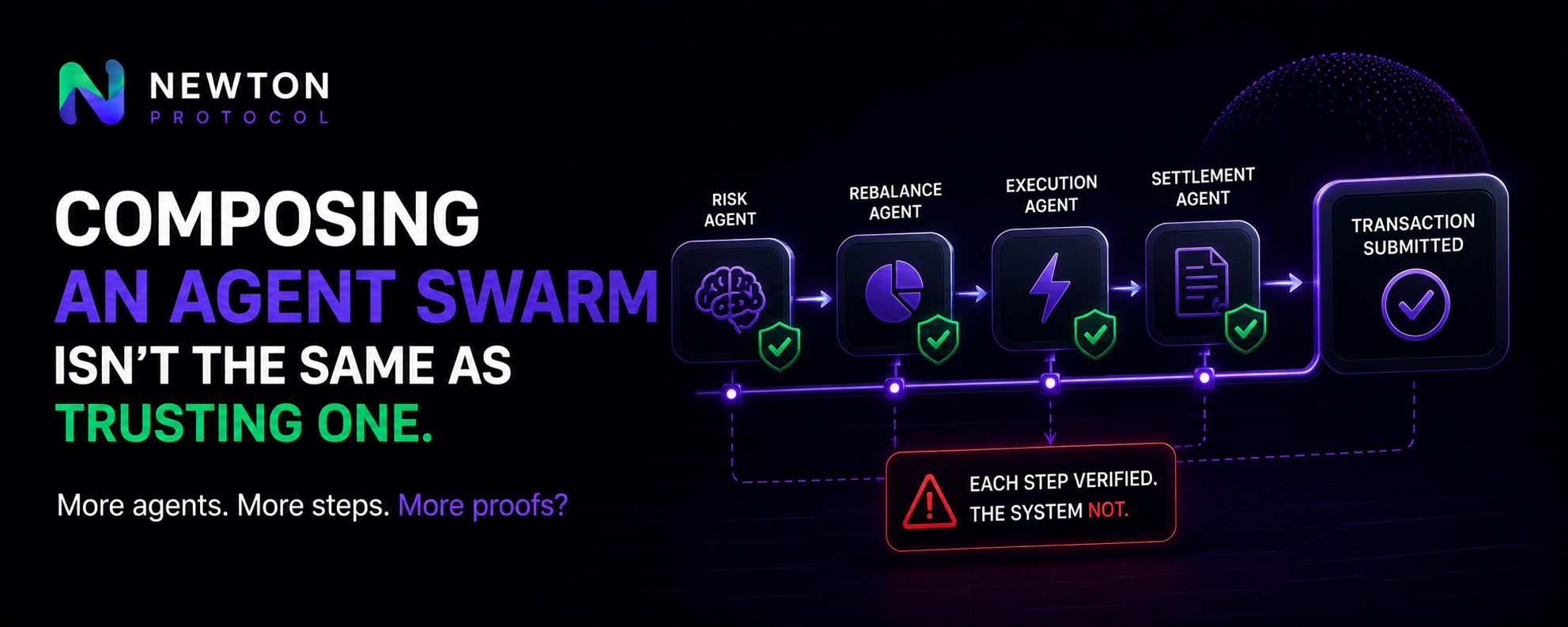

I was scrolling through Newton's own transparency updates when a phrase stopped me mid-scroll: agent swarms. Not a single automation running against a single policy, but multiple agent models composed together, discovered through the Model Registry, stitched into a longer chain of execution. The framing was optimistic, the way these things usually are. More composability, more strategies, more reasons to need NEWT for registration and collateral. I understood the pitch immediately. What I couldn't stop thinking about was what happens to verification once you stack four or five of these things on top of each other instead of just one.
Here's what a single agent model looks like when it's working the way Newton describes it. A developer publishes a model to the registry. An operator picks it up, stakes NEWT as collateral, and runs it. The operator evaluates a policy against the transaction, produces a signed attestation, and the chain accepts or rejects the intent based on that receipt. One agent, one policy check, one verifiable outcome. It's a clean unit, and I can see why it earned trust quickly.
A swarm is a different shape entirely. Now you have a risk-analysis agent feeding output to a portfolio-rebalancing agent, which feeds output to an execution agent, which finally submits the intent that actually settles. Each of those agents can, in principle, sit under its own policy, run by its own operator, verified by its own attestation. That sounds like it should compound trust. More checkpoints, more proofs, more places where something bad gets caught. But composing verified components doesn't automatically produce a verified system. It just produces a longer chain of individually-verified links, and chains don't inherit strength from their strongest link.
What actually gets attested at each stage matters more than whether attestation happens at all. Newton's operators can confirm that a given transaction cleared a given policy. What they can't confirm is whether the input feeding that policy check was itself trustworthy, especially when the input came from another agent's output rather than directly from a user or an oracle. If the risk-analysis agent upstream is compromised, or simply wrong, and it hands a clean-looking signal to the execution agent downstream, the execution agent's policy check will pass. Cleanly. Verifiably. The receipt will say everything was fine, because from the execution agent's narrow vantage point, it was.
That's the part that sits uneasily with me. A swarm can produce a stack of green checkmarks while still executing a compromised decision, because verification in this architecture is local. Each agent verifies its own slice of the world. Nobody verifies the whole swarm's reasoning as a single thing, because there is no single thing to verify. There's only a sequence of handoffs, and each handoff looks legitimate in isolation.
I keep thinking about how this compares to reputation systems in traditional software supply chains, where a dependency's dependency turns out to be the actual point of failure, and nobody upstream even knew it existed. The registry model has the same shape. A developer builds an agent model that composes three other registered models under the hood. It passes every check Newton runs on it directly. But its actual risk surface is the union of everything it's quietly calling into, and that surface isn't something a single policy line item captures well.
Slashing helps, but slashing is retrospective. An operator loses collateral after a model misbehaves, not before. That's a reasonable deterrent against operators cutting corners, but it does very little against a swarm-level failure that's nobody's individual fault, where every operator ran their model exactly as specified and the emergent behavior of the whole was still wrong.
None of this means the marketplace idea is bad. Composability is genuinely how useful software gets built, in crypto or anywhere else. And I don't think Newton is pretending swarms eliminate risk. But I do think the market narrative around agent marketplaces tends to treat "verifiable" as a property that scales linearly with the number of verified components, when it might not scale that way at all. A swarm of five individually-sound agents is not obviously five times as trustworthy as one agent. It might be, or it might be exactly as fragile as its weakest handoff, dressed up in four extra layers of proof that all technically checked out.
The unresolved question, for me, is whether anyone building on top of the Model Registry will actually price that difference in, or whether "composable and verifiable" will just get treated as one word.