


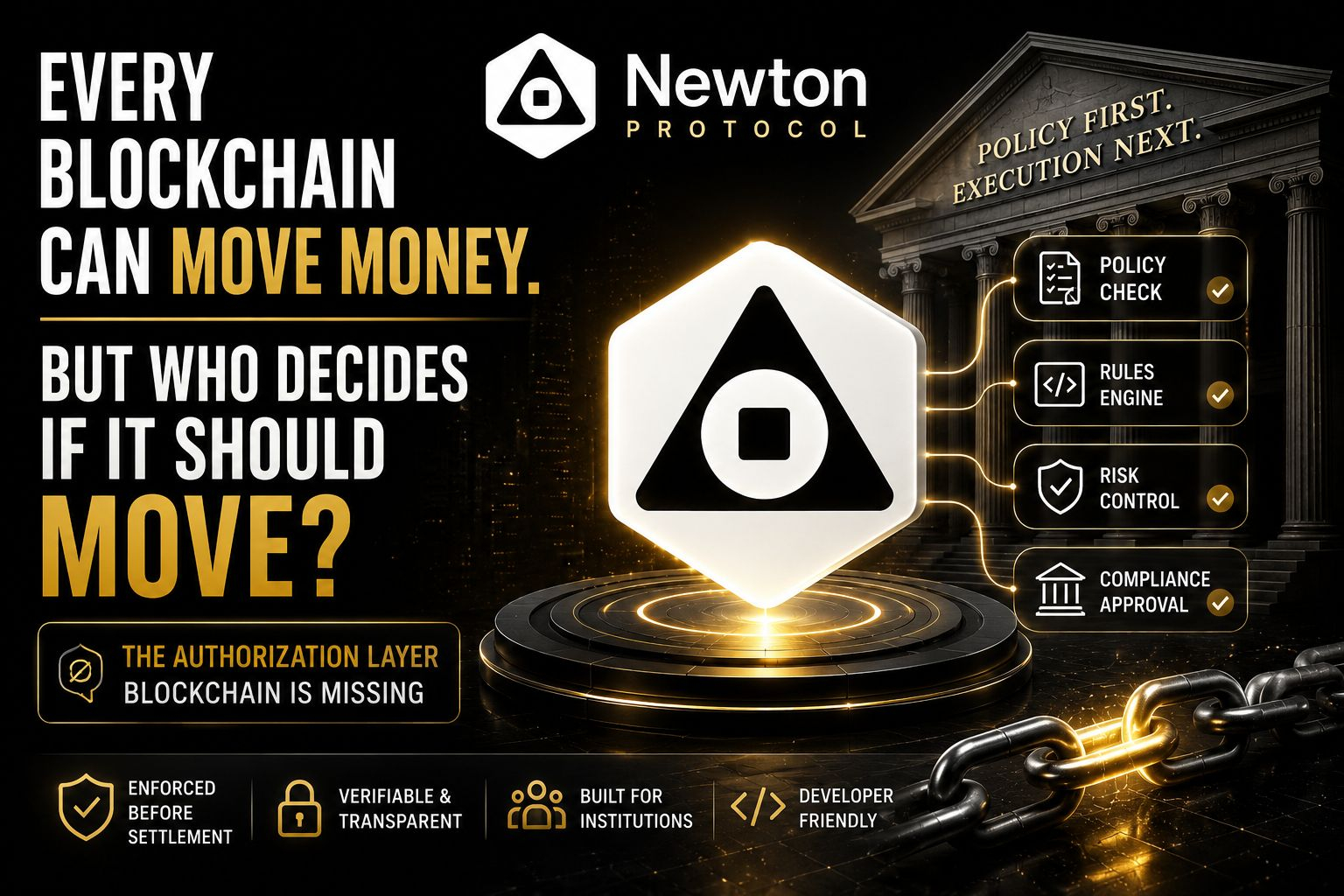
𝐈𝐟 𝐈𝐭 𝐒𝐡𝐨𝐮𝐥𝐝 𝐌𝐨𝐯𝐞?
Imagine a treasury accidentally approving a multi-million dollar transaction.
The blockchain doesn't ask whether it follows company policy.
It doesn't know spending limits.
It doesn't care if the payment breaks an internal rule.
It simply executes what it has been instructed to execute.
From the blockchain's perspective, nothing went wrong.
From the organization's perspective, everything did.
That made me realize something.
Maybe blockchain never had a settlement problem.
Maybe it has an authorization problem.
We've Optimized Execution for Years
The industry has spent the last decade chasing faster settlement.
Lower fees.
Higher throughput.
Better scalability.
Those improvements transformed blockchain.
But execution is only the final step.
Before any money moves in the real world, someone decides whether it should move at all.
Banks have approval chains.
Companies have spending policies.
Funds have investment mandates.
Rules exist long before the transaction reaches a payment network.
Blockchain made settlement programmable.
The decision-making process is still largely left outside the protocol.
A Different Way to Think About Infrastructure
This is why Newton caught my attention.
Instead of asking, "How can transactions execute faster?"
It asks a more fundamental question:
"Can authorization itself become programmable?"
That shift may sound small.
I don't think it is.
If policies can become part of the transaction flow instead of remaining manual processes, organizations may gain something blockchain has struggled to provide—consistent rule enforcement before execution.
Why VaultKit Stands Out
One component that reinforces this idea is VaultKit.
Rather than focusing only on moving assets, it is designed around defining and enforcing policies that govern how assets can move.
That distinction matters.
Settlement answers:
"Can this transaction execute?"
Authorization asks:
"Does this transaction satisfy the rules we already agreed on?"
Those are completely different questions.
The Bigger Picture
Whether it's institutions, DAOs, fintech platforms, or future AI agents, one thing remains constant.
As more value moves on-chain, the cost of a bad approval becomes much higher.
Speed alone doesn't solve that problem.
Better authorization might.
That's why I think programmable policies deserve more attention than they're currently getting.
Not because they're exciting.
But because the strongest infrastructure usually works quietly in the background.
Final Thoughts
Blockchain changed how value moves.
The next chapter may focus on how value gets approved before it moves.
Newton's long-term success will depend on adoption, developer experience, and whether projects actually integrate this model.
But I believe it's asking a question that deserves far more attention than it gets today.
The future of blockchain may not be defined by faster transactions.
It may be defined by smarter authorization.
Follow for more deep research on Web3 infrastructure and emerging protocols.
Tags