
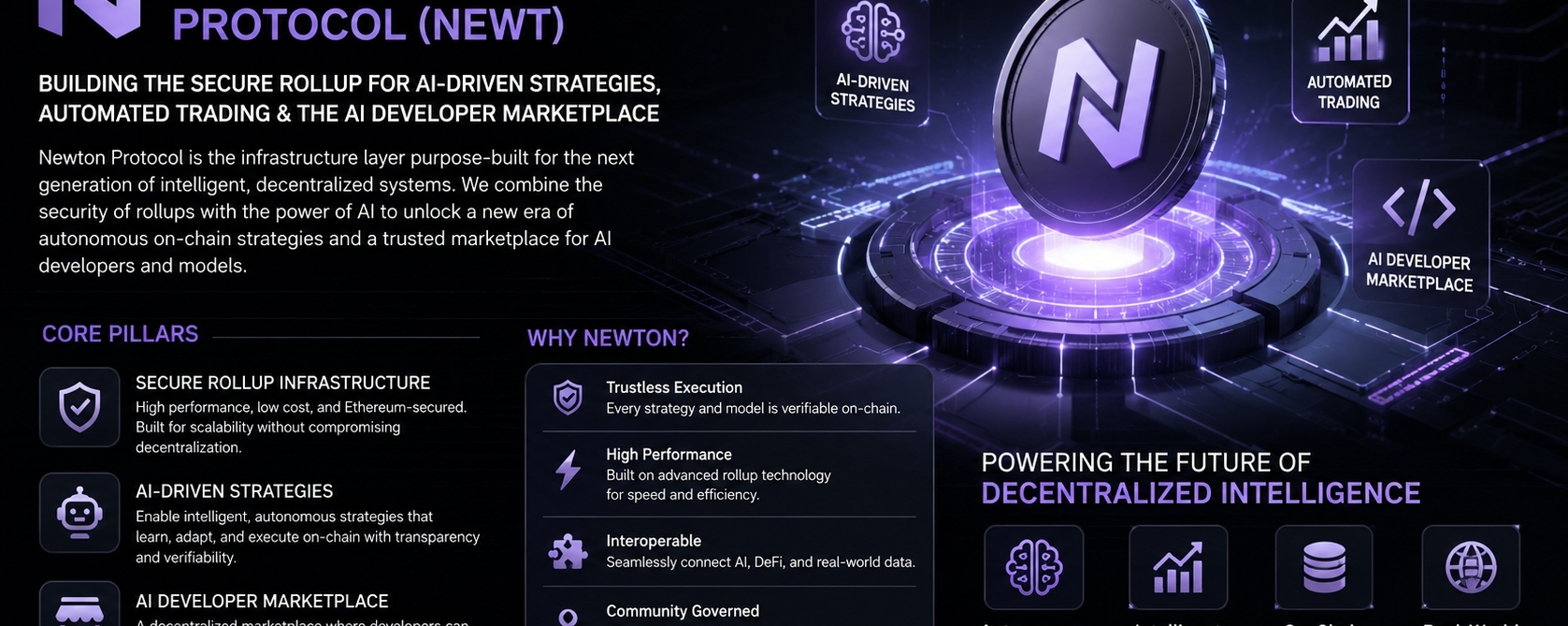
I'm watching Newton Protocol without trying to decide too quickly whether it's the next big thing or just another ambitious experiment. Crypto has taught me that first impressions usually don't matter much. The projects that survive are often the ones that spend more time solving difficult problems than creating exciting headlines. That's probably why this one caught my attention in the first place.
The longer I follow this industry, the less interested I become in promises. Every cycle brings new buzzwords, and eventually they all fade into the background. What stays relevant is whether a project understands the problem it's trying to solve. That's what I've been thinking about while looking at Newton Protocol. Bringing AI and blockchain together sounds compelling, but it's also one of the hardest combinations to get right.
AI is becoming better at making decisions, while blockchains are built around making decisions verifiable. Those aren't exactly the same goal. One system learns and adapts, while the other depends on predictable rules. I find that contrast more interesting than the technology itself because it forces developers to make choices instead of chasing every possible feature.
Something I've noticed over the years is that crypto often mistakes complexity for innovation. A protocol can have impressive architecture, dozens of technical diagrams, and endless documentation, yet still struggle because real people don't find it useful. Simplicity isn't always exciting, but it usually lasts longer. Whenever I look at a new protocol, I ask myself whether it's reducing complexity or simply moving it somewhere else.
Newton Protocol also makes me think about accountability. If AI starts handling more financial decisions or automated strategies, then transparency becomes even more important. It's not enough for a system to produce good outcomes. People eventually want to understand why those outcomes happened and whether they can trust the process behind them. That's a conversation I expect to become much bigger over the next few years.
I've never believed that faster transactions alone are enough to build lasting infrastructure. We've spent years competing over speed, fees, and scalability, yet users usually stay because a network feels dependable, not because it's marginally faster than another one. Reliability rarely becomes a headline, but it quietly determines which ecosystems continue growing after the excitement disappears.
Developers matter just as much as the technology. Every successful blockchain ecosystem I've watched had one thing in common: people genuinely wanted to build there. That doesn't happen because of incentives alone. It happens when documentation is clear, tools improve over time, and developers believe the protocol will still be relevant years from now. Communities aren't built overnight, and neither is trust.
I also think governance deserves more honest discussion. It's easy to say a protocol is decentralized, but it's much harder to design a system where decisions remain thoughtful instead of emotional. Voting mechanisms don't automatically produce good outcomes. Healthy governance depends on culture, incentives, and people who are willing to think beyond short-term gains.
One lesson the crypto market keeps repeating is that technology alone doesn't determine success. Timing matters. Execution matters. Security matters. The ability to adapt without abandoning core principles matters. I've watched technically brilliant projects disappear while simpler ones quietly gained traction because they understood how people actually behave.
That's why I don't feel the need to make bold predictions about Newton Protocol. I'd rather watch how it develops, how developers respond, and how the ecosystem evolves over time. Markets are good at rewarding confidence in the short term, but they usually reward consistency in the long term.
Maybe that's the bigger question I keep coming back to. As AI becomes more capable and blockchain infrastructure becomes more sophisticated, are we building systems that people will genuinely trust, or are we simply making technology more complicated than it needs to be? I don't think anyone knows the answer yet, and that's exactly what makes this space worth paying attention to.