

There is an old pattern in crypto that repeats itself almost every cycle. Builders often create infrastructure long before most people realize they need it. Some of those projects eventually become invisible pieces of the financial system because everyone relies on them without thinking. Others remain technically impressive but spend years waiting for a market that never fully materializes. That pattern is exactly why VaultKit caught my attention. The technology isn't difficult to appreciate. The difficult part is deciding whether it's arriving ahead of demand or precisely at the moment institutional finance is beginning to need it.
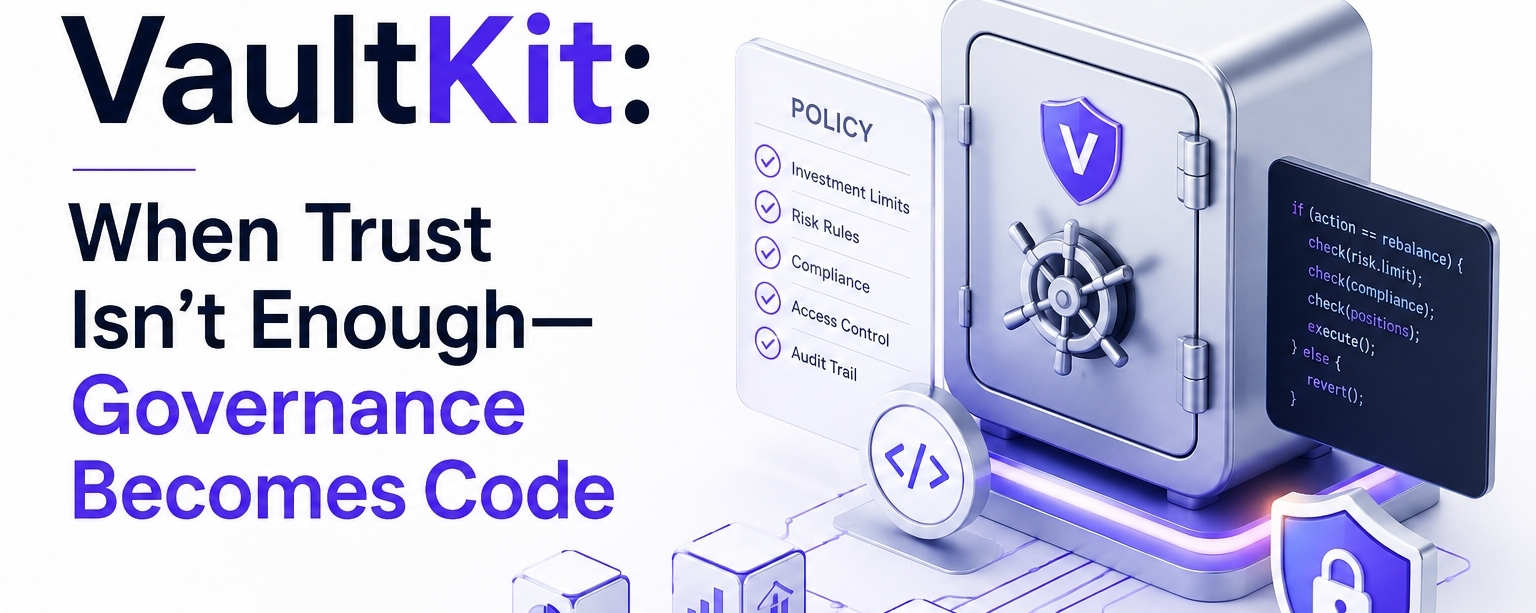
Most onchain vaults today are built around a simple assumption: trust the manager. If the authorized curator decides to rebalance assets, adjust exposure, change allocation limits, or enable a new strategy, the protocol simply checks whether they have permission to execute the transaction. It doesn't evaluate whether the decision follows an agreed investment mandate. VaultKit changes that relationship by introducing programmable policies that every management action must satisfy before execution. Instead of relying solely on human judgment, operational rules become part of the software itself. The vault no longer asks, "Is this person authorized?" It also asks, "Does this action comply with the rules?"
That distinction may sound subtle, but it fundamentally changes the governance model. Rules become transparent instead of implied. Compliance becomes enforceable instead of procedural. Oversight shifts from periodic reviews to continuous verification. In traditional finance, these controls are often maintained through paperwork, internal approvals, and operational processes. VaultKit attempts to translate those safeguards into deterministic code that executes automatically and consistently.
The interesting question is whether today's crypto market actually values that capability. Retail participants generally don't choose a vault because its governance framework is mathematically elegant. They compare returns, liquidity, ease of use, and perceived safety. Governance architecture remains largely invisible unless something goes wrong. Institutions approach the same decision from an entirely different perspective. Their questions revolve around accountability. Can investment restrictions be enforced automatically? Can auditors reconstruct every management decision? Can compliance teams prove that operational policies were never bypassed? Those requirements exist long before anyone starts discussing yields.
Viewed from that angle, VaultKit isn't really selling software to depositors. It's selling operational confidence to organizations responsible for managing other people's capital. That customer base is considerably smaller today, but each participant carries significantly higher requirements and potentially greater long-term value. As institutional participation expands, governance itself may evolve from a competitive advantage into a baseline expectation.
At the same time, it's important not to overstate what programmable policies actually accomplish. They cannot eliminate market volatility. They cannot prevent losses caused by poor investment decisions or external protocol failures. They do not make smart contract vulnerabilities disappear. Their purpose is much narrower and, in some ways, much more practical. They ensure that agreed operating rules cannot be quietly ignored when decisions are made. In professional asset management, proving that procedures were followed is often just as important as measuring the final investment outcome.
Like every infrastructure layer in crypto, VaultKit doesn't remove trust—it redistributes it. Confidence moves away from individual managers and toward policy definitions, oracle networks, external data providers, monitoring systems, governance processes, and execution logic. Those dependencies become part of the protocol's security model. If policy inputs are unreliable, even perfectly designed governance rules can produce flawed decisions. That's why the surrounding ecosystem may ultimately matter as much as the policy engine itself.
This creates another challenge that deserves attention. VaultKit encourages an open marketplace where independent teams can publish policy packs and compliance modules. That openness encourages innovation while reducing dependence on a single provider. Yet history suggests that open ecosystems rarely remain evenly distributed forever. Reputation naturally accumulates around contributors with proven reliability, stronger research, better data, and longer operating histories. The marketplace stays permissionless, but trust gradually concentrates. Ironically, decentralization often produces its own hierarchy of trusted participants.
One of VaultKit's smartest design decisions is how little disruption it introduces. Existing vaults remain intact. Familiar development workflows continue unchanged. Integration focuses on replacing operational assumptions rather than rebuilding entire systems. Lowering technical friction certainly improves adoption, but organizations rarely transform governance simply because implementation is convenient. Real adoption happens when the cost of maintaining older processes becomes greater than the cost of modernizing them. That pressure usually comes from clients, regulators, auditors, or competitive markets—not from technology alone.
Looking beyond today's DeFi landscape, the broader direction of digital finance becomes increasingly relevant. Tokenized assets, regulated stablecoins, institutional custody solutions, and professionally managed blockchain portfolios are gradually moving from experiments toward real financial infrastructure. As that evolution continues, programmable governance may become less of a premium feature and more of a standard operational requirement. Rules that are automatically enforced could eventually become as expected as multi-signature security is today.
There is still one question that technology alone cannot answer: can the surrounding ecosystem sustain itself economically? Policy providers, compliance specialists, oracle operators, monitoring services, and risk intelligence platforms all require ongoing investment. A governance marketplace succeeds only if every participant has clear incentives to continue improving the quality of their work years after launch. Sustainable economics often determine whether infrastructure becomes permanent or slowly fades into irrelevance.
Perhaps that's what makes VaultKit interesting beyond its technical architecture. It represents a bet on where onchain finance is heading rather than where it stands today. The project assumes that future capital markets will demand transparency that can be verified, governance that can be inspected, and operational rules that cannot simply be overridden behind closed doors. If that assumption proves correct, VaultKit could become an invisible but essential layer beneath institutional digital finance. If adoption arrives more slowly, it may spend years being appreciated by developers while waiting for the broader market to recognize why programmable governance matters.
History has shown that infrastructure rarely receives attention when it is built. It becomes valuable only after enough people realize they can no longer operate efficiently without it. VaultKit's future may ultimately depend less on the elegance of its engineering and more on a simple shift in expectations: the moment organizations stop asking whether they trust the manager and start asking whether every management decision can be independently verified before it ever reaches the blockchain.