
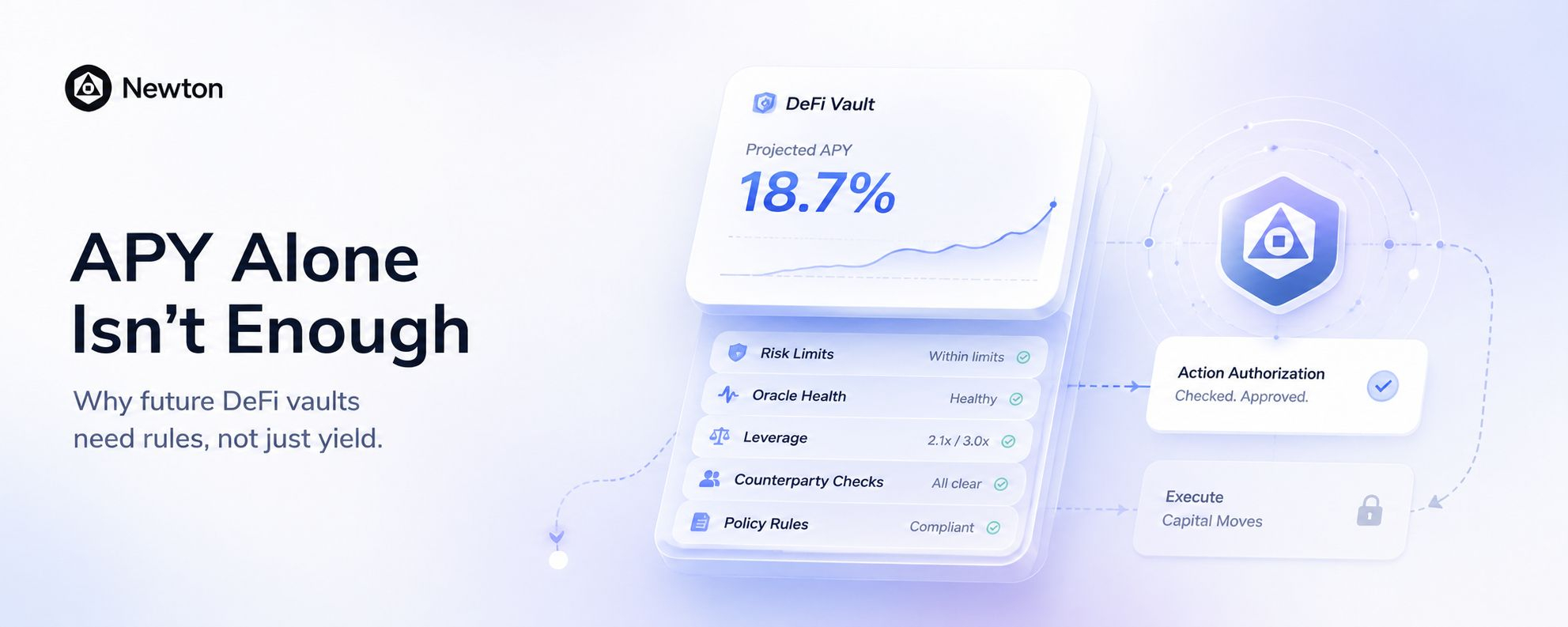

A vault can show a beautiful APY, but I still want to know what kind of risk is sitting under that number.
That question came back today while I was reading around @NewtonProtocol Mainnet Beta and watching two very different charts.
$LAB had fallen from around $16 to near $2, while $EVAA had moved from around $0.7 to above $3 in a short time.
One looked like damage.
The other looked like opportunity.
But both pushed me to the same point:
If assets can move this violently, why do we still judge DeFi vaults like the biggest yield is the whole story?
I am not saying those tokens are good or bad. That is not the point. They just reminded me how quickly risk can change underneath any strategy. A chart can look broken in the morning and exciting at night. A yield source can look attractive until the exposure behind it starts moving against everyone. A strategy can look smart until volatility makes the rules behind it matter more than the return number.
This is where I think many people still read DeFi vaults too casually.
They see APY first.
Higher number, better vault.
That mindset feels too simple now.
A future vault will not win only because it shows a bigger yield. It will need to prove how it handles risk when the market stops behaving cleanly. What assets can it touch? How much exposure is allowed? What happens if leverage rises too fast? What if oracle data changes? What if counterparty risk increases? What if a curator’s strategy starts drifting away from what users expected?
These questions are not as exciting as APY, but they are the questions that matter when real capital is inside the vault.
I do not see Newton here as a simple security slogan. The stronger point is onchain authorization before the action goes through.
Newton Mainnet Beta is built around checking actions against active policies before they clear, instead of only explaining them after the move.
A vault should not only report later that something became risky.
Its rules should matter while the move is still being made.
That is the part I think people overlook.
Today, a lot of vault logic still feels scattered. Some rules live in documents. Some controls sit offchain. Some decisions depend on dashboards, curators, backend checks, or users trusting that everything is still being followed.
That can work when conditions are calm.
But crypto rarely stays calm for long.
When prices move like LAB and EVAA did, the weakness becomes easier to see.
APY tells users what they might earn.
Authorization tells them what the vault is not allowed to do.
That second part may become more important as vaults become more complex.
If DeFi wants vaults to support stablecoins, RWAs, AI agents, and automated strategies, then "trust the curator" will not be enough. Users and institutions will want clearer rules. Not just promises. Not just a clean interface. Rules that can actually affect the action before capital moves.
This is also where the risk sits for Newton.
If policies are weak, old, too slow, or ignored by apps, then the idea stays nice on paper. Authorization only matters if it is used at the exact point where risk is being created.
That is the real test for NEWT.
For me, the future of vaults is not about who can advertise the biggest APY for the longest time.
It is about who can prove better control when the market gets messy.
Because yield attracts capital.
But guardrails decide whether that capital stays.